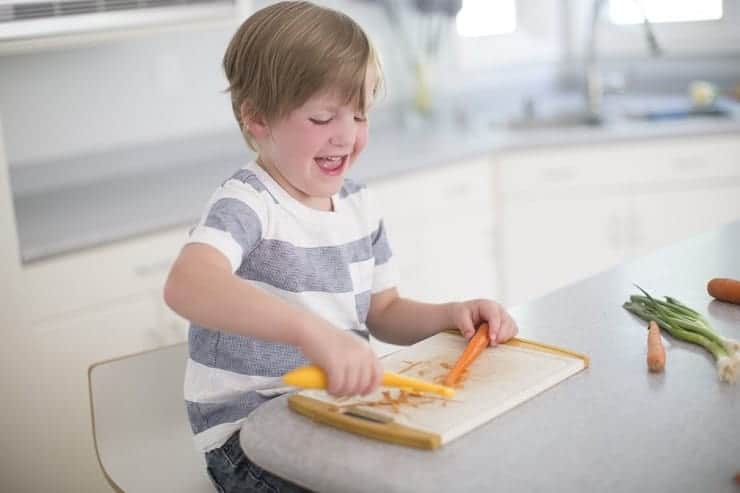
When I was young, I used to sell painted rocks.
My poor neighbors!
I also charged 25 cents for 2-dimensional paper bows, colored with the most amazing self-professed 5-year-old artistic talent.
And I used to create menu prototypes for the restaurant I would open, highlighting my signature recipe:
Crunchy Tuna Tacos
I made this one up all by myself:
- Tuna salad
- Wrapped in a big iceberg lettuce leaf
- Topped with crushed Ruffles potato chips
- And…wait for it…a big ol’ squeeze of ketchup!
Like most kids, I thought what I created was Always. Awesome.
Kids have such confidence before the world gets to them, don’t they?
They also have bucketloads of intrinsic motivation. If you told me to start a business selling a product now as an adult, it would take me months of hemming and hawing and market research, and I still wouldn’t be as happy (or spend as much quality time) as I was at age 4 and 5 painting rocks to sell to unassuming family and neighbors.
Work?
Hardly!
My “job” was child’s play, and it was FUN.
Little Kids are Intrinsically Motivated

Ever notice that it’s the adults who tend to say, “No,” and the kids who ask to be involved?
“Mama, can I help? Daddy, can I vacuum? Grandma, can I dust?”
Kids are totally ready to help before the age of 5 or 6, and they really don’t understand the concept of “work” or “chores” until we train them that chores are boring, as I explained in my canceled TEDx talk, “The Power of Teaching Kids to Cook.”
In fact, little ones think cutting bananas is “Fun! It’s like a party!” as one three-year-old in our classes exclaimed.
Another 2-and-a-half-year-old asked his mom every day when it was time for cooking class, and Bella’s mom actually used our class as a REWARD for good behavior!
Did you catch that? Cooking IS the reward!
What adults find mundane, kids find fascinating.
We forget that because we have bills to pay and hours to clock.
When does the shift happen between kids who are excited to dust and cut bananas and adults for whom much is drudgery?
According to the thousands of families we work with at Kids Cook Real Food™, somewhere between 7 and 17.
Older Children Don’t Always Want to Learn to Cook
We talk a lot about how to motivate kids in our VIP members-only Facebook group, but it’s extremely rare for a parent to ask about a child under 5.
It’s those older kids who start to lose interest, start complaining about chores, and do what they can to avoid helping out.
That’s another power struggle parents don’t need!
Most of the time, it just takes “getting started” to get the snowball of motivation going. Kids feel that confidence that comes with learning a real, authentic task, and they’re ready for more.
Kids don’t need plastic knives. They need real skills.
Teach safe technique, focus, and confidence in the all-time fav lesson from our kids cooking class! (ages 2-12)
Just recently, my youngest, age 6, didn’t want to be part of a video we were shooting demonstrating how to make blended green soup. He would rather play, he was nervous about cutting something he hadn’t worked with before, and he got cranky.
Once we got started, however, he didn’t want anyone else to help with “his job,” and he dutifully cut up the two zucchinis into smaller pieces than required, because crinkle cutters and working in the kitchen IS fun when you’re still little. He just forgot until he was in the moment.
We adults forget sometimes too, like when one of our summer camper moms, Laura Butler, had a realization: “Teaching kids to cook isn’t just ‘for later’ but for now.”
RELATED: Kids who cook grow up to be healthier adults
Research Supports Teaching Children to Cook at Young Ages
Psychologists studying families in Guatemala and Mexico observed children helping do chores in their families without complaint, and even taking the initiative to help out without being asked.
They plumbed into the whys and wherefores and determined that there are actually a few systems at play culturally and developmentally that make children’s experiences of household chores different in the indigenous families in particular as compared to similar age American counterparts.
First, there’s simply the family culture of “we,” that household work is something to which everyone contributes, a shared endeavor that benefits all.
Volunteering to help is such an important part of family culture in Mexico that it has a word that can’t be translated equally into English: acomedido.
“Mooooom, I’m hungry!!”
How many times do your kids ask for snacks each day? Wouldn’t it be a relief if they were empowered to prepare their own snacks, instead of coming to you and whining about how hungry they are?
Download and print:
Second, developmentally, there’s a certain training of the brain when children are young. Parents have an incredible opportunity to capture that intrinsic motivation we see (“Mama, can I help?”) and show kids that yes, they are welcome to help.
When kids are expected to help before age 5, they’re more likely to volunteer to help when they’re elementary-aged. Saying, “Yes,” creates an unbroken line of motivation from the younger ages through elementary school.
But in America, we often say things like, “No, I don’t need help, you go play and I’ll do it myself,” don’t we? It’s faster and easier just to do the chore ourselves, which is true in the short term, but we’re missing the long-term investment.
When we boot them from the kitchen, we’re literally training their neural pathways to believe, “No, I don’t belong here.” That’s setting ourselves up for chore time to be an uphill battle when they’re 8 or 10 and actually capable of contributing to the family without slowing us down.
“Early opportunities to collaborate with parents likely sets off a developmental trajectory that leads to children voluntarily helping and pitching in at home,” says Andrew Coppens, an education researcher from the University of New Hampshire.
It’s important to note that the tasks children get involved in must be authentic, with actual value. Giving your toddler a broom to “sweep” after you’ve just swept, or letting them play with water and already-clean dishes isn’t a terrible thing, but it’s not going to help them understand their responsibility in the family.
They see right through us when the jobs are falsified.
And don’t think you should reward your child for these chores. In fact, researchers found that giving prizes to self-motivated toddlers actually made them LESS likely to help the next time! They don’t need to be trained and incentivized, because they’re coming in with the motivation already in place. Don’t break it!
As a final incentive for us parents, researchers at the University of Minnesota actually discovered that “the best predictor of young adults’ success in their mid-20s was that they participated in household tasks when they were three or four.”
Wow!
This means letting your child help when they’re not very good at it not only increases quality time with them as little ones, not only creates a family culture of shared responsibility when they’re big kids but EVEN sets the scene for them to grow into competent adults—every parent’s goal!
Get this – when kids didn’t start contributing to family life until they were 15 or 16, they were actually less successful as adults. It really is key to start young, if you can!
“I just want my kids to eat what I make!”
This free 5-day challenge was made for you.

Spend just 30 minutes a day learning practical strategies that reduce mealtime battles and help kids build confidence with food.
All that research can be boiled down to this:
When kids do chores or learn how to cook (however badly) before the age of five, they’re likely to grow into helpful, competent big kids who are less resistant to helping the family, AND successful, independent adults.
That’s why we start our classes at age TWO, a number that always raises eyebrows when people ask me during interviews, “So, what is a good age to start teaching kids to cook?” I don’t think they’re expecting a child so young to be involved!
Sources:
- NPR 2018
- Extrinsic rewards undermine altruistic tendencies in 20-month-olds, 2008
- Children’s Initiative in Contributions to Family Work in Indigenous-Heritage and Cosmopolitan Communities in Mexico, 2014
- Children’s Initiative in Family Household Work in Mexico, 2014
- Involving Children in Household Tasks: Is it Worth the Effort?, 2014
But My Kids Are So Messy and Slow in the Kitchen!
I know it feels hard to help the littlest members of the family get involved with cooking, and it’s 100% true that it’s easier and faster to do it yourself.
We’ve already discussed how it’s NOT faster in the long run, so if you’re considering making an effort to include the under-5 crowd but feel that “messy/slow” roadblock, I can help your kids be less messy and slow you down less.
Disclaimer: Kids are always messy. Shoot, I’M messy in the kitchen, especially when I’m trying to measure flour or really, cook anything quickly. But we can get “less” messy.
With proper training, they’ll automatically be less messy, because instead of playing around in the kitchen, kitchen skills become the new playground.
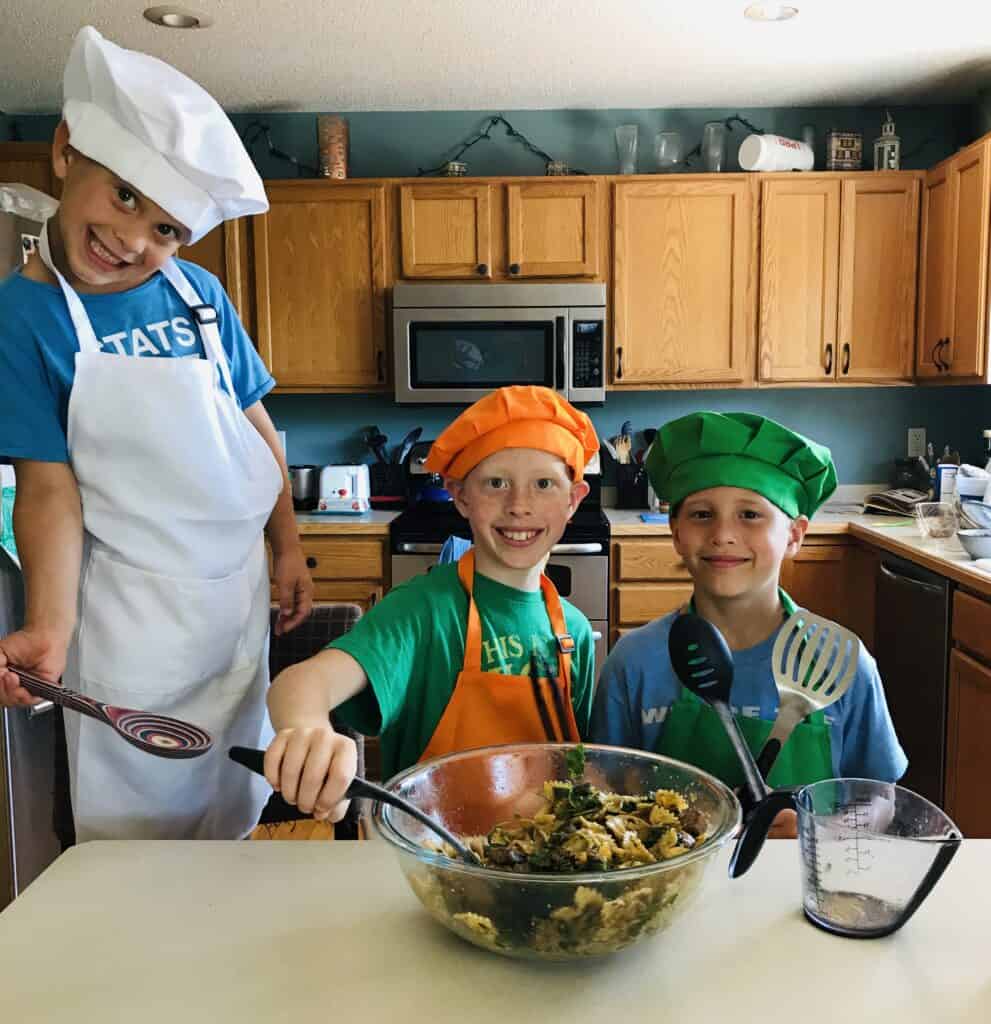
Becky, the mom of those 3 boys in the chef’s hats from the talk, sent this message (in her own words):
“My 5 -year-old had ridiculous amounts of fun with the pouring class, and I am so excited he can actually be helpful in the kitchen instead of just in the way and making messes. He is VERY involved and capable, so this was perfect for him.”
Another mom of a 3-year-old was lucky enough that a friend included her daughter while she was teaching her own with Kids Cook Real Food™. The 3-year-old came home and mom was amazed that suddenly she’s not making any PB&Js anymore!
Pro tip: If you’re already a member of the Kids Cook Real Food™ eCourse, find proper measuring strategies and stirring techniques like the Roller Coaster stir that will reduce the messes in Foundations 101. Spreading, the ninja skill for PBJ, is in Beginner Class 1.
Messes are mitigated with proper stirring and measuring skills and when kids feel like their involvement matters, so they’re not just messing around.
Kids will always also be slower than we want them to be, of course, but the secret is to give them their job in their space while YOU continue to do your job in yours.
Then they can be as slow as they need to be, but they don’t slow you down and it’s very tolerable.
A tip as simple as having the kids work at the table while you’re in the kitchen can be magical, and one mom said it forever changed the way she thinks about her kids joining her while cooking!
I always tell parents of littles to teach proper measuring skills using our special naming system for pre-readers for the measuring supplies, and then they can always say, “YES!” when their young one asks to help, even in the rush at dinner.
The secret is to set the child helper up at the table while you’re in the kitchen. They can have a little “spill bowl” to measure over and one jar of herbs or spices at a time.
Let’s say you’re making chicken noodle soup, so you need salt, pepper, and dried thyme.
Your 4-year-old could take 5 minutes to measure a teaspoon of salt, but it doesn’t matter because you’ve chopped 3 carrots and 3 celery ribs in that time!
Maybe it’s a full 2 minutes to measure a half teaspoon of pepper, but guess what? Not only does our special naming system allow little cooks to find the right measuring spoon without you leaving the kitchen, but you were probably able to add the noodles and broth to the soup and wash your cutting board in that time.
With your voice, you direct your 4-year-old to the thyme and the proper spoons for 1 1/2 teaspoons, and you chop all the chicken, add it to the pot, and then go to the table to get the properly measured (or at least close) seasonings and add them to the pot.
Your tiny one feels real involvement, you can compliment them at dinner for helping make the soup taste so delicious, AND you weren’t slowed down one bit except to take a few trips to the table. Win for everyone!
We must resist the American temptation to do what Laurie confessed after summer camp: ” I’ve always shooed the kids away so I could be more efficient. And now that they’re older, I’m feeling embarrassed that they can’t do much for themselves.”
But They Don’t Seeeeem Motivated!
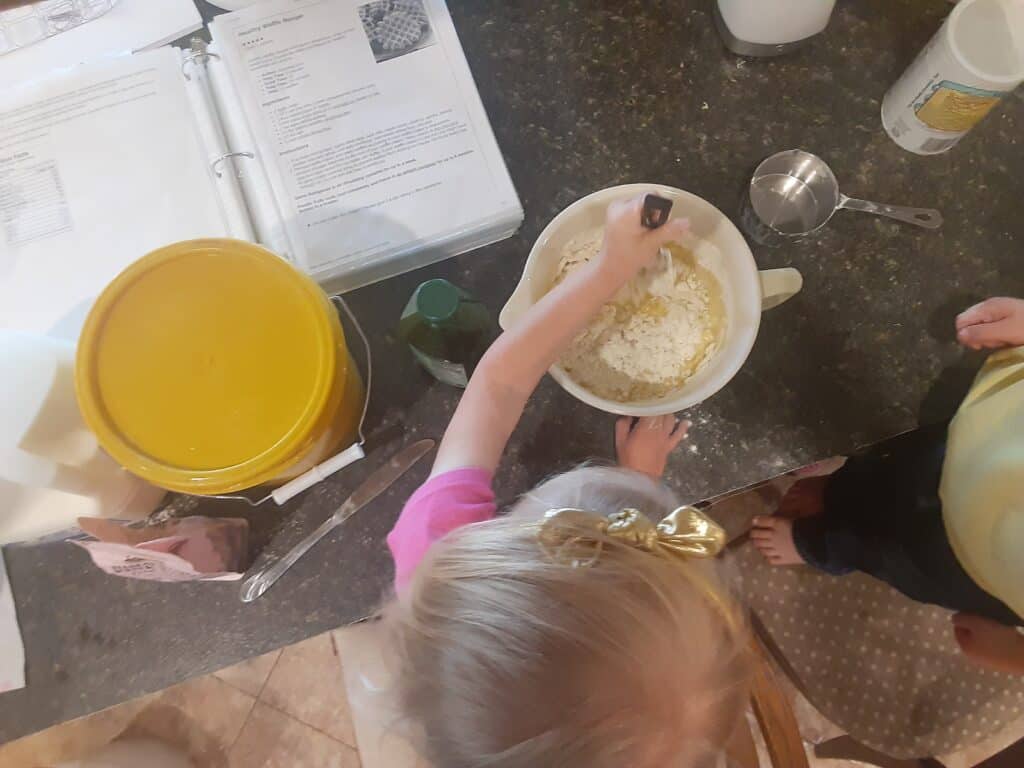
Believe it or not, but little Cadence (Courtney’s daughter) “wasn’t super pumped ahead of time.” Even at the tiny age of two, Courtney reported, “She is the type of kid that will often ask us to ‘do this for her’ [as a game], she knows its faster! This was especially true in the kitchen.”
Intrinsic motivation isn’t always obvious
Sometimes the kiddos need a nudge and something authentic to do.
Kids don’t need plastic knives. They need real skills.
Teach safe technique, focus, and confidence in the all-time fav lesson from our kids cooking class! (ages 2-12)
Big kids and little kids alike are often surprised by how much they enjoy the feeling of competence in the kitchen, like Cadence after learning skills at summer camp:
“Now she insists on helping and doing things herself when we cook together, and she has begun independently practicing things like spreading. This may seem like a subtle shift, but it feels like less mental work for me in the kitchen and that my kids are helping me cook instead of begging me to ‘cook.'”
When kids feel like the kitchen is the new playground, AND they know how to play the game well, everyone wins!
But even if you have a teenager who doesn’t know how to boil water, it’s never too late.
60% of the families in our program find that their kids are more motivated to help out with meal prep as soon as they build confidence in the kitchen!
Just Don’t Make These Common Mistakes When Teaching Children to Cook Young
I’ll dig into these parental mishaps in more detail in other posts, but most of the time, when we try and fail, it’s one of these reasons:
- Cooking before dinner (too stressful)
- Expectations are too high (they’re still little kids after all)
- We don’t account for kids’ poor small motor control (they’ll still be slow and make messes, even properly trained, but it won’t last forever)
- We avoid doing it at all!
That last is the worst of all.
Promise me today that YOU are now intrinsically motivated, that you see the value in teaching your kids to cook, that you’re able to push through the psychological block of letting your slow, messy kids in the kitchen because you KNOW it will be worth it!
Far too many parents for too many years have been “doing it for them” in many areas of life, and teachers are seeing it. I interviewed a number of one-and-two+-decade veteran teachers a few years ago, and they reporting seeing big shifts in how kids behave during their time in certain grades.
RELATED: My interview with teacher, Jessica Lahey, about why we need to let kids fail!
“I just want my kids to eat what I make!”
This free 5-day challenge was made for you.
Spend just 30 minutes a day learning practical strategies that reduce mealtime battles and help kids build confidence with food.
Teachers tell me they see anxiety increasing at alarming rates in kids as young as kindergarten. And these same teachers tell me stories about kids who come to school acting completely helpless. They can’t even find their own shoes!
They’ve never been asked to do things for themselves. Our summer campers and eCourse students, on the contrary, are being asked to cook dinner for their families.
I’m guessing they can find their shoes AND the sharp knives in the kitchen, and their confidence is skyrocketing.

For my Skimmers: A Summary
Don’t worry, I’m a big skimmer too. That’s why it’s hard to slow down for our kiddos in the kitchen, isn’t it? Here are the bottom line points:
- Kids younger than 5/6 years old are intrinsically motivated. They don’t really consider chores or cooking as “work” until we teach them that it’s not fun and engaging.
- Parents have a great opportunity to capture that intrinsic motivation because it won’t last forever if we train it out of them. Older kids aren’t always so excited to help out!
- Research shows that when kids do chores or learn how to cook (however badly) before the age of five, they’re likely to grow into helpful, competent big kids who are less resistant to helping the family, AND successful, independent adults.
- To take advantage of that research, parents should treat household responsibilities as belonging to everyone, a “we” mindset, and be sure to keep that unbroken line of motivation going from little kids through to the big kids.
- Say “yes” and involve the young ones even when they feel too messy or too slow. Proper training can reduce the messy factor (although not eliminate it), and having little ones work at the table creates far less stress and almost zero slow-down for the parent.
- If kids don’t seem motivated, the first step is to get them to do something in the kitchen. Often they enjoy the feeling of competence, confidence, and independence and are more motivated to come back for more. But if you have kids under 5, don’t squander the opportunity to keep that unbroken line!
How to Get Started with Preschool Children & Toddlers in the Kitchen:
- Not quite sure exactly WHAT to allow your tiny ones to do in the kitchen? Here are some creative and practical tips for toddlers in the kitchen (age 18 months to 3 years).
- More ideas and inspiration for what age to start a child in the kitchen—hint: young!!
- If you love the idea of videos to show your kids exactly what to do, with fun phrases kids repeat to their preschool classmates, we have a special mini-course for kids 7 and under, a special deal for you who made it to the end of this post! This is how you capture and keep the intrinsic motivation going!
- Most importantly, say YES. Say yes when you’re tempted to say no when your little ones ask to help in the kitchen. Be present in the moment, knowing you’re investing in the whole family’s future.
Marisol, a mom of two of our summer campers who also became eCourse members, said, “The course gave me permission to let them help.”
Our culture says, “If we have to feed them, we just need to get it done quickly!”
But I want to give you permission to slow down, accept some imperfection, and make kitchen work the new way families spend time together.
Say yes when your child asks to help, even if it’s “Yes, tomorrow after snack,” because you can’t do it positively at dinner.
I’m grateful my mom said “yes” to letting me experiment even though she doesn’t love mess or waste.
My “crunchy tuna tacos” are just like building a recipe for cooking success for kids:
- It stinks that they might be slow, just like tuna salad
- They need the potato chip crunch of creativity
- And the messy squirt of ketchup down the middle
- All wrapped in a lettuce leaf of love and quality time with Mom and Dad (or grandma or neighbor or, or, or…)!
Sometimes I wonder if I could have been famous for that tuna taco – it was a Paleo grain-free lettuce wrap well before its time! Too bad I never got to publish those menus and open my restaurant…
…but at least I had the confidence to try new things in the kitchen and be involved. Thanks, Mom!

Leave a Comment