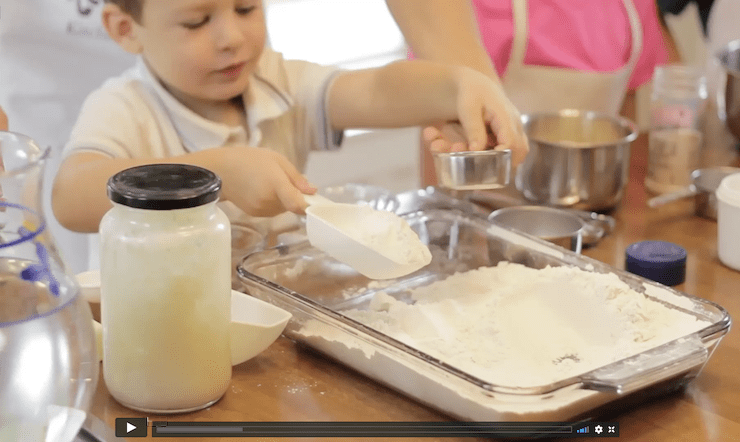
When I was a young mom with just one baby who grew into just one toddler, I was determined to do everything right. I was fortunate to attend a Montessori School for my own preschool and kindergarten, and those ideals never left me.
I wanted my child involved in practical life skills from an early age, including getting started cooking in the kitchen very young.
With my background as an educator, I felt no qualms diving in, giving him tools, demonstrating, and letting him loose. In fact, this picture is from when he was just over 18 months old, cutting cooked potatoes for potato salad.
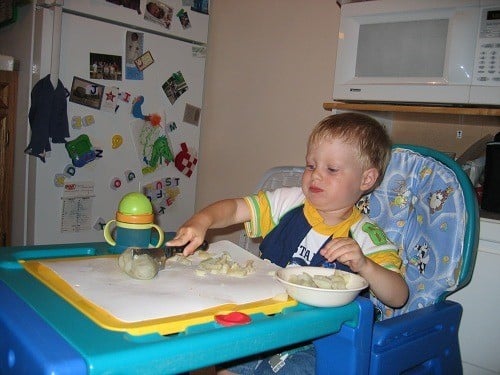
It looks like he’s using a tiny meat cleaver, but it’s really a dull cheese knife. 🙂 It’s shorter and easier to handle than a butter knife but just as safe (and slightly more effective) because of its shape and sharpness.
I have another memory of one of my 18-month-olds in the kitchen. But this one doesn’t have a picture to go with it—you’ll find out why in a second.
Two Young Children in the Kitchen
You see, becoming a mom of two kids was a challenge for me. I still wanted my kids to learn how to cook and be involved in the kitchen, but I wasn’t sure how to manage two different developmental ages and grow their skills at the same time.
When my daughter Leah was about 18 months old, she started climbing up onto the chair my now four-and-a-half-year-old son Paul was standing on. She always wants to be involved in whatever was going on, and that hasn’t changed.
I figured I could do the same thing I recalled doing with Paul. So I handed her a different cheese knife and let her “play” with it.
Much to my alarm, she quickly cut her finger, because that cheese knife didn’t play by the same rules as my first one. Besides that, I hadn’t shown her anything since all my focus was on working with my older child.
This was a bit of a crisis for me. I struggled the next few years to teach my kids new cooking skills in the kitchen. It felt like they were just too young all of a sudden, I suppose because I wasn’t handling the chaos of “the many” very well.
But I was wrong.
After half a decade as a kid’s cooking teacher working with tens of thousands of families around the globe, I know cooking has no age limit.
What Age Should a Child Start Cooking?
Your child can start cooking as early as 18 months or 2 years old.
Real cooking skills can be taught to toddlers, depending on the child’s maturity and the parent’s supervision. At Kids Cook Real Food™, we teach bananas and butter knives, starting officially at age 2.
Many of our members definitely get their one-year-olds involved in the kitchen. Especially when those one-year-olds are watching the older siblings.
Because our videos do the demonstrating, we help alleviate the parental struggle of juggling multiple age groups and developmental skill levels.
I always tell parents who are just starting their parenting journey that even in the first week of a baby’s life, they should be having positive experiences in the kitchen.
How to Get Babies Involved in the Kitchen
I’ve always been a big fan of wearing my babies. And that’s never more important than in the kitchen!
When your babies are right with you, they get to hear the sounds of cooking, smell the amazing smells of the kitchen, and are exposed to a lot of soothing movement as you move about the kitchen. This begins to train their neural pathways that food is a positive experience and a collaborative community effort.
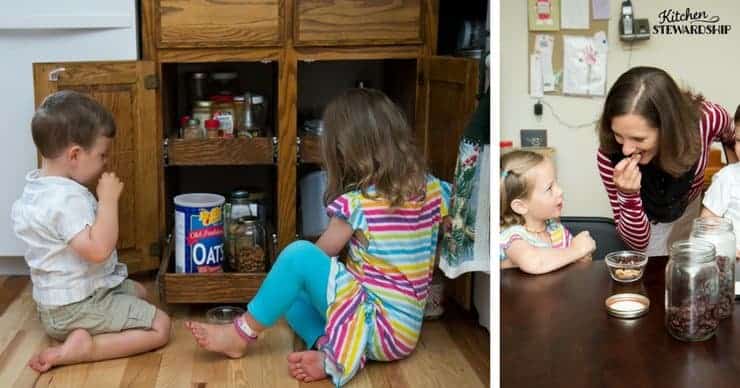
When your baby becomes mobile, be sure to leave at least one or two cupboards or drawers unlocked for them to explore. Yes, it’s annoying to have all your plasticware strewn across the room, but allowing your baby to be in the kitchen continues to train their neural pathways in the right direction. (More on the dangers of doing the opposite coming up!)
Even through toddlerhood, most parents can continue to wear their babies. At this point, you really want to make sure you are narrating everything you do.
“See, Mommy is cutting a cucumber. We add a broth to the pot. Look at the bubbles. Watch the steam; that’s a boil. Hot, hot, hot! No touch!” <<all in a positive, uplifting tone of voice, not scary.
You can train your baby even before their first birthday to respect the stove, appreciate a variety of foods, and feel like they belong in the kitchen.
Kids don’t need plastic knives. They need real skills.
Teach safe technique, focus, and confidence in the all-time fav lesson from our kids cooking class! (ages 2-12)
How to Get One- and Two-year-old Toddlers to Feel Involved in the Kitchen
I understand completely if you’re thinking Katie, there’s no way my one- or two-year-old can actually contribute to family life. And that’s okay.
At that age, and even through the start of school, just feeling involved and playing a tiny role helps kids to take ownership in the meal.
Ownership means they’re more likely to engage at the dinner table, which every parent of a food-throwing, high chair-squirming toddler desires!
Here are some quick ideas for toddlers to feel involved with cooking without them touching anything:
- Let them smell all the herbs and spices
- Have them put their hand on yours as you crack eggs or stir batter.
- Ask them something non-essential, like which bowl you should use or which spoon you use to stir. Just making a choice creates agency.
We all know that toddlers are tactile beings, and they want to get their hands involved.
Here’s a list of some simple ideas for toddlers’ hands to get messy without interrupting or cooking at all.
- Let them throw away the peels from your cutting board.
- Let them peel garlic over a bowl on the floor. They can take 10 minutes to do this, and it won’t slow you down in the least.
- Give them their own bowl and spoon on the floor for some pretend play. At this age, pretend play is very developmentally appropriate, and as long as they are often truly involved, there’s nothing wrong with it. Beware of making false involvement the only way kids are invited into the kitchen though—Kids will begin to see right through that, even at age 1.
- Ask your child to bring you a spoon or bowl or measuring spoons. Hint: make sure you have some items low enough for them to reach. Read how to set up a kid-friendly kitchen for more.
- Allow your toddler to “help” set the table. Put out some utensils and napkins (non-breakable things for now, or sturdy glass juice glasses and Corelle), and they can carry the items one by one to the table. Even if they end up in a heap in one spot, they’ve been occupied happily for 10 minutes, and you haven’t really lost more than five seconds of prep.
- Give your toddler a “cooking” job of moving an item from one place to another. This might be frozen peas from the bag into a cold pot or some carrot sticks you just cut from the cutting board into the bowl. As soon as their fingers are strong enough, give them tongs for this task to improve small motor control.
As you feel able, be sure to give your tiny toddlers other tasks that get them more and more involved. The important aspect of kids cooking at this age is to maintain a positive feeling in the kitchen.
We want to train our baby’s neural pathways to appreciate food, cooking, and working in the kitchen.
We want them to feel as if they belong.

Research shows that continually booting kids out of the kitchen trains their neural pathways the opposite. 🙁 Then we get an 8-year-old who says, “I don’t want to help.”
Their brain is telling them “they don’t belong in the kitchen.”
Whatever you can do within your sanity range to keep your toddler feeling that “I belong” in the kitchen is a vital step.
What Else Can Your Kids DO in the Kitchen?
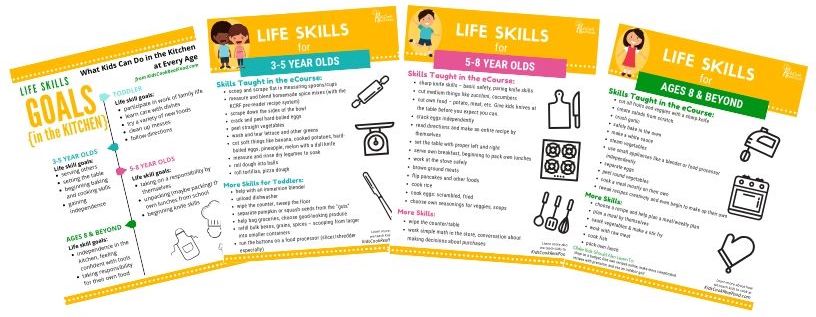
Download this printable list of age-appropriate kitchen skills for kids of any age to tack up in your kitchen and remind you what your kids can do to really help in the kitchen!
Note: When you grab our free gift, you’ll also get helpful emails about getting kids into the kitchen and eating healthy food.
How to Get Children Ages 1 to 3 Learning to Cook (Real Involvement)
Depending on a child’s maturity and the parent’s personality, kids can actually start to contribute and be involved as early as 18 months, and certainly by the time they are 3 years old and you’re working on big-kid tasks like potty training and preschool!
Continue to keep in mind what neural pathways you are creating in their brain. Donald Hebb said, “The neurons that fire together wire together,” which means that the experiences we have, what we do at the same time, literally builds our brains to do those things more effectively later.
That’s why we want our kids to have positive feelings in the kitchen. Then they will want to come back as they grow!
We want them to feel like they can generously serve their families.
To feel like they can take responsibility, no matter how young.
This will train their brains to have more aptitude and less attitude about doing chores when they’re in elementary school. (Score for the whole family!)
We can even train their brains in a healthy way to evaluate and accept risk. When we allow little ones to take tiny risks, like using a butter knife that they see adults use, they learn how to take safe risks. Lenore Skenazy, the author of Free-Range Kids and founder of Let Grow, says that knives in the hands of children inoculates them to appropriate risk. See this interview for more details on that.
Your toddler’s brain is in its fastest growth period of the child’s whole life. (Adolescence is second, look out, moms of teenagers!) It’s our great privilege and responsibility to help them grow into the best adult possible, even when we can’t imagine this tiny, messy, ear-splittingly noisy human being becoming an adult.
Those tiny, messy beings have a lot more skills than we realize.
“I just want my kids to eat what I make!”
This free 5-day challenge was made for you.
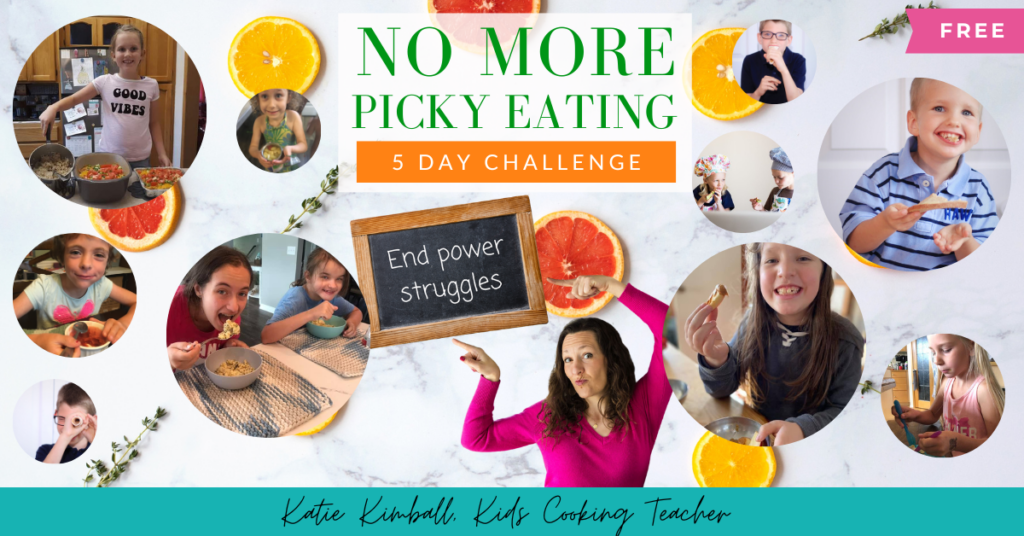
Spend just 30 minutes a day learning practical strategies that reduce mealtime battles and help kids build confidence with food.
In preschool, a major milestone is to improve small-motor skills.
Small-motor competence opens up an entire world to children such as cutting with scissors, drawing and writing their name with a pencil, and safely turning the pages of a book without tearing.
In the kitchen, as kids learn to cook, we practice small-motor skills with tongs (check our resources page for some tiny tongs for tiny fingers), measuring flat with teaspoons, and yes, that good old butter knife or cheese knife and a banana.
Here are some simple ways we teach in the beginner level of the Kids Cook Real Food™ eCourse to help children ages 1 through 3 start learning to cook and stay involved and positive in the kitchen:
- Using a butter knife on not only bananas, but any soft fruits or cooked vegetables
- Spreading nut butters, cream cheese, or softened butter on anything they can get their hands on
- Early measuring skills with teaspoons (Pro tip: use a spill bowl. If you’re already a member, check our Foundations 101 and Beginner Lesson 4 for this training.)
- Picking through dry beans looking for rocks
- Refilling from bulk to smaller jars (this applies to dry foods like rice, beans, other whole grains and as they get older, herbs and spices.) (Pro tip: have the child work with one food at a time on a rimmed cookie sheet so the mess is easy to clean up.)
- Pouring with a one-cup measuring cup or creamer pitcher (Pro tip: get the video in Beginner class 6 if you’re already a member or our preschool mini course, if you’d just like a taste.)
- Working with dough of any kind, whether that’s homemade bread, homemade tortillas, homemade crackers, or even making homemade playdough together
- Building a colorful salad—again, any type of assembly or moving food around is great for this age to be involved
For this young crowd, even having the child’s hand on top of yours as you cut something dangerous, crack an egg, or stir is fantastic. They feel involved and loved, and it only slows you down a few percentage points on your productivity scale.
Want to learn how even the tiniest kids can contribute to the family?
Check out our Preschool Mini-Course, which teaches skills like pouring, measuring, and setting the table. Preschoolers can learn actual helpful skills! And that confidence will spur them on to learn even more.
Plus, there’s genuine learning going on, because they can feel how much pressure you exert on these difficult-to-master skills.
Like our babies, they continue to be exposed to the sights, sounds, smells, and tastes of the kitchen.
Engage with all their senses.
And of course, the most important habit: positive emotions around food and cooking.
RELATED: Why you don’t want food to be associated with negative emotions
As our kids get older, many parents get stuck with some of these same skills for their big kids.
- We let them assemble “recipes.”
- We let them dump what we’ve already measured.
- Perhaps we let them stir something up.
My challenge is to raise the bar at all ages!
Get those little ones involved so that they feel they are actually contributing (and they actually can!), and make sure you continue to raise the bar for what the bigger kids can do.
For more inspiration on starting young and why that’s so important, enjoy my canceled TEDx talk, The Power of Teaching Kids to Cook. You’ll love the photos of our little summer campers and members smiling with confidence because of their authentic involvement in the kitchen.
How young can you teach kids to cook? They’re never too young to get started!
Now head over to our 10 Snack Ideas that Preschoolers Can Make for even more specific ideas.

Leave a Comment