
Did you know the pre-frontal cortex where executive functioning lives doesn’t fully develop until our early 30s???
I still struggle with some executive functioning skills like time management and following a plan, but if I learned anything from this interview, it’s that we ALL can continue to grow, change, and improve. You are not married to your weaknesses!
If we can help our kids BEST develop their executive function, they will be more independent, better at their jobs, find deeper relationships, and be better parents themselves. It’s THAT important!
My guest today, Noel Foy, helps us understand what executive functioning is, how it develops over time, and some really practical ways to build it best in our kids.
Her question, “What is your plan for that?” is pure gold, and I know you’ll love all the little strategies she shares to reduce anxiety in our kids while improving their executive function. As we teach life skills and independence, we are also teaching executive functioning skills! Score! 🙂
Find all the episodes of the Healthy Parenting Handbook here, or wherever you get your podcasts:





Don’t forget to leave us a review on Apple Podcasts too! Thank you!
Can’t see the video? Watch Executive Function Development here on YouTube!
No time for the video? Here are the notes! The time stamps match up with the video rather than the audio podcast, but they won’t be that far off!
Executive Function Development for Kids
- 0:01: Today we have repeat guest Noel Foy back on the Healthy Parenting Connector. You can see her first interview about helping kids with ADHD here.
- 2:08: Noel used to be a school teacher, but her career shifted after her son had a concussion and she began researching brain function.
- 3:09: What is executive function? Executive function is a set of skills that queue, coordinate, and direct what we need to do, as well as when and how we’ll do it. Setting goals, getting started, setting priorities, remembering directions, being flexible, being persistent if things go wrong, etc. are all parts of executive function.
- 4:33: Noel has an illustration to help you picture how executive function works.
- 5:24: Executive function skills don’t fully develop until close to age 30 for men, and generally a few years earlier for women.
Can You Strengthen Executive Functioning Skills?
- 6:55: While they take years to fully develop, executive function skills begin developing very young. You can provide opportunities for your kids to strengthen their executive functioning skills from a young age. Noel shares some ideas.
- 9:05: Many kids with executive function deficits struggle with time awareness. An analog clock will help them understand the passage of time better than using a digital clock.
- 9:55: Reduce cognitive overload by giving kids one step at a time when giving instructions and making sure they have everything they need before they start a project or homework.
- 11:22: Many parents struggle with stepping in too early to help a child before allowing them to figure it out on their own. Give them the opportunity to build new skills for themselves. Noel gives an example of queuing your child vs directing your child.
One risk as parents is that we tend to do the thinking FOR our kids, but we need to give them opportunities to build skills. -Noel Foy
Kids don’t need plastic knives. They need real skills.
Teach safe technique, focus, and confidence in the all-time fav lesson from our kids cooking class! (ages 2-12)
Life Skills Build Executive Function
- 13:54: Here at Kids Cook Real Food™ we value learning life skills to prepare our kids for adulthood. This is all in the same arena as executive function. Executive function could be considered your highest level of thinking. Watch my TEDx talk on the importance of teaching kids critical thinking skills.
- 15:36: When we’re highly stressed or anxious, our executive functioning is inhibited.
- 18:00: You can help your kids become aware of how the stress cycle works and how to identify their own stress response so that when they notice they’re beginning to get anxious, they can use coping skills to interrupt the cycle. You can get some practical coping skills in this interview and this post.
- 19:28: Language matters when you’re helping support your kid’s executive function development. Noel shares some examples of phrasing and word choice she likes to use.
- 23:05: Time management is a struggle for many of us. Being in a rush and trying to push your kids along will really make things worse if a child has a hard time with executive functioning. Some of Noel’s suggestions above take longer up front, but in time you will reap the benefit.
- 24:35: Let’s connect executive functioning skills to cooking. The kitchen is a phenomenal place to develop executive function skills.
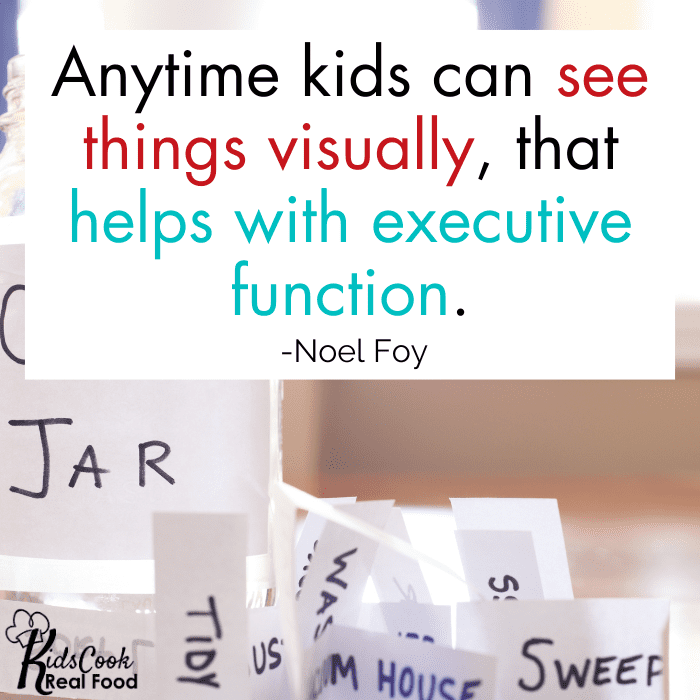
- 25:11: Kids with executive dysfunction benefit from seeing a picture of the final goal before they start i.e. show them a picture of a clean bedroom before they start cleaning, or look at a picture of the cake you’re getting ready to bake.
- 27:30: An interesting note is that it’s easier to turn on our executive functioning for things we enjoy. It’s great to practice with something they like doing and then transfer those skills to things that aren’t as exciting.
- 28:20: Even those of us over 30 struggle with different executive functioning skills. There are some strategies we can use to improve the skills we’re weak in. Here’s Ned Johnson’s book The Self-Driven Child that Noel mentioned.
Shift that locus of control from telling to asking. -Noel Foy
- 31:35: We leave you with one super practical step you can take today! Noel has some great ideas to make processes visual for your kids.
- 35:25: As kids get older they have more long-term tasks and they may put them off until the last minute and not even know how to get started because they don’t have an image of the final goal they’re working towards. Text outlines, examples, and graphic organizers all count as visuals for older kids and adults.
Resources We Mention for Executive Function
- Find Noel online here
- Noel’s books: ABC Worry Free, Are You a Bird Like Me?, 15-Minute Focus
- You can see my first interview with Noel about helping kids with ADHD here
- Watch my TEDx talk on the importance of teaching kids critical thinking skills
- Get anxiety coping skills in this interview and this post
- Here’s Ned Johnson’s book The Self-Driven Child that Noel mentioned
 Noel is a mom, anxiety coach, neuroeducational consultant, and author of Are You a Bird Like Me? and ABC Worry Free, a Mom’s Choice Award recipient. She is a former classroom teacher and learning specialist who now specializes in workshops and one-on-one coaching for schools, families, and organizations on anxiety, stress management, executive function, and growth mindset. Her passion is to equip kids and adults with practical problem-solving tools to decrease stress, promote healthy change, and maximize one’s unique potential.
Leave a Comment