
Starting Tweens and Teens Off Right with a Planning System that Actually Works
Have you ever looked at your kid’s schedule and thought, “How are we supposed to fit all of this in?”
School. Sports. Music practice. Homework. Clubs. Family stuff. That giant project they somehow remember at the most inconvenient possible moment.
And then we wonder why our kids feel stressed…while we’re over here acting as the family calendar, reminder system, transportation coordinator, and human push notification.
In part one of my conversation with productivity expert Megan Sumrell, we talked about time debt and why so many of us keep carrying unfinished tasks from one day into the next.
But this time I wanted to ask a different question:
Can we teach our kids to avoid that mess before they become adults?
Because I did NOT start life with excellent planning habits. Megan didn’t either. So if we can give our tweens and teens some of these skills at 12, 15, or 18 instead of making them figure it out at 35 while juggling work and kids…yes, please.
Megan shares a very practical system for helping kids actually see their time, instead of treating everything that isn’t happening right this second as some vague place called “later.”
And parents, there are some really good ideas in here for us too.
In this interview, we dig into:
- Why Megan says most kids basically have two categories of time: “now” and “not now”
- The four levels of planning that can help students manage a whole semester without Mom becoming the Chief Information Officer
- Why writing tasks in a little box labeled “Monday” might still be nothing more than a glorified to-do list
- How one teen used her calendar to make a completely logical case for getting out of family yard work (and yes, it worked!)
- What kids should do when a teacher assigns a five-week project so it doesn’t magically become a five-hour panic session the night before
- Megan’s surprisingly helpful strategy for procrastinators who look at the thing they planned to do and think, “Nope. Don’t wanna.”
- Why you may need an actual uncertainty budget for your time, just like an emergency fund for your money
- How teaching kids these skills can eventually free parents from remembering every exam, practice, deadline, and assignment for them
One idea especially made me stop and think: Megan intentionally blocks time on her calendar for problems she doesn’t even know about yet.
Because something always comes up, right?
The internet dies. A teacher assigns something unexpected. A project takes twice as long as you thought. Somebody needs a form filled out by tomorrow morning. (Naturally.)
Instead of pretending those surprises won’t happen, Megan plans for them.
And that may be one of the most practical ways I’ve ever heard to get out of the constant cycle of, “I’ll just squeeze it in somewhere.”
If you want your kids to head toward high school, college, and adulthood knowing how to manage their own responsibilities without you constantly chasing behind them, this conversation is packed with skills worth teaching now.
Because the goal isn’t to raise kids who can cram more into every day.
It’s to raise capable humans who can look at their time, make good decisions, and know when the answer needs to be, “I actually don’t have room for that.”
...
Chores Matter More Than Extracurriculars for Teens — Here’s Why
If you’ve ever looked around your house thinking, “Why am I still doing everything for these capable humans?” — this episode is for you.
I’m deeply passionate about helping parents raise kids who are not only healthy, but independent, resilient, and prepared for real life. And honestly? Chores and family responsibilities are one of the most powerful tools we have to make that happen.
In this conversation with Hunter Clarke-Fields from the Mindful Mama Podcast, we talk about why chores are about so much more than getting help around the house. They help kids build confidence, ownership, problem-solving skills, and even better mental health.
We also talk about:
- Why responsibility protects teen resilience
- How to start chores with toddlers and preschoolers
- What to do if your teen has never really helped before
- Why contribution matters more than perfection
- How to stop nagging and build systems that actually work
And yes — I share the exact chore system we’ve used in our family for over 10 years.
Whether your child is 4 or 14, it’s never too late to start building the life skills they’ll carry into adulthood.
...
Family Dinners, Tech Boundaries, and Resilience: A Recipe for Teens Who Launch Well
If you listened to part one of my conversation with Tania Johnson, you already know how powerful it was to understand what is happening inside the teenage brain. In this second half, we move from the “why” into the “what now?” We talk about the practical side of parenting teens in today’s world, including chores, emotional intelligence, resilience, family connection, and of course… technology.
One thing I really appreciated about this conversation is how balanced and hopeful it felt. Tania does not come from a place of fear or perfectionism. Instead, she reminds us that parenting teens is about relationship, repair, and helping our kids gradually build the skills they need to become capable adults. We also talk honestly about screens and smartphones, and I think every parent of tweens and teens will feel seen in this conversation.
In this episode, we cover:
- Why emotional intelligence may matter more than IQ long-term
- How parents teach EQ through everyday conversations and reactions
- Why family dinners and chores build confidence and connection
- How to hold expectations without constant power struggles
- The reason more teens seem afraid of failure and independence
- Why resilience grows through small risks and mistakes
- What parents often get wrong about smartphones and social media
- Why it is okay to “rewind” and change tech decisions later
...
Why Teenagers Are Like Toddlers (& What That Means for Practical Parenting)
If you have ever looked at your teenager and thought, “Why are we suddenly having toddler-level emotional meltdowns again?” this episode is going to make so much sense. I had such a fascinating conversation with Tania Johnson from the Institute of Child Psychology about what is actually happening inside the teenage brain, and honestly, it completely reframed some things for me as a parent.
We talk about why teens and toddlers are surprisingly similar from a brain development perspective, why emotional outbursts and withdrawal are actually normal parts of development, and what parents can do to stay connected without smothering their kids. I especially loved how practical this conversation became. Tania has such a gift for taking complicated psychology concepts and making them feel doable in real life.
One of my biggest takeaways from this episode was the reminder that connection is still the foundation of parenting during the teen years. Even when they roll their eyes, shut their doors, or seem like they do not want us around, attachment and relationship still matter deeply.
In this episode, we cover:
- Why the teenage brain develops similarly to a toddler’s brain
- What co-regulation actually looks like during emotional moments
- Why talking less can sometimes help more with teens
- What is happening when your teen explodes and then withdraws
- Why parents should step back into connection after conflict
- How attachment continues shaping mental health during adolescence
- Simple family rituals that help teens feel loved and connected
- Why family meals matter more than most parents realize!
...
How to “Launch” on Purpose: Teaching Life Skills to Your Teens Today That Will Prepare Them for Tomorrow
One of the motivations for creating the Kids Cook Real Food™ eCourse was that I was just over halfway to “launch” with my oldest child.
Nine years old is half of the intensive part of parenting, and Paul had just turned 10. He demonstrated how to make homemade guacamole to his 4th-grade class, and I realized that guac was the only thing he truly knew how to make!
One cannot live on guac alone…so I knew I needed to teach him more before he left my home!
I love that parenting expert and author Amy Carney also uses the word “launch” to describe the process of sending off a child into the world, ready to serve and grow and live on purpose.
She too had a crisis of parenting when her oldest kids were about 10, and she reacted even more strongly than I did – that and more in today’s interview!
What Amy made me desire: The sort of MARGIN she found in her life when she taught her kids certain things.
How I’ll rethink something today: That being frustrated about a task is an opportunity for a teaching moment.
A goal I need to keep in mind: Play is as important as “being busy.”
In the first two days after the interview, I quoted a certain portion twice, and it’s what college professors and deans all agreed that young adults need more of.
This is a heartfelt, fun, fascinating, and inspiring interview, and I hope you enjoy Amy as much as I did!
Amy is teaching on How to Spot a Scam in #LifeSkillsNow Season 5 – register now!
...
Teen Tidbits, Day Day 5: The Teenager’s World Is No Longer Black & White: How to Use That to Your Advantage as a Parent
Today’s teen tidbit is number five, and it gets right to the heart of what’s actually happening in your teen’s brain right now! Somewhere around ages 11 or 12, kids move from a black and white way of thinking into a world full of gray, nuance, and questions, which is why “because I said so”...

Teen Tidbits, Day 4: Passing on Family Values Through Teen Involvement in the Kitchen
In this Teen Tidbit, I share how the kitchen is one of the most powerful places to pass on family values through working side by side toward a common goal. Cooking together naturally opens up conversation and creates opportunities to model what matters most, whether that is serving others, being good stewards of our resources,...
Teen Tidbits, Day 3: Why Cooking Helps Teens Let Go of Perfectionism
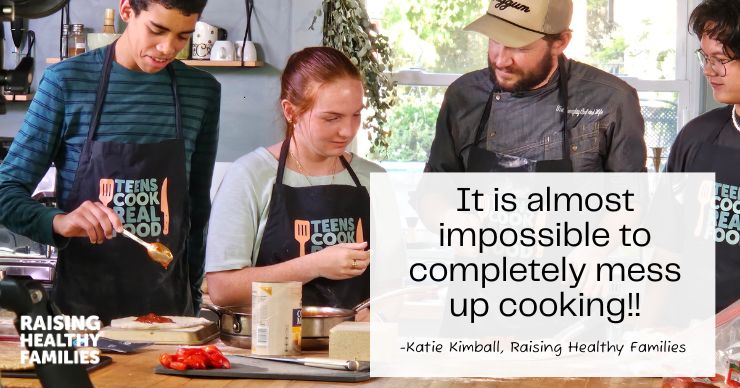
The kitchen, in my opinion, is one of the best places to practice letting go of perfection. When I filmed Teens Cook Real Food with eight real teens who were mostly beginners, we captured the messy, real-life moments: broken eggs, small cuts, burned food, and lots of learning along the way. I intentionally pushed them...

Teen Tidbits, Day 2: How Agency in Cooking Teaches Teens to Make Smart Choices
In this Teen Tidbit, I dive into why agency is such a powerful (and often overlooked) developmental need for teenagers. Agency is really the combination of having choices and having the skills to act on those choices, which together give teens real options in life. I’ve intentionally woven this into the Teens Cook Real Food...
Teen Tidbits, Day 1: Passing on Ownership to Your Teens
In this Teen Tidbit episode, I share why passing on ownership of health, time, and responsibility to our teens matters so much, especially through teaching real-life skills like cooking. After hearing from a beta test mom whose 13-year-old confidently made pancakes on his own, I explain that ownership has two parts: practical skills (which are...