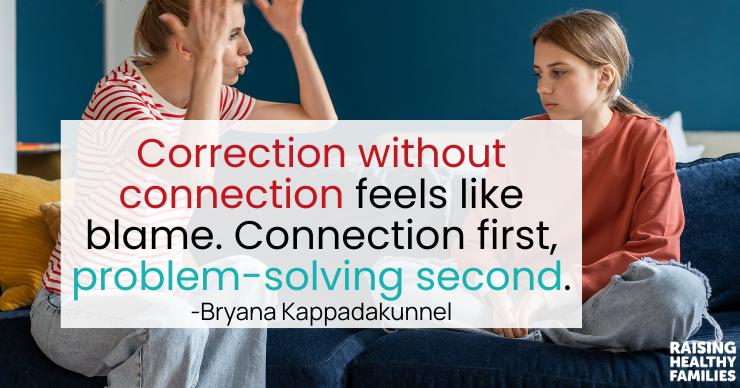
Have you ever blown up at your kid because they’re melting down?
Just wanted their bad behavior to STOP because you feel like a bad parent if it doesn’t?
Committed that you would parent differently than your parents, but see some cycles repeating you don’t like?
My guest today is a Licensed Marriage and Family Therapist who has seen a lot of hurting and struggling families in her decade-plus working with clients, and she brings some of the best scripts I’ve ever heard to this interview today.
Get answers for issues like:
- Your teen says everyone else gets to do X and it’s not fair that she doesn’t!
- Your preschooler throws an epic 45-minute tantrum
- You try to put the child in time-out but it only makes things worse
- Your child’s behavior triggers anger or resentment
- Feeling like you have to choose between being a warm, connected parent and giving your kids chores and boundaries
Plus Bryanna tells us the two most important things we can say to our teens – and they’re good ones.
I know many parents are going to have a mindset shift after this one, and I can’t wait to hear what you think!
Find all the episodes of the Healthy Parenting Handbook here, or wherever you get your podcasts:





Don’t forget to leave us a review on Apple Podcasts too! Thank you!
Can’t see the video? Watch here on YouTube!
No time for the video? Here are the notes!
What “Parent Yourself First” Really Means
03:26 – Bryana shares how her own chaotic, abusive childhood led her into therapy work and eventually to her book Parent Yourself First.
05:39 – She defines “parent yourself first” as learning to be the parent for yourself that you never had, and responding first to the child within, then to the child in front of you.
Your child’s tantrum is not proof you are a bad parent. It is an invitation to heal old stories about not being enough. – Bryana Kappadakunnel
Turn expert advice into a handbook you can actually use.
I’ve interviewed hundreds of incredible experts on the Healthy Parenting Handbook podcast! Out of time to listen? You can skim on your phone!
These one-page summaries give you the highlights of every episode fast, so you can find what you need when you need it (and nothing to download).
06:58 – Instead of rushing to stop a child’s tantrum or disrespect, she teaches parents to ask, “Why is this so triggering for me, right here, right now?” (Learn more about why kids have tantrums and how to deal with them here.)
A Real-Life Example of Breaking Generational Patterns
07:23 – Bryana describes a client, “Alicia,” whose strong-willed child had epic 45-minute tantrums that left Mom feeling like a complete failure.
08:41 – Together they uncovered Mom’s childhood experience of parents who did not tolerate emotions and shut her away until she was “pleasant.” Bryana explains how kids who trigger us often mirror the parts of ourselves we learned to dismiss or reject, such as big feelings and strong opinions.

11:03 – As Mom learns to see herself as “enough” and to validate her own emotions, she starts to see her daughter’s strong will as perseverance and healthy boundaries instead of a problem to control. Once Mom shifts her inner story, tantrums shorten, cooperation increases, and the relationship feels safer for both of them.
Parenting from a Place of Connection (for Toddlers through Teens)
12:55 – Bryana defines parenting from connection as looking beneath behavior to the child’s underlying needs, not just managing what you see on the surface.
13:43 – She describes her “connection garden” idea, where parents practice curiosity, emotional safety, and seeing the whole child, not just the difficult moments. Bryana then talks about how connected kids tend to develop stronger self esteem, empathy, problem solving, communication, and critical thinking.
The traits you call “strong willed” in your child might grow into perseverance, healthy boundaries, and courage. – Bryana Kappadakunnel
14:30 – For little ones, connection looks like affection, rocking, and play. For older kids and teens, it looks like presence, putting your phone down, playing their games, asking about their world, and showing that you genuinely care about what they think and feel.
15:37 – Bryana stresses that connection means caring not only for your child’s body and schedule, but also caring about their inner world.

Tantrums, Triggers, and How to Respond without Exploding
16:54 – Bryana normalizes how inconvenient and threatening tantrums can feel in our bodies and why our nervous system goes on alert when kids scream, slam, or yell “I hate you.” Listen to Ann Odom’s interview on preventing nervous system wounds for more!
18:12 – She frames tantrums as an opportunity to regain connection instead of a problem to squash, and cautions against old school responses like ignoring, shaming, or automatic punishment. Then Bryana walks us through a 3-step response to a tantrum.
Pause is a parenting superpower. Ten seconds of noticing yourself can save ten minutes of yelling. – Bryana Kappadakunnel
Kids don’t need plastic knives. They need real skills.
Teach safe technique, focus, and confidence in the all-time fav lesson from our kids cooking class! (ages 2-12)
20:41 – For toddlers, connection sounds like simple mirroring of feelings. For older kids and teens, it sounds like, “I hear that you are frustrated with me. Would you be open to talking about it another way?” followed by working together on alternative ways to express big feelings.
Is It Too Late for Teens, and How Do Limits Fit with Connection?
22:49 – Bryana reassures parents of teens that it is never too late to make changes, although it can be harder when patterns are long standing or mental health issues are intense. She notes that many parents “give up” on parenting teens by withdrawing boundaries, and encourages moms and dads to stay in the game while still honoring teens’ growing need for freedom.
25:12 – She offers a script for responding when teens say, “Everyone else gets to do this. Why do you hate me?” that frames freedom as something you want for them too, but that must expand gradually as they show responsibility.
27:50 – On chores and responsibilities, she explains that warm, connected parenting absolutely includes clear boundaries, standards, and life skills that prepare kids for adulthood. Grab my free chores system to start getting those kids life skills now!
28:57 – Bryana recommends weekly family meetings to look ahead at the schedule, talk about what is and is not working, adjust chores, and give kids practice in negotiation and problem solving so they feel they belong and contribute to something bigger than themselves.
Picky Eating, Modeling, and Neurodiversity in the Family
31:14 – Bryana talks about parents who fear passing on their “bad habits” such as picky eating, and invites them to explore the deeper roots like shame, sensory issues, scarcity, or undiagnosed eating disorders.
33:15 – She emphasizes that the real work is healing yourself first, because children learn far more from what you do with food than what you say about it.
34:43 – On neurodivergent families, she explains that autistic and ADHD brains are highly individual, so the priority is creating an environment where everyone’s needs can be met without shame.
“I just want my kids to eat what I make!”
This free 5-day challenge was made for you.
Spend just 30 minutes a day learning practical strategies that reduce mealtime battles and help kids build confidence with food.
37:07 – For ADHD kids, she highlights how often they are criticized and misunderstood, and encourages parents to notice and specifically praise every genuine positive effort, since this boosts dopamine and motivation.

One Small Step to Start Parenting Yourself First
41:18 – Bryana’s simplest starting point is to pause before you react and notice yourself first. She believes that this tiny habit becomes the jumping off point for everything else, because awareness of your own inner child and nervous system is what makes a different response possible.
Resources We Mention for Calm Connection
- Find Bryana’s book Parent Yourself First on Amazon or Bookshop.org
- Diagnosing the Root Cause of Meltdowns and How to Deal with Tantrums with Dr. Tina Payne Bryson
- My TEDx talk on critical thinking for kids
- The Kimball family chores system that works!
- How to create a family meeting “Power Hour”
- More on ADHD and neurodivergence in interviews with Mike McLeod and Emily Hamblin
- Visit Bryana on her website Conscious Mommy or follow her on social media: TikTok, Instagram, Facebook
 Bryana Kappadakunnel is a Licensed Marriage and Family Therapist and the voice behind Conscious Mommy. Bryana is the author of Parent Yourself First: Raise Confident, Compassionate Kids By Becoming the Parent You Wish You’d Had. She serves new moms and families with young children who are in need of compassion, comfort, and support during life’s inevitable changes and transitions. She runs the Conscious Mommy Community, an online membership platform for parents who wish to heal their inner child wounds and parent from a place of intention and confidence. She lives in Southern California with her spouse and 2 kiddos.
Leave a Comment