ADHD is not just an attention disorder; it’s an executive functioning disorder.
The myths abound!
If you’ve always thought of kids with ADHD as those who struggle in school, think again.
If you expect ADHD kids to have trouble focusing, wrong again.
If you think kids with ADHD are destined to struggle more throughout life, Mike McLeod is here to tell you that ADHD is not a limitation, just a different path.
The ADHD brain is truly different from neurotypical brains, although some truths apply to both groups, like:
- Children learn best through play and unstructured time.
- Outdoor play is vital for developing real-world skills.
- Boredom is essential for self-regulation and creativity.
- Cooking teaches kids self-sufficiency and life skills.
- Unstructured time is crucial for children’s development.
- Parents should set high expectations for their children.
- Removing screens can reveal hidden talents in kids.
- Parents need to place more importance on chores & balancing structure and freedom.
Parents of kids with or without ADHD need the information in this episode, but especially stuff like this:
- Screen time can exacerbate ADHD symptoms, but it does not cause ADHD.
- The ADHD brain struggles with self-regulation and motivation for NON-preferred tasks.
- Varied experiences are vital for skill development.
- Executive functions are crucial for success in life.
I love Mike’s energy and expertise, like sitting at the feet of a master. What an honor to work with him both for this podcast and as a #LifeSkillsNow Season 4 camp leader! Your whole family can learn more about the power of “varied experiences” in his #LifeSkillsNow workshop in Season 4. Check out the Season 4 package here, or see if #LifeSkillsNow is open for registration for this year!

Love the Handbook?
Find all the episodes of the Healthy Parenting Handbook here, or listen on your favorite podcast player:





Don’t forget to leave us a review on Apple Podcasts too! Thank you!
Can't see the video? Watch on YouTube →
No time for the video? Here are the notes!
Myths About ADHD
- 1:27: Today, I’m talking with a man on a mission. Michael McLeod improves the quality of life for youth and families with ADHD with specialized support through the GrowNOW treatment model.
- 3:41: Mike has worked with kids and adults with ADHD for 20 years. Even before that, he had always worked with youth and had been a speech language pathologist for years. After being late diagnosed with ADHD, he realized there was very little help out there for boys with ADHD.
What is Executive Function?
- 5:43: Let’s start by defining executive function. Executive functions are an internal set of skills that create all the external symptoms that people think about when they hear executive function, like time management, organization, messy backpacks, and folders etc.
Executive functions are the most crucial set of skills that any person can develop throughout life, more important than grades, GPA, a high school degree, or a college degree. -Michael McLeod
- 6:45: Mike identifies 4 pillars of internal skills as part of executive functioning.
- The first is self-awareness. This is the ability to understand your strengths, needs, how your choices impact yourself, and how they impact others.
- 7:29: Next is self-regulation, which is the foundation of all executive functioning. This is what parents see the most: the ability to regulate your emotions, your language, your body, and your behavior in various environments.
- 7:41: The third pillar is self-motivation. Of course, this is motivation to perform non-preferred tasks, like non-screen-based tasks and non-stimulating tasks.
- 7:57: Finally, self-evaluation. This is the ability to learn from past experiences and apply them to the present.
- 9:23: ADHD isn’t just about focus, it’s about the ability to self-motivate and stay focused on non-preferred tasks specifically. Kids now are being raised on screens, and their brains are being hardwired towards instant gratification and external motivation. It’s a recipe for disaster.
Screens and ADHD
- 10:39: Screen usage is not going to cause ADHD; it’s hereditary. BUT, it can cause ADHD symptoms and decreased executive functioning in kids who don’t actually have ADHD. Kids are learning to regulate themselves through screen usage instead of self-regulating. They are so overstimulated by screens that the normal aspects of life are too boring.
- 12:07: We’ve gotten stuck in the mindset that kids need to be taught every skill in life through direct instruction. Kids actually learn the most crucial set of skills in life, executive functions, through play, through unstructured time, through being bored, learning how to self regulate, learning how to self motivate, playing with peers outdoors, experiencing nature, having to deal with discomfort, having to deal with struggle, all of these things that we are now shielding kids from by putting them on screens.
- 12:54: An ADHD brain produces much less dopamine than a neurotypical brain. ADHD is highly correlated to addiction because of seeking a dopamine hit. Mike recommends that if you have a child with ADHD, you dramatically reduce or even eliminate screens from your home. Swiping an iPad, hitting a controller, watching a YouTube short, or TikTok is like a drug to these kids.
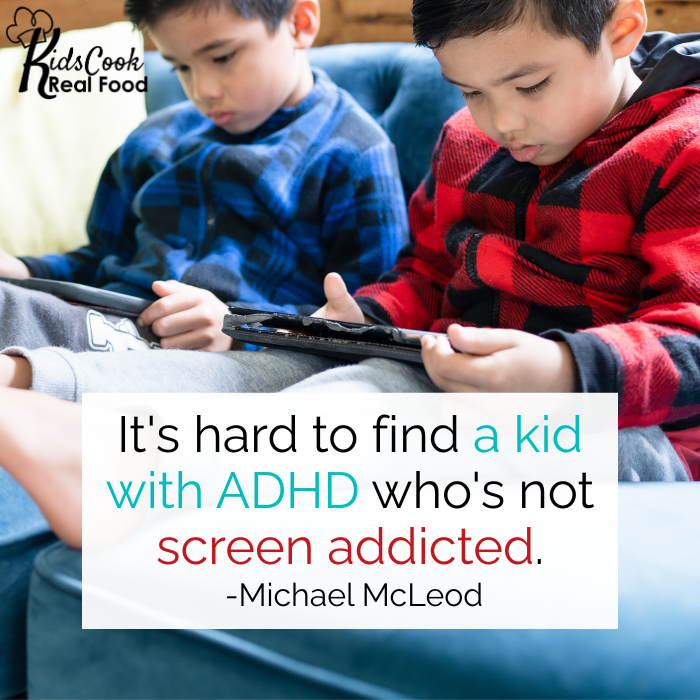
- 15:16: Mike describes some of the problems with having so much tech in schools. He observes lots of classrooms in his work, and he constantly sees kids playing games and messaging each other instead of paying attention in class. School administrators say the kids need to learn to manage their own screen use, but that isn’t possible. Their brains aren’t developed enough to resist the temptation.
ADHD is a Home Based Disorder
- 17:19: The ADHD brain is stuck in the now. They lack the hindsight to learn from past experiences. They lack the foresight to visualize the future, plan, prioritize, problem solve, or delay gratification. They are looking for the most stimulating thing here in this moment. The two big magnets that pull the ADHD brain in are screens and conflict.
- 18:12: Parents are the ones who see this conflict-seeking behavior. ADHD is a home-based disorder, not school-based, like most people think.
ADHD is not really a school-based disorder. Yes, ADHD kids struggle at school, but the home is where you see the majority of ADHD behaviors. -Michael McLeod
- 18:47: In the vast majority of cases, the parents reach out to the teachers to tell them the concerns they have at home, and the teacher doesn’t see that child at all at school.
- 19:33: There are three areas of executive functioning: academic, home (self-regulation towards parents and being able to do tasks at home), and social (making and keeping friends, and perspective taking). Typically, someone with ADHD will struggle with one or two of these areas; if they struggle in all three, that’s severe ADHD.
Kids don’t need plastic knives. They need real skills.
Teach safe technique, focus, and confidence in the all-time fav lesson from our kids cooking class! (ages 2-12)
Tips for Parents of ADHD Kids
- 20:17: Michael gives his number one tip for parents. Use less language. You need to switch your verbal prompting with visuals. For example, instead of saying, “Go clean your room,” give them a picture of what their room looks like when it’s clean.
- 22:51: If we’re taking away screens, what fills the void? Kids need to be bored, you are not your child’s entertainment system. Boredom and play are like going to the gym for your brain.
Let them be bored. You let them struggle, and they will figure it out. Kids are resilient. No one has a greater imagination than a child. -Michael McLeod
- 26:21: Kids need to feel important. Give them chores to do, and let them contribute to the family in a meaningful way. Do not use screens as a bribe to get your kids to do chores. Have high expectations and don’t make it a choice.
- 29:04: Another reason kids tend to have more symptoms at home is the type of relationship. School is full of conditional relationships; peers can choose not to be your friend, and teachers will discipline you for wrong behavior. At home, kids know their parents will love them unconditionally, no matter what they do. You can give an inch and they’ll take 50 miles.
- 31:37: Homeschooling families have a bit of a different situation since the child is with the parents most of the time. Michael’s advice is to have someone else do some of the teaching if possible, either through a co-op or by partnering up with another family. If you can’t do that, have a separate area in your house for school, have structured school time, and then unstructured home time.
Life Skills Teaching Executive Function
- 33:54: Understanding nutrition and cooking, getting involved in the kitchen, and doing things for yourself instead of relying on others. Those are true life skills, and you can make a pretty strong argument that kids learning how to cook and how to be self-sufficient is far more important than anything they’re going to learn in a rigid curriculum from math and science, and social studies.
- 36:01: Michael shares an encouraging story about a kid he worked with who was addicted to his Xbox.
- 37:43: We have a youth mental health crisis. You can trace it to when the iPhone was announced, when Facebook began, when the like button started, and when Instagram came out. You can see the effect all these types of things had on our mental health, and it’s worse in our kids.
“I just want my kids to eat what I make!”
This free 5-day challenge was made for you.
Spend just 30 minutes a day learning practical strategies that reduce mealtime battles and help kids build confidence with food.
- 38:30: Cars should be 100% screen-free. Let kids look out the window, use their imagination, process their day, and plan their afternoon. ADHD kids especially need boredom to allow them to develop some of these executive functioning skills, like reflecting and forecasting.
- 39:35: Adults have fully developed brains, so we can take a break from the computer and go take a walk or get a glass of water and stretch. Kids don’t have that ability. They can’t get off a screen at night and shut their brain off to go to sleep.
- 40:53: You’ve probably heard “all things in moderation” in regards to screen usage for kids. Is this true for ADHD kids? Your kids will show you what they can handle. If you give your child 30 minutes of computer time, do they get consumed with talking about it for the rest of the day? Do they melt down when the timer goes off or follow you around asking for more? If so, they can’t handle even that amount.
There’s really no legitimate reason to have Roblox in a child’s life. It’s not adding to their quality of life in any way, shape, or form. -Michael McLeod
- 42:37: We’re coming up on summer. Make a plan now for your kids’ screen usage over the summer. Give them that 90s childhood Mike was talking about.
- 43:49: Perservere through the 1-3 weeks of withdrawal behaviors after removing screens and watch your child blossom into new interests and skills. You have no idea what your kids are capable of and talented in if they spend all their free time on screens.
- 46:05: Mike is one of our camp leaders for season 4 of #LifeSkillsNow summer camp. He gives us a bit of a preview of his workshop for parents.
- 47:41: A couple of practical ideas to help you create varied experiences this summer are to make a habit of asking around the dinner table, “What’s one thing you did today that you didn’t do yesterday?” or getting a summer bucket list for your family.
Resources We Mentioned for ADHD Myths
- Check out these other interviews I’ve done on ADHD: Does ADHD always mean medication? and Practical Solutions for ADHD
- Find Mike online: GrowNOW ADHD
- Follow him on social media: Instagram, Facebook
- Mike’s book is set to come out in 2026. You can preorder it here on Amazon or Bookshop

In 2016, Michael McLeod developed the Internal Skills Executive Function Strengthening Model – and GrowNOW was born, with the mission to improve Quality of Life for youth and families.
As a respected keynote speaker, Mike has presented this model to audiences nationwide and internationally, offering specialized support for ADHD, Executive Functioning, Social Executive Functioning, and Parent Coaching.
Mike brings over two decades of experience working with youth and families affected by ADHD and executive function challenges. With a Master’s degree from Lehman College in New York and international experience collaborating with non-profits and ADHD organizations, Mike has developed a comprehensive understanding of neurodevelopmental support.
For 10 years Mike has learned invaluable insights from leading doctors and neuropsychologists, deepening his expertise in ADHD and executive function research. This experience and his years of hands-on work led Mike to develop the innovative GrowNOW Treatment Model

Leave a Comment