Family Therapist Andi Grandy spends much of her time helping parents get their anxious kids and teens to go to school.
Straight up, they will let their cell phones be taken away and forfeit bribe payments because they really don’t want to go. Those aren’t the right strategies…but what is?
I heard Andi speak in person and knew I needed her on the Healthy Parenting Connector. Today you’ll learn:
- Some popular myths behind WHY teens might be more anxious these days (some shocked me that aren’t part of the issue!)
- The biggest change in the last 20 years that may be causing our kids to have less capacity to deal with normal, everyday issues
- How this time of quarantine is changing the way teens feel anxiety (and what parents can do about it)
- What parenting techniques WILL work to help teens self regulate screens and manage their anxiety
- How parents can create an anti-anxiety home life (both during and after our shelter in place time)
- 3 questions to ask your kids every day
I honestly am changing my parenting and my reactions to my kids because of this interview, and I was able to implement this new philosophy just HOURS later with one of my kids! Most practical, mind-bending interview I’ve had in a while – a must watch!!!
Can’t see the video? Click to watch “How To Help Your Anxious Teens” on YouTube.
No time to watch the whole video? Here are the notes!
Helping Anxious Teens Video Time Stamps
- 0:33: I heard Andi speak locally on adolescence and anxiety and I knew I had to have her on the Healthy Parenting Connector. She is a family therapist who loves sharing practical strategies with parents.
- 2:05: We start off by discussing the similarities between teenage brains and toddler brains. If you’ve ever yelled “what were you thinking?” at your teen, this part is for you.
- 3:23: It’s easier to look at an emotional toddler with compassion. Teenagers are bigger and more capable so it’s more difficult to have that same compassion when they are having big emotions.
It’s hard to be a teenager. -Andi Grandy
- 4:29: 1 in 3 humans (including teens) in the US are dealing with anxiety.
Why is Anxiety Increasing in Teens?
- 4:49: We go through some myths and facts as to why kids are more anxious these days.
Responding to danger is not anxiety. Anxiety is overestimating the threat or underestimating your ability to handle it. -Andi Grandy
- 6:05: Anxiety tricks our brain into fight or flight when the situation doesn’t warrant that response.
- 6:22: Some things researchers considered as the cause of increased anxiety were increased danger in the world, academic pressure, and parenting style. None seemed to account for the dramatic rise in anxiety.
- 7:13: Andi shares some of the negative effects she sees of helicopter or lawnmower parenting.
- 8:16: Then researchers noticed that the spike of anxiety in teens matches the rise of the smartphone. Andi shares a whole list of ways that increased screen time correlates with a huge jump in anxiety and depression in teens and kids.
- 9:46: I just listened to Nicole Beurkens speak and she had a great way to look at screen time.
Teens and Anxiety during COVID-19
- 10:25: We’re recording this during the COVID-19 quarantine. Technology is a lifesaver for many. Connecting with friends and completing school assignments are possible because of our phones and computers.
- 11:07: There’s no school which is a source of anxiety, but there are plenty of new sources of anxiety these days. Andi shares what she has seen in her patients during the quarantine.

Teens and Screen Time Boundaries
- 13:26: If screen time is part of the problem do we just cut off screens? How can we use screens as a tool without letting it lead to increased anxiety?
- 13:57: Social media is designed to give a quick dose of happy chemicals like dopamine. It’s a way to numb out boredom or negativity.
- 14:37: Andi shares the number one thing parents can do regarding their kid’s screen time.
- 15:02: We discuss how we can practically make this happen.
- 17:15: It’s rare for a teenager to be able to regulate themselves and set healthy boundaries, there are many adults who can’t even do that. As parents, it’s our job to help guide and teach our teens as they’re learning how to set boundaries.
- 17:50: Andi has a few examples of screen time boundaries.
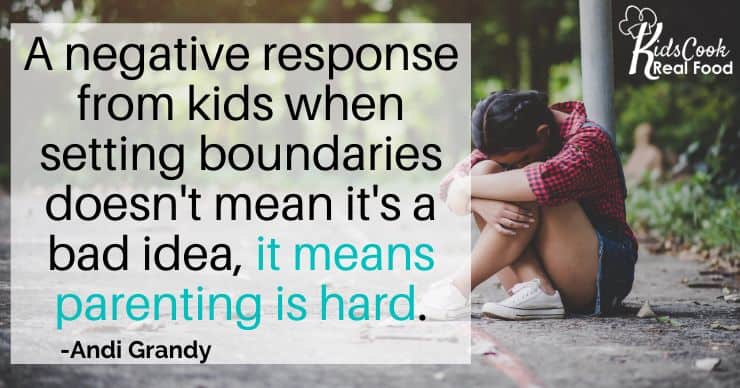
- 18:41: Setting a boundary doesn’t need to create an instant power struggle. Andi has a visual example of how to set boundaries with empathy.
- 20:24: The ideal situation is that teens will learn to self-regulate by the time they’re college-aged or out of the house. How do we transition from parent-led boundaries to child-led boundaries?
If you want your kids to have a skill, you have to give them the opportunity to practice. -Andi Grandy
- 24:14: You need to know your kid to understand where they are and where they’re ready to be gently pushed.
- 25:02: Parents need to determine what is their responsibility and what is their kids’. Often our part as parents is to manage our worry about the outcome.
Led by Elizabeth Sautter and Sarah Ward, experts in social-emotional learning (SEL) and executive functioning, this workshop will provide you with practical strategies that can be seamlessly integrated into daily routines and activities, benefiting both you and the children you love and support.

Helping Teens with Anxiety
- 25:23: A natural reaction to anxiety is avoidance. Andi shares two extremes she sees in parents dealing with avoidance. Again, setting boundaries with empathy comes in to play.
Empathize and encourage: “I know this is hard, but I know you can do it.” -Andi Grandy
- 27:46: Don’t let anxiety be the deciding factor. Your child’s anxiety should not decide whether or not they do something. Andi shares an example from a client.
Kids don’t need plastic knives. They need real skills.
Teach safe technique, focus, and confidence in the all-time fav lesson from our kids cooking class! (ages 2-12)
The parent can’t be the tool that a kid uses to deal with anxiety. -Andi Grandy
- 29:28: Small talk gets a bad rap, but it’s a necessary social skill that can be learned. Teens should be learning those skills, but instead, they carry around screens in their pockets to distract them from social situations which leads to further social anxiety developing.
- 31:14: We can’t control much about school or youth group, but there are things we can do to control what happens at home.
- How much noise is in your house? Literal noise and clutter or visual noise
- Routine and predictability help anxiety.
- Normalize failure and normalize that sometimes we do hard things.

Helping Teens do Hard Things
- 33:06: Andi recommends that parents ask their kids three questions daily. Even if you don’t get to it every day, have those conversations regularly.
- 33:40: Point out situations when your child overcame something difficult. Instead of affirming success, acknowledge and complement the process and character qualities.
We don’t our kids to think that we only love them because of what they accomplished, we want to say, “I love you because of who you are and how I see you managing the world.” -Andi Grandy
- 34:34: It’s important for your child to see that you struggle too, but they also need to know that you are strong enough to be their safe place.
- 35:56: Andi says that “busy hands can’t text.” I was thrilled to see cooking as on her lists of activities for teens. There are many reasons why cooking is a great skill for kids to learn to combat anxiety.
- 37:24: I share a recent personal story about my daughter burning sweet potato chips and getting really upset.

- 38:54: The thing about life is that there’s almost always another opportunity to try something different. It’s not about being perfect the first time, it’s about learning from every try and moving forward.
- 39:48: Parents have increased anxiety due to screens as well. The comparison game is strong!
- 40:31: I love to leave parents with a message of hope. Andi shares two practical encouragements for you.
“I just want my kids to eat what I make!”
This free 5-day challenge was made for you.

Spend just 30 minutes a day learning practical strategies that reduce mealtime battles and help kids build confidence with food.
Resources We Mention for Parenting Teens
- Find Andi online here
- My interview with Jessica Lahey author of The Gift of Failure
- My interview with Julie Lythcott-Haimes author of How to Raise an Adult
- My interview with Nicole Beurkens on Sensory Processing Disorder
- Screen time rules and brainstorming is a great topic to bring to your next family meeting!
- Managing screens is a life skill we teach our kids just like brushing teeth!
- Simplicity Parenting (book)
- The Whole-Brain Child (book)

 Andi Grandy provides training on many different topics including parenting, anxiety, and marriage. To host her at your next event check her speaking engagement page on her website.
Andi is a couples and family therapist, and mom of a beautiful feisty three-year-old. As a therapist, she knows why toddler brains and teenage brains have so much in common and she also knows that as busy moms we need real, practical ways, beyond theory to handle those hard parenting moments.
She is a Licensed Professional Counselor and a Limited Licensed Marriage and Family Therapist with a Masters degree in Counselor Education: Marriage, Couples, and Family Therapy from Western Michigan University. She has completed training in Gottman Method Second Level, Dialectical Behavioral Therapy, Trauma-Focused CBT, and Prepare and Enrich.

Leave a Comment