
There are 36 million hits if you search on Google for “Intuitive Eating,” and I’m not exaggerating!
But how many people are reaching out about teaching kids to eat intuitively? Not that many.
At Kids Cook Real Food™, we not only want to teach kids about cooking, but we also want to teach them how to listen to their bodies when it comes to food.
A lot of people ask me questions like:
- “How long I should let kids sit at the table for a meal?”
- “Do I let them dawdle forever?”
- “Do I let them leave after five minutes if they want?”
Kids refusing to sit longer than 30 seconds is a whole separate topic I’ll discuss in another post. 🙂 But let’s talk a little bit about kids who take foreeeeevvvver to finish their dinner.
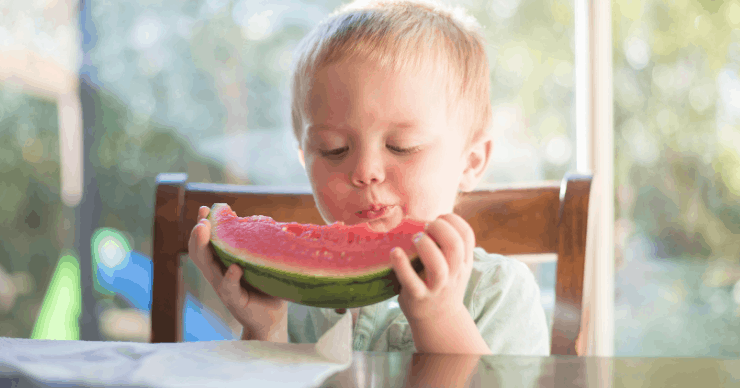
What Should I Do When My Kid Takes FOREVER to Eat?
My approach is simple: If kids are truly hungry, they will eat.
If they are sitting picking at food for two hours, they probably really aren’t hungry.
Sometimes as the parent, you need to take a step back and let your child listen to their own body and determine how hungry they are.
Of course, there are some kids who just get distracted or talk a lot and that’s why they’re sitting at the table last. I’m sharing some strategies to help you teach your kids to eat intuitively and keep mealtimes on track so that meals don’t turn into power struggles or 2-hour marathon meals!
RELATED: In this interview about kids’ eating styles we discuss both kids who eat very slowly and kids who gulp their food down in 5 minutes!
What Is Intuitive Eating? Does It Apply to Kids?
Intuitive eating means tuning in to your body so you eat what your body needs.
It isn’t just eating whatever or whenever you feel like it, and it isn’t the same as emotional eating.
Intuitive eating has to do with listening to your body’s natural feelings of hunger and satiety, which are caused by hormones.
Unfortunately, many of us have told our brains to stop listening to our stomachs and hormones for so many years that we’ve broken the ability to truly eat intuitively. We have to re-learn the entire process!
Kids are often more tuned into their bodies than adults. They might have trouble understanding or describing what they feel, but it’s easier to teach a child to eat intuitively than an adult with years of errant food programming to undo.
This isn’t a diet – in fact, it’s the exact opposite, in all the good ways.
6 Tips For Teaching Kids to Eat Intuitively
If you’re used to controlling when, how much, and what your child eats, I know it can be a bit unnerving to consider letting them take charge, but if we want to raise healthy kids with healthy eating habits (not just healthy nutrition) then we need to start teaching kids to eat intuitively.
We don’t want to set them up for NOT listening to their bodies later in life by interrupting all those hunger and satiety messages the body is working hard to send.
We don’t want to tell our kids, “Your body is wrong. Finish your food!” when they’re not actually hungry. This can cause dangerous overeating habits and more.
How about some easy “rules” to remember?
1. Don’t Let Snacks Overtake Meal Time
Begin with snack time.
If snacks are too satiating, kids might not want to eat at mealtime. If kids don’t have enough time to build up an appetite, they won’t feel and learn to recognize hunger signals.
Snack time should be about two hours before a meal, never any closer than 90 minutes. (And remember to keep the snacks away from the end of meals by 90+ minutes too – no bedtime snacking that teaches kids that dinner is “optional” because they know they’ll have a chance to get full soon afterward.)
How does this look in real life?
If your kids get home from school at 4:30 and it will be less than two hours before dinner, there’s no time for a snack!

Also, don’t forget that snacks shouldn’t be the same size as a meal! Offer small portions of whole foods—your kids should be satiated but not overfull.
If kids are getting “hangry” because dinner is taking a little too long, go ahead and set out veggies and dip on the table and call it an “appetizer,” not a snack. 🙂
RELATED: Ways to avoid hangry meltdowns with your kids!
“Mooooom, I’m hungry!!”
How many times do your kids ask for snacks each day? Wouldn’t it be a relief if they were empowered to prepare their own snacks, instead of coming to you and whining about how hungry they are?
Download and print:
2. Allow Kids to Stop Eating When They Feel Full
Don’t subscribe to the Clean Plate Club!
Please, please don’t enforce a rule that requires children to eat everything on their plates.
I know you (or someone!) worked really hard to make that meal, but forcing someone to eat when they don’t want to has both psychological and physical repercussions.
Appetite is natural.
Kids usually know when they are full.
And if they’re playing a manipulation game because they don’t love your dinner and want to leave, remember to hold fast to rule #1: No more food until breakfast!
3. Take Food Sensitivities Into Account When Kids Are Eating Slowly
Kids also know when they hurt.
An undiagnosed food sensitivity or acid reflux might be having a real effect on how your child eats at mealtime.
Think about a baby who is still taking a bottle or nursing. If it takes her two hours to eat, she’s probably throwing off her eating cycle or uncomfortable when she’s eating. Read here about breastfeeding a baby with food allergies.

We think about that a lot with babies! Do they have reflux? Should I cut out dairy? Is something causing gas pains? Is he just not hungry?
Take these things into consideration with your older children too, because they can still be issues!
It may be time to try an elimination diet and see if you can find the root of the problem. Sometimes kids are even drawn to the foods they are sensitive to, and that can cause some real issues as well.
Kids don’t need plastic knives. They need real skills.
Teach safe technique, focus, and confidence in the all-time fav lesson from our kids cooking class! (ages 2-12)
4. It’s OK to Set Limits on How Long Kids Are Allowed to Eat
If you have a kid who is kicking his feet and poking and prodding endlessly at his food, it’s okay for you to say, “You have 5 more minutes to finish up, and then we’re done.”
Some people (like me!) are slow eaters and seem to take forever to get through dinner but are eating the whole time. That’s very different from staring out the window, twirling hair, playing with peas, and taking a bite only once every 10 minutes.
We slow eaters (hopefully) are chewing better and maybe even more able to eat intuitively, because our bellies realize they’re satiated and we have a chance for our brains to get the message and tell us, “Stop,” before we’re too full.
If a 5 minute warning and other structures around mealtime are set up, children will get used to eating what they need in the expected time frame.
It’s also okay to limit certain foods if you think something is the only thing they’ll eat. (I’m looking at you, bread and carbs!)

Make a goal to always serve two to three food options at dinner, one of which you are pretty certain each child enjoys.
For the pickiest of kids, maybe just having that one bite on their plate is a big deal for a while, and you can wait on having them even try it. But one child can’t eat all the mashed potatoes when you have a family of six people!
Remember that telling a child the mealtime is over and they don’t have time to eat anymore, within reason, isn’t the same as the clean plate club. This doesn’t interrupt their ability to listen to their body.
Note: Some kids have physiological reasons they can’t chew or swallow well. Just like those infants, we want to be sensitive to that possibility. My colleague Mary is an expert at feeding challenges, and she always starts by making sure all the systems are in working order. Learn more about assessing your child’s mouth function with her.
“I just want my kids to eat what I make!”
This free 5-day challenge was made for you.

Spend just 30 minutes a day learning practical strategies that reduce mealtime battles and help kids build confidence with food.
5. “My Child is Underweight”—Don’t Worry About Weight Over Intuitive Eating
Parents are often concerned about weight, and not just kids gaining weight. Plenty of tiny kiddos keep their parents up at night worrying that they’re underweight, too. I’ve absolutely been there. But sometimes we need to remember now to worry so much about weight.
There’s a bell curve on the chart because someone is at every place!
If your child is alllll the way off the chart, then it may be time for concern and consulting with your doctor, but forcing an underweight child to eat almost always causes more problems than it solves.
If a child isn’t eating enough at a meal, their snack might be too satiating. Definitely pack in calories – give them nuts, coconut oil smoothies, etc. But it’s OK to give them a chance to get hungry for a meal without worrying about limiting snacking.
Appetite is natural.
Children know when they are full. But they also know when they hurt, and it may be that a “picky” child has an undiagnosed food sensitivity or acid reflux.
Keep in mind that our bodies are supposed to have cycles of eating and not eating. Kids need to have times between meals for their bodies to get hungry enough that they can begin to listen to those cues again.
RELATED: Check out this interview for more tips for teaching intuitive eating and talking to your kids about weight.

6. Remind Your Kids to Tune In to Their Bodies
I talk to my kids about different kinds of hunger so they’ll tune into their bodies to know whether they’re really hungry, or just “bored hungry.”
Even young children can start to understand a hungry tummy vs. a bored tummy vs. a sad tummy looking for comfort.
Kids will naturally balance themselves out if we let them listen to their bodies and learn to understand their signals of hunger and satiety.
Intuitive eating for kids is just as, if not more, important as it is for adults!
What’s your biggest obstacle teaching your kids to eat intuitively?
Further Reading for Teaching Kids to Eat Intuitively
- Learn your child’s eating style to end mealtime battles (one type is “intuitive!”)
- Raising healthy kids by focusing on habits rather than nutrition
- Avoid emotional eating habits with your kids
- Healthy body image for girls
- Fostering a healthy relationship with food in your kids
- Picky eating solutions using all 8 senses
- Solutions for picky eating from Dr. Kay Toomey, founder of the SOS Method of feeding
- Powerful eating habits and healthy body image

Leave a Comment