Chef James Barry didn’t solve his own picky eating until he was in his 30s!
In other words, there’s always hope. 🙂
Now he’s a dad and has watched his kids learn to eat PLUS done a lot of research, and he has an interesting theory on using the palate as the catalyst of change.
He feels it works well for highly sensitive kids in particular.
In this interview, we’ll talk about the many aspects of picky eating, including emotional, physical, chemical, and behavioral, and James will dig deep into his “palate first” model. You’ll hear about:
- When palate shaping starts (it’s earlier than you think!) and a critical age window to expand a child’s palate.
- The second critical age window, when a child sets his or her food habits
- Why mushroom baby food would be a great idea 🙂
- The most nutrient-dense foods on the planet
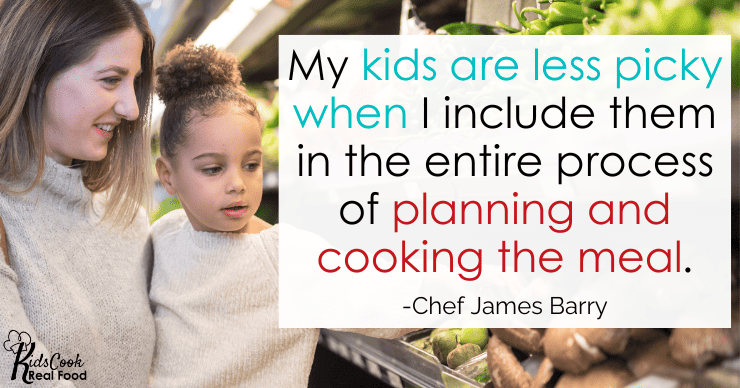
- Chef James said: “My kids eat better when I include them in the entire process.” cue Katie cheering!
- Why his advice is so much different from other advice out there
Oh and by the way, Chef James has a pretty cool resume, including cooking for celebrities such as Tom Cruise, Mariska Hargitay, George Clooney, Gerard Butler, Sean “Puffy” Combs, Barbra Streisand, and John Cusack. Fun!
Can’t see the video? Watch here on YouTube!
No time for the video? Here are the notes!
Shifting Picky Eater Palates
- 0:35: Today on the Healthy Parenting Connector I’m talking with Chef James Barry about picky eating especially when it comes to highly sensitive kids. We’re going to dive into some research-backed strategies to shift your kids’ palates.
- 2:40: Chef James shares his background with us, how he became a chef, and how he got interested in picky eating. He’s passionate about making healthy food easy and delicious!
I didn’t solve my picky eating until I was in my 30s! – Chef James Barry
- 5:38: There are more kids labeled picky eaters now than a few decades ago. Why is this? Chef James thinks there’s a combination of factors at play. Perhaps we are more aware and “diagnosing” picky eating more frequently than previous generations of parents did.
What Causes Picky Eating?
- 6:50: There are 3 categories of picky eaters: emotional, physical, or chemical. Picky eating due to nutrient deficiencies or being on the autism spectrum would fall into the chemical category.
- 7:20: For many parents, it comes down to the fact that we are supporting our children’s picky eating habits unknowingly by feeding our kids less nutritious food and being more permissive with what we allow our kids to eat or not. Our culture makes it very easy to short-order cook, and give our kids food that’s devoid of nutrients but marketed toward kids.
- 8:50: We know that amniotic fluid and breastmilk will change in flavor depending on what the mother eats so the baby is being exposed to a variety of flavors. Somehow we’ve bought into the idea that once a child is eating food their palate is fixed and it’s just the way it is.
- 9:56: The reality is that kids under age 2 have very flexible palates. They will eat non-food items if you give it to them! You have a window to expand their palate, don’t just give them the same bland baby foods. Pouches and jarred foods often fall into the same sweet flavor profile with apples as the base.
- 11:26: There are 5 flavor profiles: sweet, salty, bitter, sour and umami. Introduce them all to your toddler! Introduce fermented foods and bitter greens. Umami is not as commonly talked about. It’s in many proteins and organ meats, and vegetables like tomatoes and mushrooms.
- 12:47: From ages 2-10, you’re establishing a child’s behavior around food. Your family culture will inform their foundation for how they eat until/unless they choose to take charge of their own health and intentionally change that.
Most people don’t change their diets. They find their comfort zone and stay there. -Chef James Barry
Modeling Healthy Habits to Reduce Picky Eating
- 14:54: It’s fairly common for men to connect with their children through food. They come in as the “fun parent” who takes the kids to get ice cream for example. When you use food as a way to connect and celebrate a good day or console yourself after a bad day, you’re modeling for your kids that food is connected to those emotions. If you struggle with emotional eating in your family check out this post and this interview.

- 16:27: Chef James sees kids following in their parents’ own picky eating habits. If you want adventurous eaters, you need to model adventurous eating!
- 18:10: I know my husband and I model trying foods we’ve previously not liked for our kids to show them that sometimes our palates change and we want to keep trying things. My husband used to be a picky eater and has added several foods to his repertoire since his mid-30s after repeated tastings. “You don’t like that food yet! Maybe next time you try.” is a great phrase to use when your child dislikes something.
- 18:40: If you or your spouse are a picky eater there is hope! You can still be a picky eater when the kids aren’t around, but just be careful when they’re watching to not be overt about picky eating and let them see you try new things sometimes.
Cultural Expectations of Picky Eaters
- 20:37: Be careful of putting labels on kids. “She doesn’t like that” or “He won’t try that.” You’re just cementing that in their mind and showing acceptance of their picky eating. By your language and behavior, you can contribute to your child’s picky eating.
- 23:40: Our culture has the idea that kids only like bland foods: pasta, bread, chicken nuggets, pizza, all basic kid’s menu items. Chef James shares a study that showed that when kids were presented with a variety of whole foods they gravitated towards organ meats and bone marrow, in other words, the most nutrient-dense option that would benefit them the most in their stage of rapid growth.
- 27:10: Organ meats are one of the most nutrient-dense foods on the planet. Remember umami is the flavor found in organ meats. Umami is the flavor found in MSG and it actually makes other flavors taste better similar to how salt brings out flavors. This is why MSG is so prevalent in packaged foods.
Kids don’t need plastic knives. They need real skills.
Teach safe technique, focus, and confidence in the all-time fav lesson from our kids cooking class! (ages 2-12)
Shifting the Palate Incrementally
- 28:43: Chef James gives an example of how umami flavor from organ meats can change a child’s palate. He recently heard from a health practitioner who had a client who is a young girl on the autism spectrum who was only eating a handful of foods. The parents were concerned because she wasn’t getting very much nutrition from these foods.
- 30:32: Test it out for yourself and see if you can shift your own palate! For 2 weeks remove sugar, alcohol, starches, and high-carb foods including most fruits. In two weeks you can begin to shift your palate and change your health.
- 31:48: Many kids who are extremely picky eaters or problem feeders would notice and have a problem with a new seasoning blend on their few chosen foods. You can start super small. Use just a pinch of Pluck seasoning or add a couple of leaves of spinach to a smoothie. Every few days increase the amount.
- 34:00: The salty/sweet flavor combination is a pretty recent trend that food manufacturers discovered made people want to eat more of the food item. Frito-Lay discovered that if they had one really spicy Cheeto per every four non-spicy Cheetos in the bag people would eat more.
- 35:08: There is a balance to strike between flavors. You don’t want to lean too heavily into one flavor profile. Look at the recent charcuterie board trend where you have a variety of flavors and textures on one plate that you can combine in all different ways as you eat it. Think of a fancy restaurant salad and how many flavors and textures are combined there. People love playing with the balance of flavors.
“I just want my kids to eat what I make!”
This free 5-day challenge was made for you.

Spend just 30 minutes a day learning practical strategies that reduce mealtime battles and help kids build confidence with food.
- 36:25: I mention this interview with Elissa Arnheim. She told me to put sauerkraut juice into our condiments and after a while, my oldest started liking sauerkraut out of the blue.
- 37:31: If you have an extreme picky eater you should always look at the gut. The gut is the second brain and helps regulate many of these behaviors and chemical issues that can lead to picky eating.
- 38:05: Research has shown that if you try something enough times, you will start to like it. You will start to like what you’re eating rather than just eat what you already like.
- 38:48: Including kids in the process of meal planning, shopping, and cooking meals makes them more likely to try the food. It gives the kids agency and ownership over the meal.
- 43:45: Parents remember that picky eating isn’t just behavioral. The palate can be your way in and out of picky eating. Tap into those foods that are from a different taste receptor from what your child is currently eating. If they mostly eat sweet, start to shift to salty, umami, etc. in small increments.

- 46:21: Here’s a quick tip to train your palate to enjoy sauerkraut. Mix a little bit of kraut into cole slaw or use it as a taco topping along with your other favorite toppings.
- 48:35: Add Pluck seasoning or straight organ meats to ground meat for tacos or lasagna. Force of Nature has blends with mostly ground beef but about 10% organ meat. It isn’t enough to change the flavor especially when you’re adding this to a sauce or using taco seasoning.
Resources We Mention for Picky Eaters
- Join our No More Picky Eaters Challenge!
- Pluck seasoning (Use code KS15 for 15% off!)
- If you struggle with emotional eating in your family check out this post and this interview
- The Carol Davis study Chef James talked about
- Do you have a picky eater or a problem feeder?
- The interview with Elissa Arnheim where she mentions adding sauerkraut juice to condiments
 James Barry’s 16 + years in the culinary field started as a private chef cooking for celebrities such as Tom Cruise, Mariska Hargitay, George Clooney, Gerard Butler, Sean “Puffy” Combs, Barbra Streisand, and John Cusack. Most recently, James launched his first functional food product, Pluck, an organ-based seasoning. It’s the first of its kind and an amazingly easy and delicious way for people to get organ meats into their diet.
James is also a published cookbook author having co-authored the recipes in Margaret Floyd’s book Eat Naked and co-authored the follow-up cookbook The Naked Foods Cookbook. He most recently co-authored the recipes in Dr. Alejandro Junger’s book, Clean 7.

Leave a Comment