If you’ve ever thought, “Why can I not get my life together when it comes to time?”—you are absolutely not alone.
This conversation felt like such a breath of fresh air because we’re not talking about rigid schedules, perfect planners, or waking up at 5am (thank goodness). Instead, we’re digging into what actually works for real moms with real lives… you know, the kind where kids interrupt everything and plans fall apart before lunch.
I had so much fun hearing about Anna’s real-life experiences in the professional world, SO different than my life, and wait until you hear what we both have in common when it comes to being POOR at time management! I couldn’t believe her confession about getting in trouble at work for a time-related issue…
What I love most is that Anna brings so much grace and practicality to this topic. She doesn’t expect perfection; and honestly, that might be the most freeing part of all.
In this episode, you’ll learn:
- Why time management isn’t really about your planner (and what actually matters instead)
- A simple “mind sweep” method to instantly reduce overwhelm and clear your mental clutter
- How to figure out what actually deserves your time (and what you can let go of)
- Practical ways to involve your kids so you’re not doing everything yourself
- What to do when your plans fall apart (because… they will)
- A simple framework to handle those chaotic, stressful moments without spiraling
If you’ve been feeling scattered, behind, or just plain overwhelmed, this episode is going to meet you right where you are and give you a few doable steps to move forward.

Love the Handbook?
Find all the episodes of the Healthy Parenting Handbook here, or listen on your favorite podcast player:





Don’t forget to leave us a review on Apple Podcasts too! Thank you!
Can't see the video? Watch on YouTube →
YouTube Shorts for This Episode
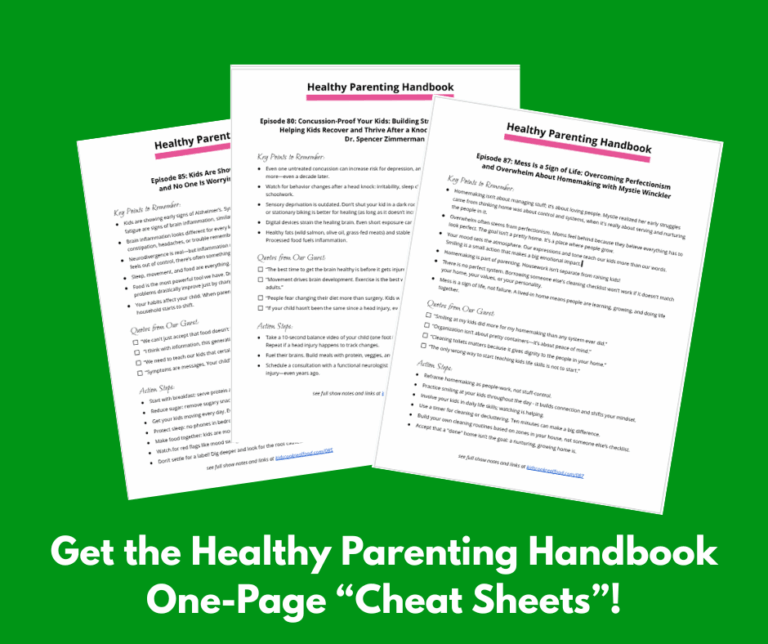
Turn expert advice into a handbook you can actually use.
I’ve interviewed hundreds of incredible experts on the Healthy Parenting Handbook podcast! Out of time to listen? You can skim on your phone!
These one-page summaries give you the highlights of every episode fast, so you can find what you need when you need it (and nothing to download).
100% privacy – You’ll also get Katie’s email newsletter with more practical tools for raising capable, confident kids. Change your preferences easily any time.
Key Takeaways about Time Management Strategies
- Time management isn’t about being perfectly on time or following a strict schedule, it’s about intentionally spending your time on what matters most.
- Most moms reach for planners, apps, and productivity hacks first, but real time management starts with clarity on your values, priorities, and vision.
- Overwhelm is the biggest barrier to managing your time well, and you have to clear the mental clutter before you can make better decisions.
“You don’t need a better planner, you need more clarity about what actually matters in your life.” – Anna Dearmon Kornick
- You don’t have to do everything yourself, and learning to automate and delegate tasks (even to your kids) is a huge part of reducing stress.
- Time management does not have to look perfect or structured, it can happen in small, flexible moments throughout your day and week.
Need More Help Getting Organized?
Here are some of our favorite tools:
- Megan Sumrell’s TOP training on how to plan, organize, and manage your life
- The SOS Planner from Anchored Woman is flexible and faith-themed
- Scoop Troop has all kinds of fun and colorful planners, stickers, calendars and more – and you can get 37% off with the code Katie when you check out!
- Sprout Kids has beautiful, Montessori-style toy storage if that’s an issue at your home!
Action Steps from This Episode
- Do a “mind sweep” by writing down everything in your head so you can clearly see what’s taking up your mental space. Here are Anna’s steps to the mind sweep:
- Cross off 10% that doesn’t matter
- Identify what can be automated
- Identify what can be delegated
- Focus on what truly needs to be done soon
“Let it be messy, because you’re learning, and messy is how progress actually happens.” – Anna Dearmon Kornick
- Go through your list and remove anything that doesn’t actually need to be done so you can free up time and energy.
- Identify tasks you can automate, like subscriptions or reminders, so you’re not relying on memory for everything.
- Look for opportunities to delegate, especially to your kids, so you’re not carrying the full load alone.
- Focus only on what truly needs to be done in the next 24–48 hours instead of trying to tackle everything at once.
- Use the CURVE method in stressful moments by asking what you can control, understand, resource, prioritize, and delegate.
Tap here for the episode transcript.
Time Management with Anna Dearmon Kornick
Host: Katie Kimball — Kids Cook Real Food
What’s more important — that you’re there for the people in your life and the things that you value, or that you made it to that dentist appointment five minutes early? Really, let’s think about it. That’s the way that I think about time management: the ability to spend your time on what matters most.
We’re talking about time management today on the Healthy Parenting Handbook Podcast — the podcast we all said we needed when we first became parents. Remember that feeling of, “Where is the handbook for this?” Now you’ve got one. I’m your host, Katie Kimball from Kids Cook Real Food, and I bring together experts in the fields of health, parenting, nutrition, and more to help you truly raise healthy, independent kids. Parenting is the toughest and most rewarding job in the world. Thank you for joining me today. I’d be so honored if you could find the time — manage your time — to leave an honest review, especially on Apple Podcasts, so that others can find us too.
My guest today is Anna Dearmon Kornick. She’s a highly sought-after Time Management Coach and keynote speaker, a top 1% globally ranked podcast host of It’s About Time, and founder of It’s About Time Academy. We’re talking all about time management today, and you’ll hear my confession that I’m just not very good at it. Anna is a true Louisiana firecracker who has become known for making time management fun. She helps busy professionals, business owners, and overwhelmed mamas struggling with overwhelm to manage their time using her personality-driven HEART method.
Anna is building on more than a decade of experience in the fast-moving, high-stakes world of political and crisis communications. Her stories are so much fun, but it’s no surprise that Anna thrives on creating order out of chaos. Early in her career, she wrangled media for a lieutenant governor and managed the hectic schedule of a U.S. congressman. Her rapid-response background and relentless approach to problem-solving position her as the go-to expert for purpose-driven time management for busy mamas.
She’s also a mom of two girls, ages six and four, so she’s bringing all the experience of the professional world and the personal world to us today. Anna, thank you so much for being here. I was on time because it was in my calendar, but for anything that’s not in my calendar with someone else keeping me accountable — forget it. My time management is in the pit. I’m thrilled to get some new ideas from you today. Tell me a little bit: how did you get started in this? Are you naturally organized when it comes to time?
Katie, thank you so much for having me. As much as I would love to tell you that I was born a time management unicorn who has always been perfect at it, that is not the case at all. I used to be considered the late friend among my friend group — the one where they would give a 6:30 time when the reservation was actually for 7:00. That was my life. I recently celebrated my 40th birthday, and my friends surprised me with a cookie cake that said “Better Late Than 40” — because I’m the Time Management Coach who used to be the perpetually late person.
When I worked in crisis communications, my boss called me into her office and sat me down with a list of every single time I had been late that quarter. Turns out I had been late to work 17 times in one quarter. That was an incredibly eye-opening, rude awakening, mortifying — all of the things. So I’ll just say: if the late friend who was written up for being late to work 17 times in a quarter can turn things around and literally write a book about time management, you can too. You’ve got this.
I feel like that just makes me love you more. If you had been born perfectly organized, I’d think, “Most of this won’t apply to scatterbrained people like me.” So I’m thrilled to hear it. Was getting written up your turning point? Did it freak you out, or where did you start to change?
Wouldn’t it be great if that was the actual turning point? But truthfully, it wasn’t. My first job right out of college was as a scheduler for a U.S. congressman. My entry into the professional working world was managing someone’s calendar — not just during the work day, but literally minute by minute from the time he woke up until he went to bed at night. Extreme time management coordination for a congressman.
I really enjoyed that job because it was all about creating order out of complete chaos. When you are that type of elected official, you’re being pulled in so many different directions, and I learned so much in that first role. But managing someone else’s calendar really well didn’t mean I was applying those same strategies to my own life.
If I had someone telling me what to do minute by minute from when I woke up — I don’t know if you know Gretchen Rubin’s framework, but I’m the rebel. I’d be like, “That’s exactly what I don’t want to do.”
I have to work on that as well. I’m a questioner that leans rebel, which shocks so many people, because I think a lot of people expect that a Time Management Coach is going to be an upholder. Not only does it have to make sense, but I still have to talk myself into doing it. I get it.
I loved working in D.C., but I’m from Louisiana and I really started to miss home. So I moved back to be closer to my family and friends and kicked off a 10-year career in crisis communications and government affairs, where literally every single day was some type of disaster. I’ve worked through oil spills, hurricanes, droughts, floods, plant explosions, and nonprofit embezzlement schemes. I’ve assisted university presidents whose universities were on the brink of financial collapse. And then there was one nude swimming scandal at a restaurant that just about broke me.
This is like being a mom at a national level — being a CEO of a household — because it is always a disaster, including probably some nude swimming incidents.
How many moms have experienced their own nude swimming scandal with kids? The toddler who runs out the front door in a birthday suit — hilarious.
As much as I loved that crisis communications work, being there for people in their darkest moments — when they don’t know if their business is going to make it, when their reputation is on the line — it’s really heavy. In an effort to be there as much as I could for these people, I wasn’t there for myself, and I slowly started sliding into true burnout, where everything was about work and deadlines. I was engaged at the time and knew I wanted a different life. There was no way I could continue working myself to sickness and also have a family, because that’s what I really wanted.
After one too many mornings spent crying in the stairwell on the way to my windowless office, I decided something had to change. I knew there had to be a way to combine my time management experience, my struggle with burnout, and my love of helping people create order out of crisis. Little by little, my path to getting my life together helped me realize that there is a way to turn things around.
It’s really complicated if you try to do it yourself. There are so many books, resources, podcasts, programs, and systems out there, and it should not take reading 37 different books to figure out how to function as an adult. One book would lead me to three more, which would lead me to some missing piece — so frustrating. And then, one day, someone asked me to speak to their group about time management, which completely blew my mind. Something was happening on the inside that was being reflected on the outside.
I’m a big believer in definitions. When you define time management, what are all the components? We’ve already talked about showing up on time, but that feels like a tiny slice. What else do you put in that bucket?
This is probably going to be the exact opposite of what you expected. I define time management as the ability to spend your time on what matters most. That’s it. Because sometimes you might be late to an obligation because you were taking care of a child, or you were having a conversation with a friend that needed to happen. What’s more important — that you’re there for the people in your life and the things you value, or that you made it to that dentist appointment five minutes early? That’s the way I think about time management: the ability to spend your time on what matters most.
It feels like it’s a mindset thing — making decisions in real time. Is that what you train people to do?
Absolutely, because that’s so much of it. For so many of the women I work with — whether they are moms, professionals, or a combination of both — the biggest mistake we make when we want to turn our time management around is that we reach for a new planner: “Let me go buy a new planner that’s going to get my life together,” or “Let me download a habit tracker app.” We reach for planners, trackers, and productivity hacks.
But the truth is, good time management does not start on the pages of our planners or our color-coded digital calendars. Good time management starts by getting to the heart of what matters most — by getting crystal clear on your vision, your values, and your priorities. Because once you know without a doubt what’s most important to you and where you are going in your life, every single decision you make about how to spend your time becomes so much easier.
I was literally just about to ask for some quick hacks, and then you said, “No quick hacks.” Moms really want to take control of chaos. You would not believe how many moms email me saying they’re so overwhelmed they can’t even sign up for a free event — they don’t have the capacity to enter their email address. There are too many priorities. If you prioritize everything, you prioritize nothing. What would you say to the chaos moms? Where do we start?
When we want to get our life in order and figure out our time management, we start reaching for tools. But we have to unravel the overwhelm first in order to create the capacity — the brain space. We have to create the capacity to even make decisions about what our vision, values, and priorities are.
In my program, It’s About Time Academy, we start with overwhelm. We start by unraveling that overwhelm, because it’s almost like the first step before the first step. If you’re coming into this feeling good and not overwhelmed, create that vision, run with those values, make it happen. But most of us are so bound by all the things we’re carrying that coming up with a vision feels insane — like, “I can barely remember to brush my teeth in the morning.”
Short of nuclear bombing my Google Calendar and saying I’m not doing anything for the next month — how does one unravel overwhelm?
Whenever someone is completely scattered and swirling, I love to have them start by doing something called a mind sweep. It’s very similar to a brain dump, but I like to think of it as the brain dump’s smarter, classier cousin. A brain dump is like dumping a junk drawer out on the floor — everything flies in different directions. A mind sweep is very intentionally creating little piles of all the mess.
Essentially, you grab a pen and a blank sheet of paper and get everything out of your head. A good way to approach this is to think about the different categories of your life. Start with life in general: What is everything on your mind pertaining to home life? Appointments that need to be scheduled, permission slips that need to be signed, sports sign-ups, lesson plans — anything home-related. Then think about the professional side: What work-related things are taking up space in your head? I actually have a mind sweep trigger word list that helps you sweep out every nook and cranny in your brain that you didn’t even know existed.
The more you get out of your head and onto paper, the lighter you begin to feel, because you cannot organize what you can’t see. But we don’t stop there, because it’s easy to look at this list and think, “How am I going to do all of this?” And here’s the best news ever: you don’t.
What you just did is empty out your head and create the space to make sound decisions. My first recommendation is to look at this giant list and see if you can cross off 10% of it — just let it go. So often we are holding things in our heads that don’t even need to be done. They’re shoulds — things we think we should do based on other people’s expectations, or expectations of ourselves that are too high, that are holding us back from doing the things we actually need and want to do. Even if you can’t eliminate 10%, the process of thinking critically about what’s on the list is so powerful.
Once you see what you can eliminate, look at what can be automated. Automation can sound like a weird word — it makes me think of a factory building a car — but it’s as simple as putting your pet food on Amazon Subscribe & Save, or setting a reminder to change the air filters instead of carrying that in your head. I’m not saying to start automating things right now; just identify them and put an A next to those items so you can come back to them.
Then look at what can be delegated. This is a big pain point for a lot of us as moms, because we tend to hold on to the belief that if we’re not doing everything, then we’re not doing enough — and that’s just not true. What on this list can be delegated, whether to a partner, a spouse, a caregiver, one of your children, a babysitter, a housekeeper, a neighbor, or a co-worker? We don’t have to do every single thing. And delegating tasks to your kids can create an awesome sense of independence, accomplishment, and pride in the responsibilities they’re given.
You’re preaching to the choir. This is what I tell people: our kids need life skills and responsibility. Yes, it’s harder to slow down in the beginning to do the teaching, but the return on investment is so huge. A lot of parents have that roadblock of “it’s faster and easier to do it myself today,” even though over the next five years it would be far better to invest time this week to teach the skill to the kids. Good to hear you echoing the same thing — this is good for your time management, mamas.
It’s an investment, yes. We do it with my six-year-old. She’s in charge of what we call “resetting the living room” after dinner — she puts all the pillows back on the sofa, puts all the blankets in the blanket basket. The first few times it wasn’t perfect. But who cares?
Do you remember how long it took before you were completely hands-off? I’m sure for a while you had to keep walking her through the checklist.
I did it with her the first few times — modeling the process. So many parents get frustrated when they tell their kids, “Clean your room,” but if the kids have never been taught how to clean their room, how are they going to know what to do? It’s not fair to expect them to automatically know. Now it’s, “Millie, can you handle resetting the living room all by yourself?” And she’s excited because she gets to do it independently.
So: based on what’s left after eliminating and automating and delegating, everything remaining should be things that you — and only you — can do, or things that you actually want to do. Once you can see that, ask yourself: which of these is most pressing? What actually needs to be tackled in the next 24 to 48 hours to avoid some kind of dire consequence?
When we’re carrying so much, everything starts to feel urgent and important, and then we don’t know what to spend the most time on. So we end up picking the thing with the least resistance — the easiest thing — rather than the most important thing. Then we get frustrated and hard on ourselves when the most important thing still isn’t done.
Using the framework of “what has to be done in the next 24 to 48 hours or there will be a dire consequence” gives you clarity. You’ve gotten everything out of your head, identified what to let go of, identified what can be automated and delegated, and identified what you must do immediately. Now you can decide: when will I delegate these things? When will I set aside time to create these automations — whether it’s an Amazon Subscribe & Save or adding reminders to your calendar so you’re not carrying the weight of remembering when to do the dog’s heartworm prevention?
This could be a repetitive process. How often should moms do a mind sweep?
After you do your first mind sweep, it might feel a little clunky or awkward. You might wonder if you’re doing it right — but practice makes progress. I find it really helpful to do it once a week, as part of a weekly planning session, to sit down and get everything out of your head. The coolest thing is that after you do that first one, subsequent mind sweeps are a lot less chaotic. The first one gets everything out; after that it becomes maintenance.
Once a week is fantastic — alongside meal planning, kid pick-ups and drop-offs, and all that. You can even do a mini one at the start of each day. If you sit down — or you’re standing at the kitchen island — and you feel that swirl, grab a sheet of paper and get whatever’s in your head out of your head and onto paper. You’ll feel so much more clarity and be able to make better decisions.
I do this — I’m looking to the side because I have the back of a graduation invite, the back of an envelope, various brain dumps with crossings-off and arrows and highlights and circles. One of my cynical questions: what do you do when the plan for the planning falls apart? If I put weekly planning in my schedule for Sunday afternoon, but then there’s a baseball tournament all day, or two graduation parties in a row, or friends over — and it’s Monday morning and you have not done your weekly planning, you don’t know what’s for dinner all week?
It happens, especially when we have it in our heads that we plan every Sunday at 2:00 p.m. sitting at the dinner table with a cup of coffee while the kids do XYZ — which is what it looks like on Instagram.
A couple of weeks ago I led the “Take Back Your Time” challenge, and one of the VIP bonus sessions was called “Watch Me Plan My Week.” I literally sat down at my kitchen table on Zoom and talked through how I plan my week — and my kids screamed in the background, interrupted, brought me stuff, waved to everyone. In the middle of it I found out the last day of school had been changed. Just a chaotic, real-life situation.
When people ask me what my weekly planning session looks like, the answer is: it is not in my calendar at a specific time every Sunday. Sometimes it doesn’t even happen on Sunday. Sometimes it happens Saturday morning because I know all day Sunday we’re going to be at activities or at a family member’s house. A lot of times it happens in sporadic, fragmented chunks.
Sunday morning I’ll stand at the kitchen island, review my calendar for the week ahead, identify the tough spots, make sure I’ve got transition time plugged in and know who’s picking up the kids. Then around lunchtime I’ll chat with my husband about his week — he handles meal planning and grocery shopping in our family, so we have that conversation and he puts the grocery list together. Then in the evening while the girls are in the bathtub, I check the weather and head to their closet to pick out their clothes for the week — making sure they have shorts, underwear, their camp shirts or school uniform shirts.
That’s not what people expect when they hear “weekly planning session,” but it’s not about having an Instagram-perfect session. It’s about making the decisions that need to be made, however you have the capacity to make them. Let go of the idea that your weekly planning session has to be time-blocked at a specific time every single Sunday. The point is to make the decisions that set you up for success.
That is so encouraging to those of us for whom time blocking has never worked — I always felt a little allergic to it. And you just shared a great hack: you set out your girls’ clothes for the whole week at once. It’s like batch cooking, but batch outfitting.
Exactly. One of them wears uniforms to school, and right now — as we’re recording this — next week is the first week of summer day camp, and they have a camp shirt they wear every day. I’m not a morning person, so setting out their outfits on Sunday is a gift to myself. It makes our mornings so much easier.
This has been super helpful. I love thinking about time management more as a mindset, more about making decisions. The mind sweep is awesome — thank you for walking us through that. Tell us about the freebie you have for our audience, and you have something called the CURVE method. We won’t go into all of it, but I want you to tell us what CURVE stands for.
Blueprint to Balance is a video course that walks you through the process of creating your own personal blueprint to your version of work-life balance. It’s all about your version and your way of thinking, because one of the biggest frustrations we experience when getting our time management together is that we try a system someone else created — but it wasn’t designed for the way we think. Maybe it was designed by an upholder, so it works for upholders, and then us questioners-leaning-rebel are left wondering why our brains are broken. Blueprint to Balance walks you through the steps of creating your personal blueprint based on the way you think and what your life looks like. You can grab it at blueprinttobalance.com. That’s the best way to get a preview of my method and philosophy around time management.
I’m literally opening that in a tab right now. And what is the CURVE method — the 30,000-foot overview?
The CURVE method is so perfect for moms. It was actually born from a day last summer when I got the dreaded call from daycare that there had been a lice outbreak. I realized that despite having never dealt with lice before, I calmly and clearly knew what to do. As I thought about why I was so calm, I realized it’s because the first thing I did was ask myself: what can I Control?
In most crisis situations — and I think we can all agree that lice is a capital-C crisis — I had to ask myself, what can I control? I could control the way I showed up for my girls. I could freak out and panic, or I could turn the day into a party: get Starbucks and Happy Meals, queue up the Bluey episode called “Nits,” and then watch Tangled after. We literally turned it into a party, because that’s what I could control.
Then U — what did I need to Understand? I needed to understand how to clean the house, what to do with hair brushes, whether we needed to burn the house down. What do we need to understand?
Then R — what Resources do I need to successfully navigate this? I had Google to give me answers. I had a family friend who had recently been through this and recommended a professional nitpicker, who we hired to come to the house.
Because in a crisis situation we tend to run around like a chicken with our head cut off, I then asked myself: what’s most Vital for me to do right now? The answer was to be there for my girls, because this was going to be stressful for them. I didn’t want them to feel yucky or gross, and my four-year-old can barely sit still. So I canceled all my meetings for the day, because the most vital way to spend my time was to be there for them.
And then E — who can you Enlist for help? The second I got off the phone with daycare, I called my husband and sent him the link I’d found. He started stripping beds, pulling hair brushes, and queued up Bluey so it would be ready to go as soon as they got home. We don’t have to do everything by ourselves.
So when you get one of life’s curveballs — a sick kid, a flat tire, the dreaded lice call — ask yourself: What can I Control? What do I need to Understand? What Resources will help me through this? What’s most Vital for me to spend my time on? And who can I Enlist for help? You don’t want to wait until you’re in the thick of a crisis to figure out how you’re going to handle it. Next time you find yourself caught off guard, you don’t have to panic. You can just CURVE.
I always ask my guests to end with either a practical step or a message of hope — and you just did both at once. The mind sweep and the CURVE method are both so practical. I hope people are writing down C-U-R-V-E. Your message of hope is so clear: anyone can do this, and your life doesn’t have to be structured in order to manage your time. What are the last words you want to say to the audience?
I want to encourage you — because I know we probably have an audience full of perfectionists or recovering perfectionists — to let it be messy. Think about what it’s like when your kids learn something for the first time, when they try something new. We’re just grown-up kids. It is more than okay for mind sweeps to be messy, for lists to be written on the back of envelopes, to show up late to the dentist because you were teaching your three-year-old how to tie their shoe. Let go of the perfection, and remember that good time management is all about spending your time on what matters most to you — and you are the only person who can decide what that is.
Thank you so much. Anna Dearmon Kornick has been here with us today — nationally ranked podcast host of It’s About Time and founder of It’s About Time Academy. Run, don’t walk, to grab that freebie at blueprinttobalance.com. Thank you so much, Anna, for spending time with us today.
All my pleasure. Thank you.
Thank you for listening to this episode of the Healthy Parenting Handbook. I’m Katie Kimball from Raising Healthy Families. I hope your brain feels fed, your heart feels full, and you feel connected knowing that there are other parents out there also trying to raise healthy, independent future adults. Look up the Healthy Parenting Handbook Podcast wherever you listen. Download some interesting-sounding episodes. Subscribe, subscribe, subscribe — so helpful and appreciated. If you’ve got 60 seconds, thank you in advance for leaving an honest review on Apple Podcasts. And if you prefer reading, or you heard something today and thought, “What did she say? I need a cheat sheet for that” — we make those too. Get those quick-skim notes at raisinghealthyfamilies.com/handbook. Email subscribers get them all the time.
The Picky Eater Playbook: Get Pre-Order Bonuses!

My first traditionally published book releases November 10, 2026! The Picky Eater Playbook: Stress-Free Strategies to Jump Start Healthy Eating Habits in Kids is packed with real-life stories, flexible strategies, and step-by-step routines to turn dinner from a power struggle into something the whole family can enjoy.
If you’ve done the No More Picky Eating Challenge and want to have all my strategies at your fingertips, it’s the perfect resource! Or if you’re just beginning to tackle dinnertime struggles at your house, it will walk you through my whole system for eliminating picky eating.
Pre-order now and get some amazing bonuses!
Learn More about The Picky Eater PlaybookResources We Mention for Time Management for Moms
- Get Anna’s Blueprint to Balance here
- Buy Anna’s book, Time Management Essentials: The Tools You Need to Maximize Your Attention, Energy, and Productivity on Amazon or Bookshop.org
- When we talk about being an “upholder” or a “rebel,” that’s from Gretchen Rubin’s book The Four Tendencies.
- Learn more from my interview with Megan Sumrell about managing your time, and check out her TOP program for a free training on getting your life together!

Anna Dearmon Kornick is a highly sought after time management coach and keynote speaker, top 1% globally ranked podcast host of It’s About Time, and founder of the It’s About Time Academy. A true Louisiana firecracker who has become known for making time management fun, Anna helps busy professionals and business owners struggling with overwhelm manage their time using her personality-driven HEART Method.
Building on more than a decade of experience in the fast-moving, high-stakes world of political and crisis communications, it’s no surprise that Anna thrives on creating order out of chaos. Early in her career, she wrangled media for a Lt. Governor and managed the hectic schedule of a U.S. Congressman. Her rapid response background and relentless approach to problem-solving position her as the go-to expert for purpose-driven time management for busy professionals.

Leave a Comment