
I actually HUGGED my to-do lists, all of them, during this interview!
My guest Megan Sumrell warned me that she was going to tell me task lists are no good. I added that to my list. 😉
If you’ve ever felt like you have too much to do, too many demands on your time, or like you’re bound to that to-do list, this episode is for you!
We discuss:
- Why traditional time management systems often fail to address the emotional and mental load
- The difference between task lists and plans
- The challenge of estimating how long something will take (spoiler: I’m terrible at this!)
- Why that time right after school deserves to be called “running the gauntlet” and how to reduce anxiety about that time of day
- Whether tech is a help or a hindrance to productivity
- Some incredible tips for building routines with your little ones and teaching tweens and teens how to begin to manage their own time effectively
- The connection between time management and a financial budget
- Why you shouldn’t feel guilty for “not being on top of everything”
I learned a lot about myself and why I sabotage my own to-do lists even as I cling to them, and I hope you get to introspect as well!!
Find all the episodes of the Healthy Parenting Handbook here, or wherever you get your podcasts:





Don’t forget to leave us a review on Apple Podcasts too! Thank you!
Can’t see the video? Watch Time Management for Moms here on YouTube!
No time for the video? Here are the notes!
Time Management and Planning for Moms
- 1:29: Today I’m talking to Megan Sumrell who says to-do and task lists do not work and we’ve got to ditch them. Today she’s going to tell us what to do instead.
- 3:00: Megan shares her story with us. She was a math major in college and worked in IT for 20 years. She took a step back and realized she was losing herself as she endlessly chased after finishing her to-do list.
- 5:00: Megan ended up totally rethinking how to plan and manage her time. Instead of making teams and projects more efficient, she used the same principles she’d used at work to make her schedule more efficient.
- 6:00: Now that Megan is 12 years into this journey of time management, she has enough time to enjoy hobbies like learning the cello, crafting and spending time outside.
- 6:32: My daughter is a rising junior in high school and she’s already starting to worry about what she is going to do with her life. I think she’d really love Megan’s system and she’d be really good at helping people manage their time like this!
- 6:50: Men and women are fundamentally different, there’s no right or wrong, just different. Women tend to carry the heavy weight of the emotional load of our families whether that’s caring for aging parents, helping siblings and friends, or being a mom. There are lots of traditional time management systems out there but they’re really built for men. They miss two key components of time management for women: the emotional load and the information overload we experience through technology.
- 8:14: Let’s define work/life harmony. The term balance can actually create more overwhelm. Think of a gymnast on a balance beam, literally every part of their body needs to be engaged to stay balanced. Harmony is a pleasing arrangement of parts. If our life is arranged daily, weekly and monthly in a way that is pleasing and serving us there is harmony.

Kids don’t need plastic knives. They need real skills.
Teach safe technique, focus, and confidence in the all-time fav lesson from our kids cooking class! (ages 2-12)
The Drawbacks of Traditional To-Do Lists
- 10:08: If you look up books written off about productivity or time management 97% of them are written by men. They’re very corporate focused, meaning a lot of the systems can work really well if you have a life where you go to your office, home goes away, you stay fully focused on your job for your eight to 10 hours, and then you leave your work and reenter your personal life again. But none of this accommodates the reality that so many, especially moms are working with today.
- 11:47: Females have been running households for millennia. Have we always been this overwhelmed? The emotional load women carry has always been there, but the expectations on moms have increased a lot in recent decades. When Megan was a child, she did soccer as her one activity and walked to practice once a week. Now kids are in activities where they have practices several times a week, travel on weekends, and they need to be driven around to everything.
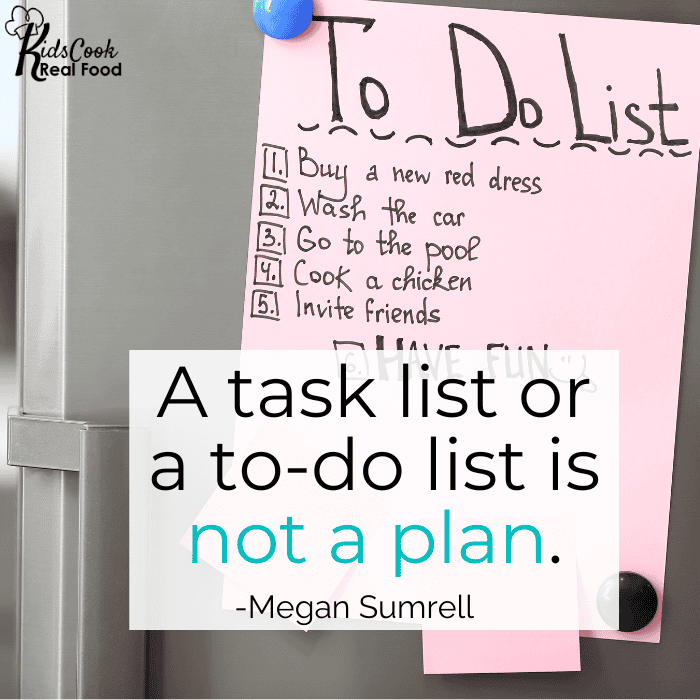
- 14:02: I have many, many to-do lists and I love them! Megan says to-do lists are no good, but what’s wrong with them? The short answer is this: a task list or a to do list is not a plan. We think we need to write everything down to reduce our overwhelm, but then we have a mile long list and no plan to execute any of it. Queue overwhelm.
- 15:41: To-do lists are missing two things: prioritization and time allotments. We just write things and don’t consider how long they will take, so we think the whole list needs to be done today, but maybe the entire list would take 45 hours to complete. Then we fall into bed feeling like a failure for not completing our list when it was an impossible task from the very start.
- 16:59: Making a task list like this is like if someone gave you a list for the grocery store and an envelope with money in it, but you didn’t know how much money you have to shop until you get to the register to pay. Megan shares more details on this analogy.
- 17:42: One of the most taxing things for our brains is to make decisions. Many parents have learned with little kids to just give them two options to choose from because they will be overwhelmed by more choices. If I ask you if you want an apple or an orange that’s a doable decision. If I show you a basket with 18 types of fruit in it, your brain will react with a fight or flight response when asked to make a choice.
- 18:47: If you give your brain a list of 1725 things to do, it will go to the quickest win as the way to feel good the fastest. 9 times out of 10, that quickest item is not the most important, but it’s what you’re drawn to first because it feels good to get something checked off the list.
- 19:16: Now because you’re doing all the quick little tasks first, you’re going back to your list over and over making many decisions throughout the day. Then by 5 o’clock you have decision fatigue.
- 19:53: I write my lists in priority order, but then I jump around because I’m looking for a quick win to get that dopamine hit. Sometimes we skip around because we only have 10 minutes, but priority number 1 will take 60 minutes, that’s a bit different but can still lead to decision fatigue.
- 20:43: Most people work from a calendar where they schedule things that involve other people, appointments, meetings, practices, pickups for kids, etc. Separate from that we have an average of 4 to-do lists that we’re working from at any given time. All day long then we’re going back and forth and back and forth between our calendar and our lists.
- 21:20: What we need to learn how to do is create a planning system that takes both of those and integrates them together. The things that would live on your traditional task list, start turning into appointments scheduled in on your calendar. Small tasks, think 5 minutes or less, can be reminders on your calendar set on a specific day.
Realistic Time Estimation
- 25:08: The whole purpose of this system is to get realistic about how you’re spending your time and how much you can get done in a day so that you can stop feeling overwhelmed by everything you “should” be doing and focus on what you actually can accomplish in a day. Most of us under estimate how much time a task will take by a lot.
- 27:18: For any recurring tasks that you do daily, weekly or monthly, start timing how long it takes. Write down a list and start tracking and recording how long each task takes. Then use that data when you’re scheduling your tasks each week.
- 29:00: Is technology helpful in this time management system? Some women do this 100% digital and some are paper people. If you have a tool that’s working for you, stick with it and use this system with that planner or software. Here are some tips for using a bullet journal for planning.
Empowering Children Through Time Management
- 30:38: Moms with kids in school will understand what Megan calls “running the gauntlet” in the afternoons. This is the time between the kids getting home and bedtime. Megan blocks this time off in her calendar every week as a signal to herself that she’s in “mom mode” and won’t be able to complete to-do list tasks during these hours.
- 32:51: When you’re budgeting, you have certain non-negotiable bills that come as first priorities when you get your paycheck, the same is true of budgeting your time.
- 34:55: Yes, we want to work on time management for ourselves, but we also want to help our kids build some of these skills. Megan shares some details about how she works with her daughter to teach her time management.
- 37:54: Megan was a #LifeSkillsNow season 2 camp leader and she taught on how to break a large project up into smaller steps. Time management and task planning are not taught in schools, but they are necessary for living well.
Time management and planning are learnable skills. -Megan Sumrell
- 38:11: Megan gives us a preview of her #LifeSkillsNow season 3 workshop. She’s teaching kids how to take notes better.
- 40:04: Megan uses a Family Communication Center with her family each Sunday so that they’re all on the same page going into the week. Here’s a whole interview about the benefits of having a family meeting each week.
Leveraging Routines and Technology for Productivity
- 43:49: Young kids love routines. You can start when they’re infants with simple routines around waking up, feeding and bedtime. A common pitfall people experience is tying routines to a clock. Instead of attempting to stick to specific times, make your routines about the order you do things.
- 45:12: Involve your kids in developing your routines. Guide through all the things you need to do before leaving the house and involve them coming up with a routine that works.
- 46:35: It reduces kids’ anxiety to sort of know what’s coming next even if your routine isn’t linked to times. On days off school, in the summer, the routines can stay the same whatever time you start.
- 47:42: The ultimate goal is that a lot of these routines start to become habits.
- 50:47: We leave you with the top priority, the super practical step, the quick win you can do immediately. Megan says to go into your phone and disable all your notifications. Having zero notifications will free up more time than you realize because you won’t be getting interrupted all day long.
- 51:49: Megan has an app called ThePinkBee app and you can follow her on social media to find out more about her planning system.
Resources We Mention for Time Management
- See Megan’s workshop in #LifeSkillsNow Season 3
- Tips for using a bullet journal
- How to have a weekly family meeting
- Find Megan online here
- Listen to her podcast
- Follow her on social media: Facebook, Instagram, Youtube, Pinterest
- How to plan, manage and organize your life free workshop
- ThePinkBee app
 Megan Sumrell is a former corporate executive turned entrepreneur. As a business owner, mom, and wife, she knows exactly how hard it is to juggle #allthethings while still maintaining your own sense of self and purpose.
As the CEO and Founder of The Pink Bee, she took her 20+ year career in systems and processes and applied it to all things time management, organization and productivity.
She is the creator of the TOP Program and TOP Planner, a program and planner that teaches her proprietary planning and time management system.

Leave a Comment