
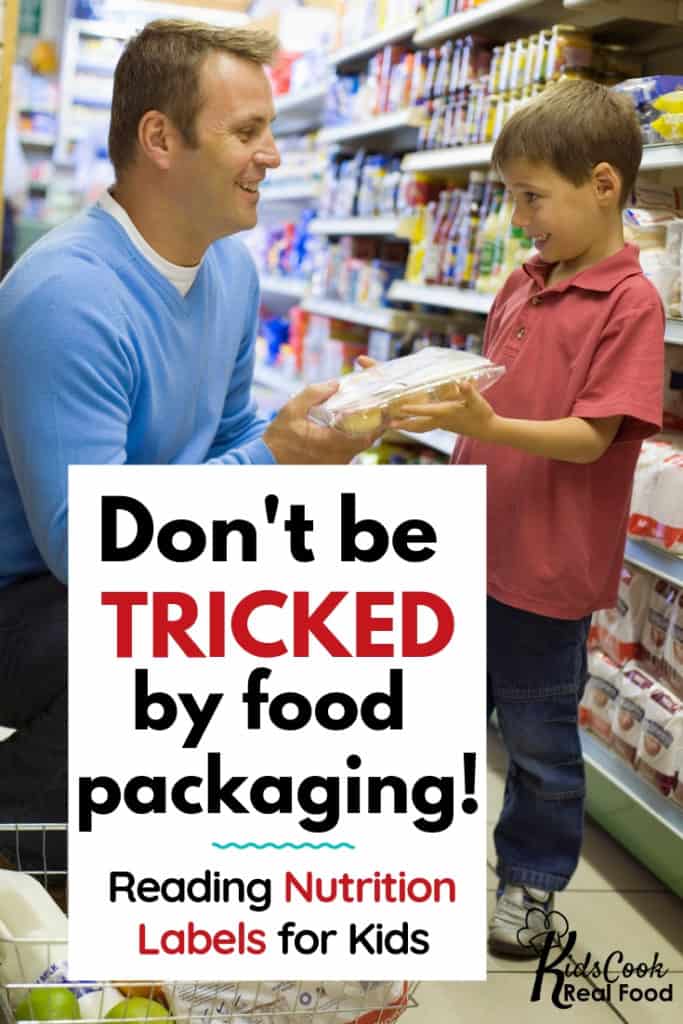
Don’t be TRICKED by food packaging trying to tell you something is healthy using sneaky language!
This video is meant for kids ages 8-18 and adults who love them. I explain the truth about low-fat foods, is “whole grain” healthy, the 2 ingredients banned in our household (and how to find them), and a quick reminder of how sneaky sugar hides in too many places.
You’ll see actual ingredients lists and packaging to practice your new skills right away! Teach your children how to read food labels without being tricked.
If your kids aren’t with you right now, that’s ok – just click here to get an email so you can always find this (plus part one and the worksheet for that).
Teaching Kids How to Read Food Labels
Check out Part 1 first to learn how to read nutrition labels and ingredients lists, the differences between good and bad fats, why calories don’t matter, and even a bit on the NEW nutrition label format.
As you watch, there may be a few lists of words you want to save for later – of course you can take a screenshot, but you can also find more info here:
Here are the slides if that helps anyone – you are welcome to use them to share with as many kids (or adults) as possible! 🙂
Can’t see the video? Click to watch “Teaching Kids to Read Food Labels” on YouTube.
No time to watch the whole video? Here are the notes!
How to Read Food Labels Without Being Tricked
- 0:33: Today we’re talking about the tricks that food marketers use to try to get you to think that a food is healthy for you!
- 1:06: Low sugar, reduced fat, sugar-free, lite, 100 calories, diet, whole grain, low fat, % less sugar, and heart health are all buzz words marketers use to convince you something is healthy.
Low Fat = More Sugar
- 1:23: We’ll start by looking at reduced fat/fat-free food. For a long time, fat-free was everywhere in America. Thankfully, we’re starting to get past that fad. Low fat usually means more sugar! Fat also helps your body absorb vitamins and minerals from your vegetables.
Even if it’s important in your family to cut down on fats, never eat fat free foods. Just look for other ways to cut fat, like not adding butter. -Mrs. Kimball
Whole Grain Buzz Words
- 2:55: Next let’s look at whole grains. Some of the phrases you may see on bread, cereals, and other grain products are 100% whole wheat, whole grain, made with whole grains, stone-ground, cracked wheat, multigrain, and wheat flour. I share a story about a time I was teaching my husband’s mom how to read nutrition labels. The only way to know that it’s really all whole grains is if it says “100% whole wheat.”
- 5:11: See a diagram of a wheat seed. There are 3 parts to the wheat seed. The endosperm is the food for the plant and it’s all starch. That’s what makes white flour. The germ has vitamin E and healthy fats. The bran is mostly fiber. So is it healthy to eat wheat? Ask your parents on that one! 😉
- 6:30: If your family does eat bread then is whole wheat or whole grain best? It’s actually possible that the bran is not good for us. It’s meant to protect the grain so the seed could grow. It may be rough on our systems. If you do decide to eat whole grain wheat, then you want it to say “100% whole wheat.” If it doesn’t say that, then it’s most likely partially white flour. If you’re gluten-free you can get “100% whole grain” bread.
Read Food Labels to Find Sneaky Additives
- 7:43: We’re pretty flexible at our house, but we do have two ingredients that are always banned. MSG and artificial sweeteners.
- 7:58: MSG is an acronym for monosodium glutamate. Its job is to make food taste really, really good. Have you ever heard of umami? It enhanced the flavors of other foods around it. It’s naturally found in foods like mushrooms, caramelized onions, and seaweed.
- 9:13: When it’s made in a lab and added as an additive it makes you want to eat more and more. It shuts down your brain signal saying you’re full so you keep eating. It is also a neurotoxin and causes hyperactivity. It’s found in foods like sausage, highly flavored chips, and crackers, canned soups, and sauces.
- 10:30: As if monosodium glutamate isn’t hard enough to remember already, it can also hide as a bunch of other names. A couple of words to look out for are anything with “glutamate” in it, anything “hydrolyzed” and anything that has “yeast” with another word (like yeast extract).
- 11:31: See some more examples of ingredient labels showing MSG. You need to be very careful reading labels if this is something that you and your family decide to avoid. There is a list here of names MSG hides under.
Identifying Artificial Sweeteners When You Read Food Labels
- 12:53: The other ingredient (not food!) we never allow in our house is artificial sweeteners. There are lots of artificial sweeteners out there and they have not been tested on kids to see if they cause any problems specific to growing kids.
- 3:15: Some of the main artificial sweeteners are: NutraSweet, aspartame sucralose, Splenda, acesulfame K (or acesulfame potassium), saccharin, anything ending in -ol (sorbitol, maltitol, erythritol…). Anything that says lite, low sugar, sugar-free, or diet is likely to contain artificial sweeteners. Read more about artificial sweeteners here.
- 13:59: See ingredient labels with artificial sweeteners pointed out.
- 14:53: In the last video we talked about where sugar hides. These are some of the words we mentioned that mean sugar: cane sugar, evaporated cane juice, high fructose corn syrup, anything ending in -ose, honey, maple syrup, anything with the words “syrup” or “juice” in it.
- 15:43: We look at a couple of examples of sugar hiding in foods you may not expect.
Do Artificial Colors Affect Kids?
- 16:54: Lastly we take a look at artificial colors. At this point, we do not bring artificial colors into our home, but we allow our kids to have them if we’re out at a party or if someone gives us candy as a treat.
- 17:48: Some people are really sensitive to artificial colors. They can affect kids emotions, and some people react differently to different colors. There’s some research that shows they can be bad for you even if you don’t show symptoms right away. Read more about the side-effects of artificial colors here.
- 18:39: If you’re interested in looking for and avoiding artificial colors, it’s very easy to find them. Look for colors with numbers after them like “red 40” or “yellow 5.”
Kids don’t need plastic knives. They need real skills.
Teach safe technique, focus, and confidence in the all-time fav lesson from our kids cooking class! (ages 2-12)
If you see anything with a number in the ingredients of your food, it’s a very good sign that this is a highly processed food. -Mrs. Kimball
- 19:00: More and more brands are starting to make things without using artificial colors. Turmeric and beet juice are some of the natural colorings that can be used instead.
- 20:05: Adults sometimes say that we “vote with our pocketbook” and that means that if we keep buying junk that the companies will keep making it. If we only buy more healthy options, companies will take notice and start making more healthy ingredient choices.
If your family eats healthy food, go give your parents a hug and tell them “thank you” for starting to change the culture. -Mrs. Kimball
“I just want my kids to eat what I make!”
This free 5-day challenge was made for you.
Spend just 30 minutes a day learning practical strategies that reduce mealtime battles and help kids build confidence with food.

Leave a Comment