Not kidding, I referenced this interview FOUR times the same week we recorded—it’s THAT pertinent to our jobs as parents!
I’m already planning to ask Michele back because she’s such a wealth of knowledge, but today we’re focusing on the MOST important quality our kids need today – resilience. Her new book THRIVERS is about 7 teachable skills that set happy, healthy, and high-performing kids apart—and I believe those are listed in an intentional order.
If you find yourself wondering why some kids struggle and others shine, spoiler alert: It’s not about GPA.
This is a must-listen! Find out:
- Why Michele has never been more worried about this current generation – even before the pandemic (and it’s worse now)
- A toxic recipe for resilience that too many of us are using to raise kids
- What makes a child a “THRIVER” – having the skills and abilities to do well in the real world
- The power of observing your kids to focus on their current strengths
- How the 7 traits show up in kids (and how many your kids need to thrive)
- The 2 things all kids need to thrive and whether all kids are capable of becoming a thriver
- One question to ask yourself that will ensure you raise confident kids (this is powerful!!)
- How the kitchen and family dinners showed up in Michele’s research
- How today’s super-busy parents can find the time to implement these strengths with their kids
- How schools implement the 7 traits withOUT creating more drain on our overtaxed teachers (phew!)
- How to raise optimistic, hopeful kids even in the midst of a pandemic (and why that matters)
We both talk fast, folks, so buckle up for a WEALTH of valuable information that will change the way you think about your kids and the choices you make as a parent!!! The world needs this!
Find all the episodes of the Healthy Parenting Handbook here, or wherever you get your podcasts:





Don’t forget to leave us a review on Apple Podcasts too! Thank you!
Can’t see the video? View How to Raise Resilient Kids here on YouTube.
No time for the video? Here are the notes?
These time stamps align with the video and not the audio podcast, but they should be pretty close!
How to Raise Resilient Kids
- 0:16: Today I have Michele Borba with me on the Healthy Parenting Handbook. We’re talking about her new book Thrivers and raising resilient kids.
- 2:50: Michele says she’s never been more worried about the current generation of kids. As an educational psychologist, she has seen an alarming rise in stress in kids (even prior to the pandemic!) As of March 2020, 1 in 5 kids is diagnosed with a mental health disorder.
- 3:37: Michele started interviewing teens and that’s when she realized we really had a problem. These kids were loved and well educated, but they all said they didn’t feel like they had the skills to thrive.
I think we’re being raised more like products than humans. -Teen interviewed by Michele Borba
Preparing Kids for the Real World
- 4:55: In Michele’s book, Thrivers, she gives simple things to weave into your daily lives that will give your kids skills to thrive into adulthood.
- 5:22: It’s not just about loving your kids or pushing them in academics, they need to be taught the skills and abilities to do well in the real world. I’m all about life skills and raising resilient healthy adults.
- 5:51: So what is a thriver? It’s a kid who has an “I can do it” attitude and the skill set to be problem solvers and innovators. It’s not about a high GPA, but when you’re intentional about raising a thriver, it doesn’t only help them as an adult, it helps them in the classroom now.

How to Build Confidence in Kids
- 6:44: The introduction of Thrivers has a questionnaire to get you started. What strengths do your kids already have that make them confident? Observe your kids and see what gives them joy and what they’re really interested in.
- 7:45: Where does this leave screens and video games? Many kids get very absorbed when they’re on the screen but does that mean it’s a passion we encourage them in?
- 8:44: The average 13 year old gives up their strength that gives them purpose because they don’t have enough time to practice it. Think woodworking, building, crafts, musical instruments, reading, cooking, and sports all these hobbies that give kids purpose and light them up inside are often seen as unnecessary and secondary to school and homework. (Having classes like shop and home ec come out of schools doesn’t help this either!)
Kids don’t need plastic knives. They need real skills.
Teach safe technique, focus, and confidence in the all-time fav lesson from our kids cooking class! (ages 2-12)
- 9:01: Once you’ve figured out your kid’s passions, look at your schedule and find time to incorporate them. Kids need life skills and passions in order to be successful, well-rounded adults. Boosting their GPA to get them into a good college isn’t enough.
- 9:37: It also turns out that American young adults are the most likely in the world to drop out of college. The reasoning seems to be that they can’t handle the stress and real-world life they encounter there. Looks like our hyper-focus on academics to secure our kids’ futures might be backfiring. This interview with Julie Lythcott-Haims talks about the dangers of helicopter parenting and raising successful adults.
Character Traits of Kids Who Are Thrivers
- 10:16: Michele identifies 7 character traits that set thrivers apart. She looked at longitudinal studies that looked at a group of people who overcame trials in their childhood for 40 years. She explains how she narrowed down the traits she chose. It wasn’t just about raising resilient kids, but also kids who are employable as adults and are happy and healthy.
- 11:30: The 7 traits are: self-confidence, empathy (social competence), self-control, integrity (make decisions well and quickly), perseverance, curiosity (openness to ideas and people), and optimism/hope.
These traits come together to raise a child who has a strong heart, strong mind, and strong will. -Michele Borba
- 13:02: Empathy is number two because Harvard Business Review named it as the top employability factor right now. Being able to get along with others is so important. More and more young adults are living without roommates when they go to college because they don’t have the social skills to get along with others.
- 13:38: Michele identifies something she calls the multiplier effect. These traits all work together to exponentially increase each other. Parents ask all the time: which is the most important of the 7 traits? Where should I start? First, you start with your child’s strengths and then see what they need most right now. Then build upon that. It’s never too late to start, but the sooner you begin the better. By the way, kids don’t have to excel in all 7 traits to be a thriver, any 3-4 traits together will multiply each other and make a resilient child.
- 15:16: Imagine your child is a rubber band, keep stretching them without snapping them. That’s how you raise a resilient child who can survive without you someday.
- 15:52: We talk to the skeptics out there. Is it really possible for all kids to develop all these traits? Michele started her career as a special education teacher and she found that her students then exhibited these traits as well.
Kids need internal skills and a protective champion who refuses to give up on them. -Michele Borba
- 16:27: 40% of kids will encounter adversity in their lifetime. They will either get through it or tank. They need the skills to handle stress, have optimism, and get through it and they need someone who refuses to give up on them.
“I just want my kids to eat what I make!”
This free 5-day challenge was made for you.

Spend just 30 minutes a day learning practical strategies that reduce mealtime battles and help kids build confidence with food.
- 17:50: Michele has one question that will help you raise confident kids.
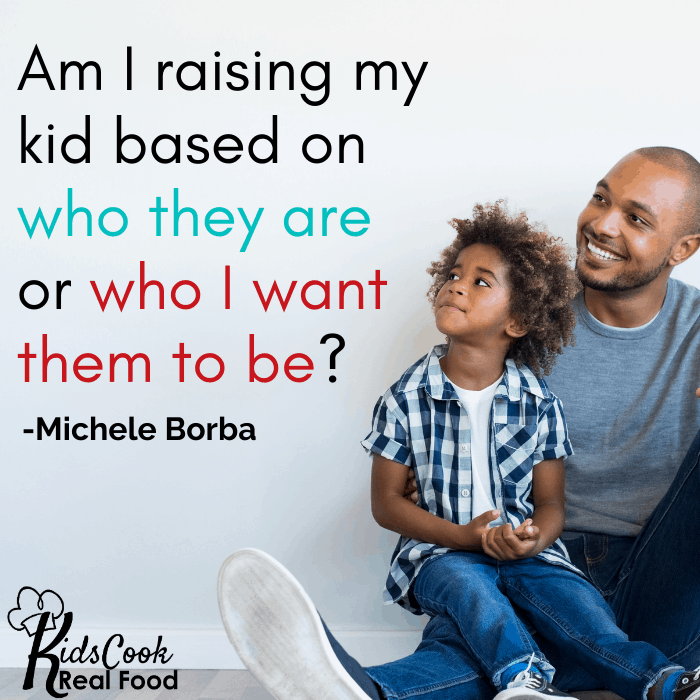
Self-confident kids are raised when you follow the child’s lead, rather than who you want them to be. -Michele Borba
- 18:29: Self-confident kids know their strengths, accept their weaknesses, are mentally healthier, know who they are and where they want to go. Here’s the survey Michele mentions.
Raise Resilient Kids Who Thrive!
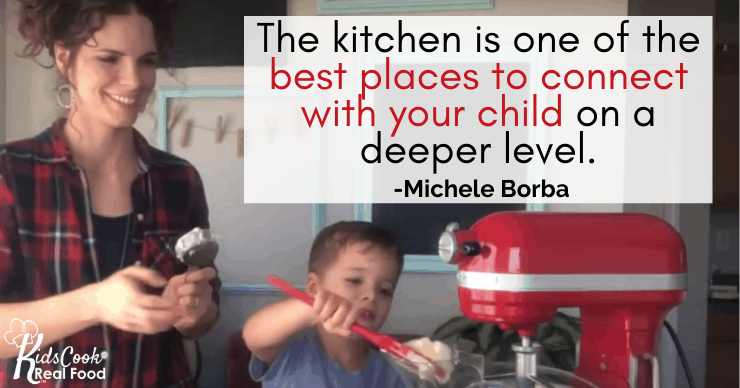
- 19:42: Here at Kids Cook Real Food™ we talk a lot about building confidence in the kitchen and giving kids real work to boost their self-esteem. Learning practical life skills like cooking, changing a tire, washing clothes, etc are all highly correlated with thrivers as well. The kitchen is also a great place to build connections with your child and learn what makes them shine. Family dinners are critical.
When you look at the good stuff happening in the world your heart opens, you’re more inspired and optimistic, hope comes alive and your mental health improves. -Michele Borba
- 21:46: Parents are busier than ever. We give you some simple ideas to incorporate building these strengths in your kids. If you’re struggling during these uncertain pandemic times, implement some routine or ritual in your day.
- 22:41: Teach a self-regulation skill as a family. Identify your kids’ (or your own!) stress triggers and practice deep breathing together. You get the most relaxation when your exhale is twice as long as your inhale. Here’s a demonstration of a relaxing breathing technique.
- 24:02: Let’s look at the school system and how that integrates with raising thrivers. Many teachers are realizing that changes need to be made before parents are. Parents and teachers need to be working together raising resilient kids.
Teachers are very concerned about children’s well-being and rightfully so. -Michele Borba
- 27:21: As we go through the pandemic, things feel uncertain so what can we do to instill hope in our kids? The most important thing you can do is model resilient behavior and bring your kids in on the process. Actually say out loud, “This is so frustrating, but I’ve got this, I can do it!”

- 28:38: We parents often need to be reminded how important our words are with our children. The way we speak to ourselves, about ourselves, about others, and to them, all has a profound impact on how their inner voice develops. Of course, we aren’t perfect, but we can talk to our kids about our own failures as well as a teaching tool.
Kids don’t need plastic knives. They need real skills.
Teach safe technique, focus, and confidence in the all-time fav lesson from our kids cooking class! (ages 2-12)
- 29:19: One of Michele’s strategies is to tell your kids “this is how I messed up, but next time I’ll…” to build perseverance.
- 30:15: We leave you with one thing you can do today to start raising resilient kids. This pdf will help you.
- 31:44: Share your goals and strategies with other people helping to raise your kids whether that’s the other parent, a grandparent, teacher, or coach. Send them this interview while you’re at it!
Resources We Mention for Raising Resilient Kids
- Michele’s book, Thrivers
- Michele’s survey to figure out your kids’ strengths
- This PDF has 10 super practical ways to start raising resilient kids who are thrivers!
- The benefits of family dinner
- Jeannine Jannot on disintegrating students
- Raising successful adults
- Letting kids fail to build resilience
- Reducing stress in kids
- Stress mastery breathing technique
- Connect with Michele online
- Follow her on social media: Facebook, Instagram, X
 Michele Borba, Ed.D. is an educational psychologist, former teacher, and mom recognized for offering research-driven advice culled from a career of working with over one million parents, educators and children. A frequent Today show contributor and recipient of the National Educator Award, she is the author of 25 books including UnSelfie, and her latest, THRIVERS: The Surprising Reasons Why Some Kids Struggle and Others Shine. She also appears on Dr. Phil, The View, CNN, The Doctors, Dr. Oz, and featured publications, including U.S. News & World Report, The Chicago Tribune, TIME, and The NYTimes.

Leave a Comment