If you’ve ever stood in the middle of your house and thought, “Where do I even start?”… you are absolutely not alone.
Decluttering can feel like one of those projects that requires a full weekend, a burst of motivation, and maybe a completely different personality. And if you’re a busy parent, that kind of time and energy just doesn’t magically appear.
But what if the problem isn’t your lack of discipline… it’s your approach?
In this conversation, I sat down with Ingrid Jansen from The Declutter Hub, and she completely reframed how I think about clutter. We didn’t just talk about getting rid of stuff. We talked about why it feels so hard in the first place—and how to make it feel doable (even in the middle of real life).
Because here’s the truth: clutter isn’t just about things. It’s about emotions, habits, identity, and sometimes even guilt. And once you understand that piece, everything starts to shift.
In this episode, you’ll hear:
- Why “decluttering your whole house” is actually the fastest way to get stuck
- The simple mindset shift that makes decluttering feel lighter and more positive
- Why starting with what you want to keep (not what to throw away) changes everything
- How to break any space into small, manageable chunks you can tackle in minutes
- The surprising advice Ingrid gives about what to do when you feel unsure about an item
- What the “messy middle” is and why so many people quit right there
- How clutter and emotions like guilt, stress, and overwhelm are deeply connected
- The hidden ways new clutter keeps sneaking into your home (and how to stop it)
There were several moments in this conversation where I realized I’d been making decluttering way harder than it needs to be, and one tip in particular completely changed how I’m going to approach my own closet (hint: it does not involve doing the whole thing at once).
If you’re feeling overwhelmed by your home, short on time, or just tired of starting over again and again… this episode will meet you right where you are.
Let’s dig in.
Love the Handbook?
Find all the episodes of the Healthy Parenting Handbook here, or listen on your favorite podcast player:





Don’t forget to leave us a review on Apple Podcasts too! Thank you!
Can't see the video? Watch on YouTube →
YouTube Shorts for This Episode
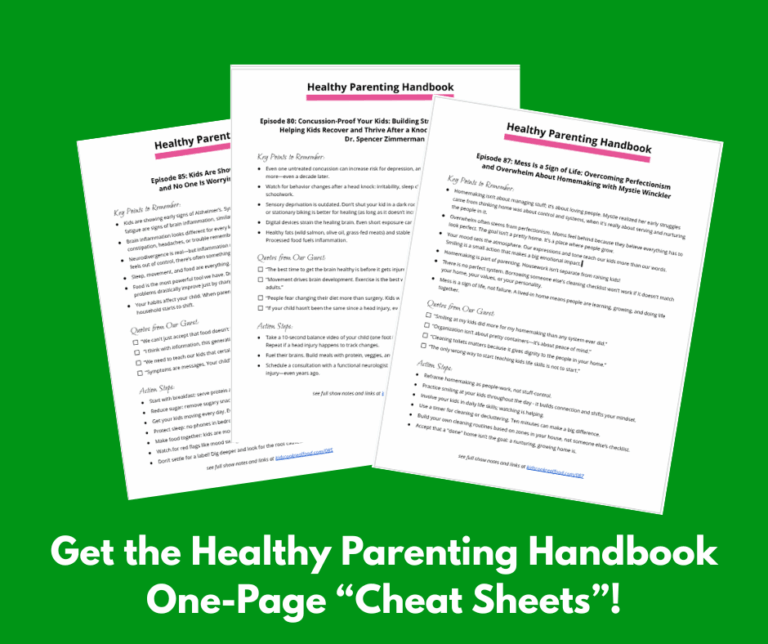
Turn expert advice into a handbook you can actually use.
I’ve interviewed hundreds of incredible experts on the Healthy Parenting Handbook podcast! Out of time to listen? You can skim on your phone!
These one-page summaries give you the highlights of every episode fast, so you can find what you need when you need it (and nothing to download).
100% privacy – You’ll also get Katie’s email newsletter with more practical tools for raising capable, confident kids. Change your preferences easily any time.
Key Takeaways about Easy Decluttering
- Decluttering is an ongoing skill, not a one-time finish line. Life changes, people change, and your systems need to adapt over time.
You do not have to tackle the whole wardrobe or whole room at once. Pick one small category and let that be enough for today. – Ingrid Jansen
- Decluttering is rarely just about the stuff. It is often tied to guilt, aspiration, identity, grief, and the stories we attach to our belongings.
- Overwhelm usually happens when people try to do too much at once. Breaking one room into tiny categories makes decluttering feel possible and helps build confidence.
- The goal is not to force fast decisions. If you are unsure about an item, keep it for now and come back to it later when you feel more ready.
If you are in doubt, keep it for now. You can always come back later when you feel clearer and stronger. – Ingrid Jansen
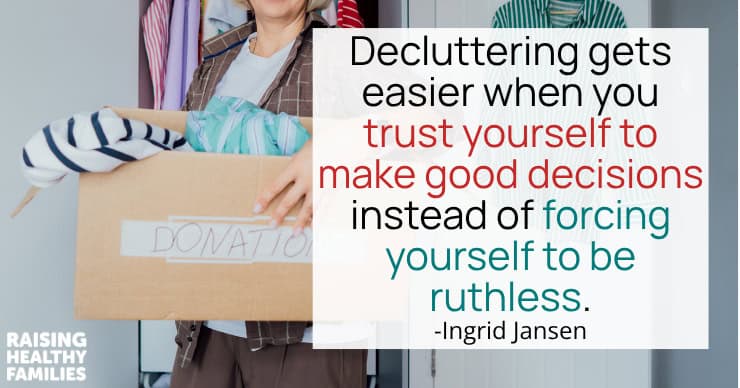
- It is more effective to focus first on what you want to keep rather than what you want to get rid of. That shift makes decluttering feel more positive and less threatening.
The Picky Eater Playbook: Get Pre-Order Bonuses!
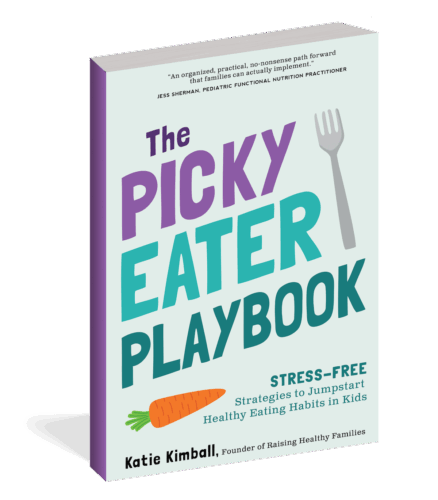
My first traditionally published book releases November 10, 2026! The Picky Eater Playbook: Stress-Free Strategies to Jump Start Healthy Eating Habits in Kids is packed with real-life stories, flexible strategies, and step-by-step routines to turn dinner from a power struggle into something the whole family can enjoy.
If you’ve done the No More Picky Eating Challenge and want to have all my strategies at your fingertips, it’s the perfect resource! Or if you’re just beginning to tackle dinnertime struggles at your house, it will walk you through my whole system for eliminating picky eating.
Pre-order now and get some amazing bonuses!
Learn More about The Picky Eater PlaybookAction Steps
- Choose one very small category to declutter today, such as T-shirts, leggings, shampoos, or blankets, instead of trying to do an entire room.
- Before you begin, decide what success looks like for this session and gather what you need, like donation bags, a trash bag, water, and a timer.
- Start by pulling out the items you know you love, use, and want to keep. Let those become your keep pile before you deal with the harder decisions.
- Create an exit plan before you declutter, so donation items, returns, and trash leave your home quickly instead of becoming a new pile.
- Pay attention to what keeps entering your home, whether that is shopping, freebies, hand-me-downs, or gifts, and start noticing the patterns without judging yourself.
- When you feel tempted to buy something, pause and ask whether you truly need it, already own something similar, or are trying to solve an emotional need with a purchase.
Shopping less starts with noticing why you are buying. Are you solving a real need, or trying to fix a feeling? – Ingrid Jansen
Tap here for the episode transcript.
Ingrid Jansen 0:00
This weekend, a walk-in wardrobe is happening, and then they start pulling stuff out, and it gets really chaotic. Then you’ve got the messy middle happening, and you’re like, “I’m really tired. I forgot to have lunch.” Then you go, “This is far too much. I’m not going to be able to do this.” Then you walk off, leaving it half finished or half started, and it’s really hard to get back.
Katie Kimball 0:26
Do you recommend “kitchen-cupboarding” everything? So if you’re going to do your walk-in wardrobe, you would say this chunk is today’s chunk?
Ingrid Jansen 0:35
Oh yeah, absolutely. So it’s like, “Right, today I’m going to look at my leggings or my jeans or my T-shirts or my jumpers or my hoodies.”
Katie Kimball 0:47
You’re listening to the Healthy Parenting Handbook podcast, just the thing we all said we needed when we first became parents. Gosh, do you remember that feeling? Where is the handbook for this? It happens again when they become teens, and sometimes it happens with our own home.
I’m your host, Katie Kimball, and I’ve brought together experts in the fields of health, parenting, nutrition, and more to give you the information you need to truly raise healthy, independent future adults.
My friends, parenting is the toughest and yet the most rewarding job in the world. Thank you for joining me to consult this Healthy Parenting Handbook, your guide to raising kids intentionally. I’m so honored if you leave an honest review wherever you listen to your podcasts.
Katie Kimball 1:30
And by the way, you can get the show notes in a really easy-to-consume way. It’s just a Google Doc with one-pagers. You could print them old school, make your own handbook, or just scroll through without having to download anything on your phone. Go to kidscookrealfood.com/handbook for access to all of them.
My guest today is Ingrid Janssen of The Declutter Hub. Ingrid grew up in a very organized and happy home in the Netherlands. She felt being organized was part of living life. She enjoyed it, and she has a whole career working in top-class hotels, progressing to become head of housekeeping.
Ingrid oversaw a large team and hundreds of bedrooms to a high standard. After having two children, who are mostly grown now, Ingrid wanted a more flexible role. Her friends always said, “You’re so organized. How do you do it?” So she realized she wanted to help other people get organized, and she launched a business.
For Ingrid, decluttering was never about making stuff look pretty, but more about being organized to free up time for the things you love doing and the people you love being with.
Katie Kimball 2:40
Now, Ingrid met Lesley Spellman in 2011 as they both volunteered on the board of the Association of Professional Declutterers. That’s a thing. They helped write the UK’s first course for professional organizers.
They hit it off so well that in 2018 they decided to team up. They haven’t looked back, becoming the UK’s leading authority on decluttering and organizing the home as The Declutter Hub. They also have a podcast of the same name.
I am always inspired and a little bit humbled interviewing organizing and decluttering experts. See, I’m nervous, but this is going to be really helpful.
Let’s jump into the interview. Ingrid, I cannot wait to talk about this. I love interviewing organizing experts because I am so unorganized and my house is so cluttered. I need this. I’ll just do the interview for me, and the audience can listen in.
I like reading your bio about your story and how you got started, but I want to hear more about the heart behind it. Where did it come from that you wanted to help others free up time to do the things they love doing through decluttering?
Ingrid Jansen 3:50
Yeah, definitely. First of all, thank you so much, Katie, for having me. I’m absolutely delighted to be here on your show.
My decluttering goes back a long time. Lesley, my business partner, and I both started around 2010 or 2011 with decluttering and organizing. I’m more the practical one, and Lesley is more emotionally led. Together, we fit really well because we each have a different take on things.
We both felt that clutter can be really debilitating for people and can hold them back from doing what they want to do. Lesley got into it because she bought a house that had been completely hoarded. While renovating, people passing by were very judgmental about the previous owner, and she found that difficult because she realized he had struggled with clutter and hoarding disorder.
That made her think other people might need help with decluttering their homes too. I got into it because my friends always said, “Ingrid, you’re so organized. Help us. How do you do this?” With my hospitality background, I’ve always loved helping and serving others.
We set up our own businesses first, and then in 2018 we came together as The Declutter Hub. We immediately realized how well our visions worked together and that clutter is never really about the stuff.
People think clutter is about stuff, buying boxes, or getting more organized. Yes, that matters, but first you need to understand the emotions behind it. Something is holding you back from letting things go, and it’s often multiple things.
If you understand that and get clarity, you can start to work your way through.
Ingrid Jansen 6:52
We always say you have to build your decluttering muscle. You can’t go from nothing to everything overnight.
It’s like kids cooking. You don’t give a tiny child a big knife. You start small. It’s the same with decluttering. You can’t start with, “My whole house is cluttered. I’m going to do everything.” You need a plan and to break it down.
Katie Kimball 7:33
When you said, “My whole house is cluttered,” I felt that physical tension. That overwhelm. Do you hear that a lot? Where do you even begin?
Ingrid Jansen 7:49
All the time. “I feel so overwhelmed. I don’t know where to start.”
People say, “I want a clean and tidy house.” I love that goal, but it’s like saying you want to climb Mount Everest. You need to figure out your why.
Katie Kimball 8:21
Because time is only one reason, right?
Ingrid Jansen 8:25
Exactly. People want to invite others over without feeling embarrassed. Open the door without apologizing. Have grandchildren stay over. Use their space again.
Speaker 1 8:52
Have friends over for dinner or tea. Use the dining table. Craft again. Sleep better. Clutter impacts all of that.
So you need your why. Once you have it, you can make a plan. It won’t happen overnight.
Ingrid Jansen 9:52
That’s why we created our membership, to help people through this. Many can’t have an organizer come into their home, for many reasons.
We teach them how to go through their house, starting with easier rooms and building that decluttering muscle over time.
Katie Kimball 10:38
Okay, and I’ve got to pick on you a little bit because I read the blurb on Amazon about your book, and it says start with the kitchen because the kitchen is not emotional. I’m like, I love all my whisks. I love all my peelers. Why would you start with the kitchen? So I want you to explain why the kitchen is the least emotional. Tongue in cheek here a little bit, but I do love all my peelers and knives.
Ingrid Jansen 11:07
Well, okay, Katie, first of all, there’s never a one-size-fits-all. But Lesley and I have nearly 30 years of experience decluttering people’s homes, and what we’ve realized is that often people find the kitchen less emotionally challenging.
Out-of-date food, plastic containers, chipped plates, those kinds of things are not as hard as books, photographs, or paperwork. Of course, there are sentimental items in the kitchen too, like a mug from Disney World, but generally, it’s easier.
Now, for people who love cooking, like you, the kitchen might be harder. In that case, we say start in a bathroom, a linen cupboard, or bedrooms, and come back to the kitchen later.
Another reason is that kitchens already have smaller cupboards, so you can break things down easily. Today it’s cutlery, tomorrow pots and pans, then baking equipment, then glasses.
A bathroom can actually be more emotional because of expensive products. You bought that cream thinking it would change everything, and now it’s been sitting there unused for years, and you feel bad.
That’s why you build your decluttering muscle over time. You don’t need to finish a room 100 percent before moving on. Even 80 or 90 percent is enough to move forward and circle back later.
And here’s the thing nobody wants to hear. Decluttering is never done.
Katie Kimball 13:48
I did not want to hear that, but it makes sense. You’re always using the space, bringing things in, and life changes.
Ingrid Jansen 13:59
Exactly. Life changes. Jobs change. Kids grow up. You pick up new hobbies. COVID changed a lot for people.
People thought they finally had time to declutter, but realized it’s not about the stuff. It’s about what’s behind the stuff that makes it hard to let go.
Another challenge is the messy middle. You pull everything out, it gets chaotic, you get tired, you forget to eat, and then you give up halfway through. That makes it really hard to come back.
Katie Kimball 15:34
Do you recommend breaking it down like “kitchen-cupboarding” for closets too? Like this chunk is today?
Ingrid Jansen 15:43
Oh yes, absolutely. Today leggings, tomorrow jeans, then T-shirts, then hoodies.
Katie Kimball 15:57
I never thought of that. I’m picturing my closet right now. My summer stuff is in drawers, winter stuff is out, and I never switched them. I just grabbed things randomly. It’s a mess because I thought I had to do it all at once.
Ingrid Jansen 16:27
Exactly. You think you have to do the whole wardrobe. But you can do boots one day, flip-flops another day, flats another, heels another.
Same with bathrooms. One day shampoos, another day nail products, another day hair tools.
Even a linen cupboard. Blankets one day, bedding another, pillows another.
Breaking it into small, manageable chunks is so helpful.
Ingrid Jansen 17:17
That’s what we teach. Ten to fifteen minutes or half an hour is enough.
You finish something small, feel proud, and it becomes positive. Then you want to do more. Or you stop and say, “I’ve done enough.” That mindset shift changes everything.
Katie Kimball 18:05
It’s so doable. We think we need a whole weekend, but five to ten minutes works.
But what about the emotional side? There’s the guilt of money spent and the hope that something will change you. It feels like a timeline of emotions.
Do anxious people have more clutter, or does clutter create anxiety?
Ingrid Jansen 19:04
That’s the big question.
We know clutter creates stress and impacts daily life, including sleep. A big emotion behind clutter is guilt. Money spent, waste, gifts from loved ones, all of that.
There’s also aspirational clutter. The juicer for a healthier life, the bread maker, the cream. But they don’t get used.
You have to be kind to yourself and focus on what fits your current life. If you keep everything from the past, it holds you back.
That’s why we go slowly. Not dramatic before-and-after transformations. And one thing we always say surprises people: if in doubt, keep it.
Katie Kimball 21:29
Really? That surprises me.
Ingrid Jansen 21:33
Most people say throw it out. We say you need to feel in control. If you’re not ready, it will bother you.
Decluttering isn’t perfect. You will make mistakes. But when you come back later, it gets easier. People tell us all the time that what they couldn’t let go of before becomes easier later.
Start with easier items. Focus on what you want to keep, not what you want to get rid of.
What do you love? What makes you feel good?
We create a keep pile first. Then it’s easier to evaluate the rest.
Katie Kimball 25:13
So working through emotions actually starts with the easy stuff?
Ingrid Jansen 25:41
Yes. And you plan before you start. Think about what you want to achieve, what might be hard, and prepare bags, returns, and cleaning supplies.
We call it “ponder your project.” Think ahead about emotions and expectations.
Then declutter, organize, and only after that consider buying storage.
Ingrid Jansen 28:02
Don’t buy storage first. Use temporary solutions, then decide what you actually need.
And plan your exit strategy. When will items leave your house?
Finally, enjoy your progress. That positive cycle builds momentum.
Katie Kimball 30:18
What about stuff coming in? How do you stop that?
Ingrid Jansen 30:44
That’s another mindset shift. Shopping habits, gifts, hand-me-downs, freebies.
Start noticing those patterns. Pause before buying. Ask why you’re buying.
Unsubscribe from emails. Leave items in your cart overnight.
Recognize when you’re buying duplicates.
Katie Kimball 34:50
That makes sense. And you have personality types too, right?
Ingrid Jansen 35:16
Yes. We created clutter personalities: happy heapers, kind keepers, warm weepers, and nostalgic knee-deepers. In the book, we added a fifth, the harassed housekeeper.
Katie Kimball 35:58
I was a happy heaper.
Ingrid Jansen 36:09
That’s very common. Busy lives, lots of piles, but you kind of know where things are.
Each personality has different challenges and patterns.
Katie Kimball 39:08
Is the quiz the best place to start?
Ingrid Jansen 39:29
It’s a great place. Also the podcast, the Facebook group, and the membership if you want deeper help.
Katie Kimball 40:05
And your book?
Ingrid Jansen 40:12
Yes, Reset Your Home. It walks you through everything step by step.
Katie Kimball 40:43
Thank you so much for being here.
Ingrid Jansen 40:52
It’s been an absolute pleasure.
Katie Kimball 40:55
Thank you for listening to this episode of the Healthy Parenting Handbook podcast. I hope your brain feels fed and your heart feels full, and that you feel connected knowing other parents are on this journey with you.
We’re all trying to raise healthy, independent adults. And the next time you think there’s no handbook for this job, now there is.
Please leave a review, subscribe, and check out our shorts on Instagram and YouTube for bite-sized parenting tips.
Resources We Mention for Easy Decluttering
- Ingrid and Lesley’s book: Reset Your Home: Unpack your emotions and your clutter, step by step (Amazon/Bookshop.org)
- Get started in the Declutter Hub!
- Take the clutter quiz
- Dig more into the mental load of clutter with Katy Wells
- Organizing styles for families with Cas from Clutterbug
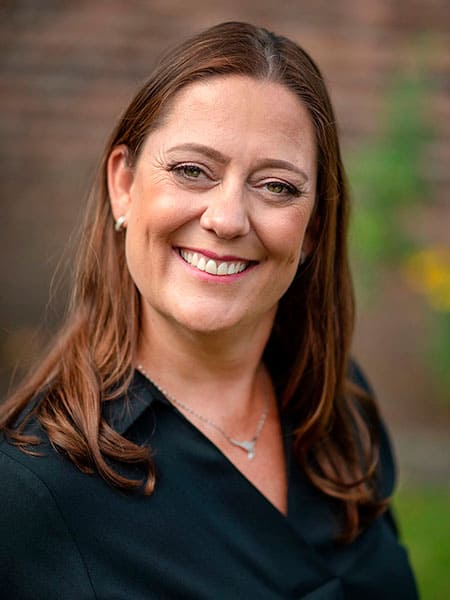
Ingrid Jansen grew up in a very organised – and happy – home in The Netherlands. Ingrid felt being organised was part of living life and enjoyed it. She started her career working in top-class hotels, progressing to become head of housekeeping – overseeing a large team and hundreds of bedrooms to a high-standard.
After having two children, in 2008, Ingrid wanted a more flexible role. She knew she wanted to help other people get organised, and Organise Your House was launched. For Ingrid, decluttering was never about making “stuff look pretty” but more about being organised to free up time for the things you love doing.
Ingrid met Lesley Spellman in 2011 and they both volunteered on the board of Association of Professional Declutterers and helped write the UK’s first course for professional organisers. The duo hit it off and then in 2018, they decided to team up, – and they haven’t looked back, becoming the UK’s leading authority on decluttering and organising the home as The Declutter Hub and launching their podcast.

Leave a Comment