What if the stress you feel at home is not just about your schedule… but about your stuff?
I know. That sounds almost too simple.
But when Katy Wells came back on the Healthy Parenting Handbook podcast, we did not just talk about decluttering. We talked about cortisol. About magnets for your attention. About why walking into your own kitchen can change your mood in seconds.
And friends, this one hit close to home.
Because if you are trying to raise independent kids, teach life skills, keep up with meals, laundry, school, sports, and somehow protect your own nervous system… your environment matters more than you think.
Here is what we dig into in this episode:
- The surprising research linking clutter and elevated cortisol levels
- Why the average American home may be holding over 300,000 “magnets for your attention”
- How clutter quietly fuels anxiety (even if you think it does not bother you)
- What a “nightly reset” looks like in real life with kids
- How to pass ownership of the home to your children without nagging
- The difference between modeling and inviting kids into responsibility
- Why action creates motivation (and not the other way around)
- The simple starting point that breaks the clutter and anxiety cycle
We also talk about something that might sting a little: why systems alone will not save you.
If you have ever walked into a messy kitchen and felt your shoulders tense… or walked into a clear counter and felt yourself exhale… this episode is for you.
Let’s talk about how simplifying your home can actually strengthen your parenting.

Love the Handbook?
Find all the episodes of the Healthy Parenting Handbook here, or listen on your favorite podcast player:





Don’t forget to leave us a review on Apple Podcasts too! Thank you!
Can't see the video? Watch on YouTube →
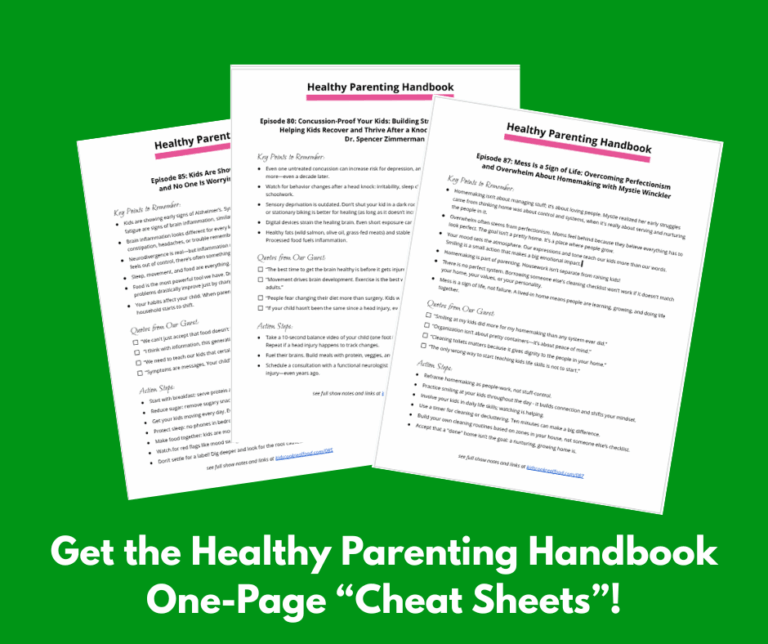
Turn expert advice into a handbook you can actually use.
I’ve interviewed hundreds of incredible experts on the Healthy Parenting Handbook podcast! Out of time to listen? You can skim on your phone!
These one-page summaries give you the highlights of every episode fast, so you can find what you need when you need it (and nothing to download).
100% privacy – You’ll also get Katie’s email newsletter with more practical tools for raising capable, confident kids. Change your preferences easily any time.
Key Takeaways about Clutter Anxiety:
- Clutter raises stress levels. Research shows that describing your home as cluttered is linked to elevated cortisol, and the more items in a home, the higher the correlation with anxiety.
- Every item competes for your attention. The average home contains hundreds of thousands of “magnets for your attention,” which quietly drain mental energy and increase decision fatigue.
“For every item you let go of, you lessen the noise in your home and in your mind.” – Katy Joy Wells
- Decluttering helps your nervous system reset. As visual noise decreases, your body has space to calm down, think clearly, and respond more patiently.
- Ownership is a life skill. Inviting kids into home management through teamwork and problem-solving builds responsibility and initiative over time.
- Progress beats perfection. Small, consistent actions create momentum, confidence, and motivation. Waiting to “feel motivated” keeps you stuck.
The Picky Eater Playbook: Get Pre-Order Bonuses!
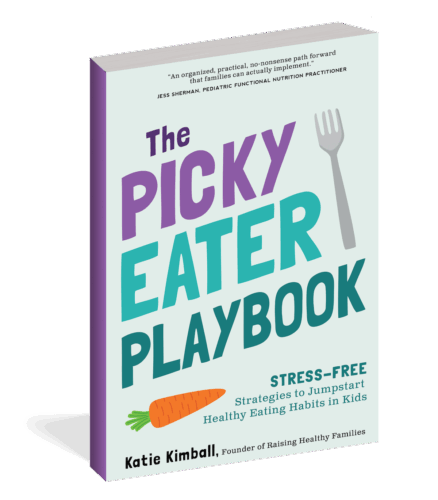
My first traditionally published book releases November 10, 2026! The Picky Eater Playbook: Stress-Free Strategies to Jump Start Healthy Eating Habits in Kids is packed with real-life stories, flexible strategies, and step-by-step routines to turn dinner from a power struggle into something the whole family can enjoy.
If you’ve done the No More Picky Eating Challenge and want to have all my strategies at your fingertips, it’s the perfect resource! Or if you’re just beginning to tackle dinnertime struggles at your house, it will walk you through my whole system for eliminating picky eating.
Pre-order now and get some amazing bonuses!
Learn More about The Picky Eater PlaybookAction Steps for This Episode:
- Start tiny. Declutter one surface or let go of two items today to interrupt the anxiety-clutter cycle.
- Anchor a five-minute reset to something you already do daily.
- Use “sports casting” language with kids by objectively describing what you see instead of blaming, and invite them into problem-solving.
“Our brains are wired to crave calm and order.” – Katy Joy Wells
- Create a nightly reset where the family works together to return shared spaces to baseline tidiness.
- Stop waiting for motivation and take a small action instead. Even two minutes counts and often leads to more.
- Notice how your body feels in a cleared space so you reinforce the connection between decluttering and calm.
Tap here for the episode transcript.
Katy Wells 0:00
Once I started simplifying in a way that got me longer-lasting results, instead of just a marathon purge, my anxiety started going down.
There’s also another study that highlights a correlation between the amount of stuff in your house and your anxiety, how you’re feeling.
So what that means is, for every item you let go of, you regain control. You lessen that noise. You take some of that noise physically and in your mind, and you get it out.
Katie Kimball 0:29
Hey friends, welcome back. Have you ever thought, where is the handbook for this about parenting? If so, you are in the right place.
You’re listening to the Healthy Parenting Handbook podcast. I’m your host, Katie Kimball from Raising Healthy Families, and each week I interview experts to bring you the information you need to raise truly healthy, independent future adults.
Thank you for joining me to consult this Healthy Parenting Handbook, your guide to raising kids intentionally.
If you’ve got a second, we would love an honest review on Apple Podcasts or wherever you listen. That helps other people find this resource as well.
And if you’re listening on the go and can’t take notes, I mean, who has time for that, be sure to check out our Healthy Parenting Handbook one-pagers. These are a quick summary of the best points each guest makes so you can literally print your own healthy parenting handbook. Or just quickly check to remember what someone said.
It’s a Google Doc available to all my email subscribers. You don’t have to download anything. You’ll find a link to it in every email. Go to raisinghealthyfamilies.com/handbook to get them all.
Katie Kimball 1:31
My guest today is one of my favorite people in the world. Katy Wells is a returning podcast guest. Last time, in Episode 23, we dove into the difference between clutter and unexpected mess.
Today we’re talking about anxiety with clutter, how we pass ownership to kids, and in part two we go even deeper.
Let’s jump right in. I can’t wait to introduce you to my friend.
Katy, welcome back.
Katy Wells 2:00
I’m so happy to be back.
Katie Kimball 2:02
Katy Wells was on the show back in Episode 23, and we talked about expected mess versus true clutter. You’ve also been a many-time returning camp leader in Life Skills Now.
I feel like our listeners have had a good opportunity to get to know you already.
If you haven’t listened to Episode 23, go back and hear about the car accident, the literal wake-up call, and how Katy got started.
But I want to fill the gap between that story and now, because that interview was four or five years ago. Your boys are older. I’d love to hear how your perspective has shifted as you wrote this new book.
Katy Wells 2:38
I think what’s shifted, on a home management level, is that my boys are now nine and ten. Four or five years ago, that’s a big difference in their cognitive capacity.
I’ve shifted more from “How do I manage the home?” to “How do I continue to invite my kids into this process of home management?”
For me, it’s not just about modeling anymore, doing what I want them to do. It’s about having real conversations about stuff, clutter, ownership, and responsibility.
That’s why I love being part of Life Skills for so many years. Decluttering is a life skill. Managing our items is a life skill.
Seeing that and doing it together as a family is so much fun.
As far as writing the book, I really had to put concrete words to what I’d been teaching intuitively for years to my kids and families. Going through that process deepened my conviction.
These approaches work. I’m watching it continue to play out in my own home and with my students. It’s powerful. It makes me squeal with joy.
Katie Kimball 3:54
I love that. Can you give us a peek-through-the-window moment where you’re having a conversation with your boys? What’s the topic? What happened? What did you say?
Katy Wells 4:04
They come at a variety of times. If we’re consistent with family meetings, maybe once a month, I’ll say, “I’ve noticed the shoes are landing on the floor again,” or “The backpacks are piling up.”
I’m identifying pain points in a non-reactive way and saying, “Here’s what I’ve noticed. How can we solve this? How can we do this as a team? How can I help you put your shoes away?”
Just because we teach something once doesn’t mean they’re going to do it forever. There are different seasons.
I’ve continued to depersonalize it. Shoes on the floor don’t mean they don’t care. I used to think that, and it made me resentful.
Now I look at it through the lens of, how are we going to solve this together? It’s more fun. It’s more engaging. It takes pressure off them. It helps them be part of the solution instead of me saying, “Put your shoes away. I always tell you to put your shoes away.”
It shifts my perspective and my patience level. There are times I don’t put my shoes away either.
My husband recently came on my show and said, “If you walked into our house, you would not know Katy is a declutter expert.”
He meant that we still have messes. We’ve made huge progress, but it’s not perfect. When you follow most decluttering experts, you see polished before-and-after photos. That’s not real life.
Our kitchen still gets dirty. My kids still leave art projects out. We’re always working on habits and systems.
When culture tells you your home should stay perfect forever, you set yourself up for failure. It’s helpful to know that even my house gets messy.
Katie Kimball 6:33
Especially a kitchen. If you use it, it’s going to get messy. Cleaning is cyclical.
I love how you depersonalized it. Saying “the backpacks are landing on the floor” instead of “you left your backpack on the floor.” You assess the situation, not the person. That’s fantastic.
Let’s talk about passing on ownership. What have you seen change as your boys grew to nine and ten?
Katy Wells 8:19
They take initiative more. Not 100 percent of the time, but often. They clear their plates. They start doing dishes. They get the ketchup out and put it back instead of leaving it on the counter.
We do a nightly reset. We reset our entryways back to baseline tidiness. That’s a family habit.
There’s camaraderie in the teamwork. “I’ll get the dishes.” “I’ll get the shoes.” It’s become part of our culture.
The first time my kid cleaned his room on his own, I had that parenting moment of, “Is this working?” It takes time. It takes them growing up.
They start to understand that ownership means more time together. It means we can play Uno. It means extra bedtime stories.
Katie Kimball 9:41
Tell us about the nightly reset. How did you start it? How do you remember?
Katy Wells 9:58
Anchor the habit to something you’re already doing. I’m not going to say seven o’clock every night, because schedules change.
Dinner happens every night. So reset happens after dinner.
When they were younger, I anchored it to snack time or before going outside. Transitions are powerful anchor points.
It becomes automatic. “We reset the space, then we put shoes on and go outside.”
Katie Kimball 11:46
Let’s shift to anxiety. Tell us about the link between clutter and our nervous systems.
Katy Wells 11:46
A UCLA study found that women who describe their homes as cluttered have elevated levels of cortisol throughout the day.
Cortisol spikes in the morning and then gradually drops. But when we’re in an environment with visual noise, our brain registers that as unfinished business.
Imagine hiking and seeing a black bear. Your cortisol spikes. Even after it walks away, you stay slightly on edge.
Clutter has a similar effect. Elevated cortisol never gives your body a full chance to reset. That leads to fatigue, brain fog, irritability.
I used to come home, open the front door, and see piles of stuff I’d procrastinated on. I’d immediately feel triggered. I was a different mom inside my house than outside it.
Once I started simplifying in a sustainable way, my anxiety went down.
Another study shows a correlation between the number of items in your house and anxiety.
For every item you let go of, you reduce that noise physically and mentally.
Katie Kimball 15:39
That subtle physiological response when you see a clear counter is powerful.
Katy Wells 16:07
The average American home has over 300,000 items.
But here’s the nuance. They aren’t just items. They’re magnets for your attention.
Each one represents micro-decisions. Where does it live? Do I dust it? Do I keep it?
That’s exhausting.
When you release some of those magnets, you get back space, time, energy, and clarity.
Katie Kimball 20:49
Is there a way to break the clutter-anxiety cycle?
Katy Wells 20:49
Yes. Progress, not perfection.
When you’re at the bottom of a mountain, it feels impossible. You don’t need the full staircase. You just need the next step.
Set a timer if that helps. Or don’t. Gamify it. Do one thing a day. Five minutes on a surface. Start with easy clutter.
Small actions create momentum. They also release dopamine.
Action creates motivation. Not the other way around.
If I waited to feel motivated, I’d still be buried in clutter.
Sometimes I tell myself, “Two minutes.” That’s enough to get the ball rolling.
Katie Kimball 23:20
Action creates motivation. I love that reminder for parents and kids.
In part two, Katy and I go deeper into emotions, beliefs, and habits. If you feel stuck in a clutter loop, it’s not a system that will save you. It’s something else.
Listen to the next episode to find out what it is.
Thank you for listening to the Healthy Parenting Handbook podcast. I hope your brain feels fed and your heart feels full.
Please leave a review and subscribe. That helps other parents find us.
You can also find our shorts on Instagram at @raisinghealthyfamilies or subscribe to the Healthy Parenting Handbook Shorts channel on YouTube.
Resources We Mention for Making Home Your Happy Place
- Order Katy’s new book, Making Home Your Happy Place, on Amazon or Bookshop.org
- Check out her courses if you need help at home: Toy Clutter Cure System, Home Management Mastery, Clutter Challenge
- Get the one-page handbook episode guides at raisinghealthyfamilies.com/handbook
- Here is Katy’s earlier episode of the podcast: Expected Mess Vs. True Clutter – What’s the Difference and How to Solve Them
- More on decluttering and working together as a family in my interview with Tidy Dad

Katy is a leading voice in the decluttering space, known for redefining how families approach their homes with more clarity, ease, and compassion. She is the host of the top-rated podcast The Maximized Minimalist, with over 5 million listens and reaches listeners around the world. Katy is recognized for offering a refreshing, real-life alternative to the exhausting “do more, try harder” approach that’s dominated the home space for decades.
Through her podcast, teaching, and community, Katy has helped thousands of families reduce overwhelm, restore ease at home, and create supportive habits that last. Her work has been featured on NBC News Daily, Martha Stewart, Real Simple, Southern Living, and more. She lives in Asheville, North Carolina with her husband and two sons.

Leave a Comment