Andrea Davis of Better Screen Time is back! I can’t tell you how much our own family needed these strategies and tech-use resets, and I know you need it too!
Today we’re focusing more specifically on our tweens and teens and how to decide when (or if!) a child gets a personal device.
We cover:
- Screen “time” vs screen “quality” and the 3 Cs of tech usage
- Why we as parents need to embrace being countercultural and the “hard/easy” form of parenting
- How to assign tech tasks to devices (and why that’s important)
- One of the 3 Cs is the one to really look out for and help kids manage digital dangers – and our kids need our help!!
- The 2 questions (and many sub questions) kids or teens should be able to answer correctly so we know they’re ready for a smartphone (or any personal device)
- How new phones are letting kids step up in responsibility bit by bit
- The big step of social media and when teens are ready
- Why Andrea encourages us parents to follow the tech usage family rules too
- How we can help kids build their internal filter (no matter where they are) for what they see
- Why kids self-regulating on devices is a myth 😮
- The importance of family dinners (and whether they should be screen-free)
This one is sooooo good, folks! We can’t escape the screens, although Andrea and her husband really did try for quite a few years. We need to teach our kids to not only survive but THRIVE in spite of and along with technology.
It’s absolutely possible to help our kids build a healthy relationship with screens, but it requires us to be intentional. It’s not going to go well if we just roll with it, promise.
Can’t see the video? Watch Teens and Screens here on YouTube!
No time for the video? Here are the notes!
Building a Healthy Relationship With Technology
- Andrea Davis is back on the Healthy Parenting Connector! You can see her previous interview here.
- 0:54: Andrea introduces her background and how she started Better Screen Time.
- 2:08: Setting a timer for screen time with little kids is a completely different parenting game from managing screens with teens who have smartphones and use computers for school. Here’s my TED talk on teaching critical thinking to our kids.

- 3:00: Once kids are older, using screens for school or asking for phones we can’t just set a timer. How do we interact with screens and discuss this with our older kids?
3 C’s of Screen Time
- 4:17: Andrea uses the 3 C’s for screen time: connecting, creating, and consuming. Facetiming grandma is going to affect us differently from scrolling social media mindlessly. Here’s an example of a creative use of technology from my son Paul.
Our kids don’t have the natural limits we had as kids. When the TV turned off we moved on with our lives. -Andrea Davis
- 7:29: Andrea’s family doesn’t allow personal devices until high school and all other technology is for the family as a whole. They have boundaries in place about how, when, and how much they can be used.
- 8:36: Assign your tech tasks. For example, Andrea’s family has an iPad. It isn’t for gaming, they use it to zoom for piano lessons, make movies and watch movies on vacation. It isn’t a free-for-all where kids can do whatever they want on it.

When Is a Teen Ready for a Smartphone or Personal Device?
- 10:50: When is a child ready for a personal device like a smartphone? Have conversations over time with your kids about this. Andrea has a self-evaluation kids can fill out to prompt them to think through some of this on their own. Two big questions to start conversations are “what does it mean to be responsible?” and “what does it mean to be emotionally mature?”
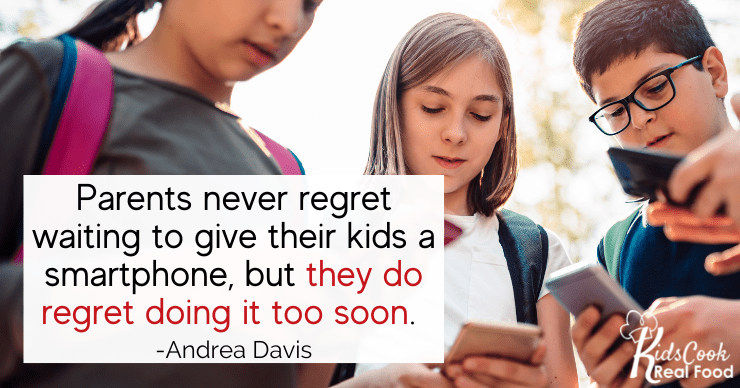
- 14:20: There’s no “right” age for a personal device. Kids are different! You won’t regret waiting, but there can be some big consequences to giving a device too soon.
- 15:59: Gabb phones and watches have no internet access, but kids can make calls and text. You can use tools like this to ease into introducing a personal device to see how the child handles it. There are so many more options now to set up boundaries. Pinwheel and Troomi are the other two phones Andrea mentioned.
Kids don’t need plastic knives. They need real skills.
Teach safe technique, focus, and confidence in the all-time fav lesson from our kids cooking class! (ages 2-12)
When Are Kids Ready for Social Media?
- 17:49: The last thing you hand over to your child is social media. It’s definitely for older, mature teens. The risks generally outweigh the benefits. Marco Polo is a good alternative to something like snap chat where kids can send each other video messages.
Social media confuses vulnerable teens who are trying to find their identity and define their values. -Andrea Davis
- 19:44: Make friends with other families who have similar convictions to you on social media and technology if possible. I’m so grateful that my daughter’s closest friends are also not on social media so she doesn’t have that added pressure to join!
- 21:02: How can parents model healthy tech boundaries for our kiddos? It’s ok for parents to have some different boundaries from teens, but be intentional with your tech use and set up a family tech plan to talk over your boundaries.
- 23:40: What about when only one parent is on board with having tech boundaries? Andrea has a good perspective on this. Have your spouse listen to the first part of my last interview with Andrea where we talk about all the potential dangers of screens.
“I just want my kids to eat what I make!”
This free 5-day challenge was made for you.

Spend just 30 minutes a day learning practical strategies that reduce mealtime battles and help kids build confidence with food.
Releasing Responsibility to Teens
- 28:20: You can install every filter in the world on your kids devices, but that won’t help them when they’re out of the house. How do we help kids create internal boundaries? Here’s the book Andrea mentions: Good Pictures, Bad Pictures, and her course for teens.
Helping kids create an internal filter takes a lot of conversations. -Andrea Davis
- 33:30: It’s hard for most adults to self-regulate their time on devices, and now we give them to kids! How can we give over this responsibility to kids and teach them how to self-regulate?
We can give kids digital training wheels – and parents are the primary wheel! -Andrea Davis
- 38:31: Think about ways to build self-discipline in your kids in general, not just when it comes to screens. It’s a muscle you can build across the board.
- 40:48: Research shows that what you do in the first hour of your day trains your neuropathways for that day. Scrolling through email or social media first thing can impact your whole day.
- 42:50: We talk about screens and dinner time. If you feel like devices are taking over relationships, start by implementing a screen-free dinner.

- 45:52: We end with a message of hope for you! Definitely check out Andrea’s freebie Am I ready for a personal device? The self-evaluation to determine whether or not your teen is ready for social media is no longer available.
Resources We Mention About Technology for Teens
- You can see my previous interview with Andrea here
- Follow Andrea on social media: Instagram, Facebook
- Andrea’s book: Creating a Tech Healthy Family
- Andrea’s courses
- Andrea’s course for teens: Untangling Teens and Tech
- Good Pictures, Bad Pictures
- Andrea’s self-evaluation to determine if your child is ready for a personal device
- Our review of Troomi phones
- Pinwheel is the other phone Andrea mentioned
- Here’s my TED talk on teaching critical thinking to our kids
- Here’s an example of a creative use of technology from my son Paul
- Marco Polo the messaging app my daughter uses with her friends
 Andrea Davis is a former secondary ed teacher turned screen time navigator. She is the founder of Better Screen Time where she shares family-tested ideas from the (tech) trenches as a mom of five. She is on a mission to help parents worry less about tech, and connect more with their kids. Andrea and her husband, Tyler, live in beautiful Hood River, Oregon where they love spending time outdoors as a family.
Leave a Comment