There’s a fear going around that AI is going to make our kids’ brains soft. That they won’t have to think anymore, because the screen will think for them.
I don’t buy it!
AI hands you an answer the instant you ask. But AI does nothing for the kid who never thought to ask in the first place…
The kid who can’t tell when the answer is wrong…
The kid who can’t sit with a hard question long enough to do anything about it…
The skill our kids need now, more than ever, is the skill of asking the right question.
And while that’s helpful to write and evaluate AI prompts, I don’t want to reduce our kids to prompting machines either. Asking questions about our world, asking questions directly to other people, and asking questions about the answer you get, whether it’s from a human or a bot, is critical to being human.
Asking the right question can change the trajectory of your entire life, as it did for me in 2008 when I wanted to earn a little money to get our young family out of the red after leaving teaching. I asked a magazine editor via email, “Where do I start with this idea I have to write a book? Do you think anyone would read it?”
Miraculously, this busy editor-in-chief of a small magazine answered.
He said I should start a blog to see if there was interest in my idea called “kitchen stewardship.”
I didn’t know what a blog was!
You can bet I asked a lot more questions, luckily this time NOT to a busy magazine editor…probably Google searched it?
That was the beginning of not only a little extra income for my family, but full-time entrepreneurship, a movement online of parents who really cared about health and nutrition for their families, my husband leaving his corporate job to start his own business, a passion and mission in life discovered, and hundreds of thousands of children learning to cook and build a healthy relationship with food.
All because I’m an unabashed question-asker.
I’ll tell my kids until I’m blue in the face: “It never hurts to ask the question.”
And often, it makes a huge difference.
Let’s pile up some proof, shall we?
I asked some of the camp leaders teaching at #LifeSkillsNow this summer to share one question they once asked that genuinely changed their lives. Their answers are below, in their own words.
Read them with your kid. Or read them and then go ask your kid a question you’ve never asked before. They learn what we model…
What if I fail?
Lisa Yvonne, founder of Learning Moments and homeschool mom of 8, learned this one in 9th grade from a teacher who refused to baby her.
“One of the most important questions I ever asked was, ‘What if I fail?’ These days, I celebrate my failures, but it took me decades to get there. I first asked this in 9th grade to my Earth Science teacher when I was debating about trying out for something new. He was a mentor of mine, and I really appreciated his wisdom; it had always steered me in the right direction. I expected him to talk me off the ledge and reassure me that I’d do fine and give me some tips. Instead, he said, ‘I hope you do. If you’re not failing, you’re not trying hard enough.’ That answer floored me and eventually freed me. He taught me that failure is just feedback. You test, you take the data, you try again. I’ve built a lot of my life on that idea, and I’m still glad I asked. That’s how I learned that failure wasn’t something to avoid; it was evidence I was finally stretching beyond what was guaranteed. This (unwanted at the time, but very wise) advice works for business, relationships, homeschooling…everything. Try big enough to fail, then regroup…and do better!”
Lisa Yvonne, founder of Learning Moments® is teaching parents how to teach elementary kids to do chores in this year’s #LifeSkillsNow summer camp!
If your kid is afraid to try something hard, this is the reframe. Failure is just a lesson. The question gets you on the class list.
What if I just ask anyway?
Cynthia Heren of Inside Our Normal asked a bold question at age 18 and got back something she never could have planned for.
“A question I asked that helped me in a surprising way: When I was 18, a movie was being made in my local area, and as an aspiring TV/Film student, I asked if I could visit the set for a day to get experience and see what I was going to study. They told me no, but instead offered me a spot as a production assistant and film editor on the project! I got to meet Hollywood actors and get a huge experience boost as I entered my college program, giving me an overall better experience than the single visit I asked for.”
Cynthia Heren of Inside Our Normal will give your teens something to think about with her workshop “Creating CALM for Teens: Understanding Your Neurodivergent Brain” in season 5 of #LifeSkillsNow.
The smallest ask sometimes opens the biggest door. The “no” wasn’t the end! It was the start of a better offer she would have missed if she’d never asked at all. Advocate for yourselves, my friends! Many adults truly want to help young people find their calling or career.
The Picky Eater Playbook: Get Pre-Order Bonuses!
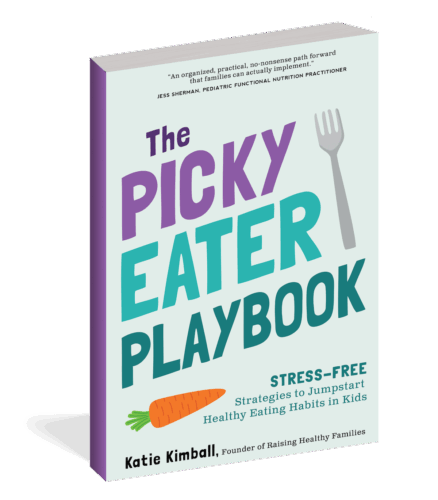
My first traditionally published book releases November 10, 2026! The Picky Eater Playbook: Stress-Free Strategies to Jump Start Healthy Eating Habits in Kids is packed with real-life stories, flexible strategies, and step-by-step routines to turn dinner from a power struggle into something the whole family can enjoy.
If you’ve done the No More Picky Eating Challenge and want to have all my strategies at your fingertips, it’s the perfect resource! Or if you’re just beginning to tackle dinnertime struggles at your house, it will walk you through my whole system for eliminating picky eating.
Pre-order now and get some amazing bonuses!
Learn More about The Picky Eater PlaybookHow do I find out for myself?
Kathlena, The Allergy Chef, doesn’t even remember the question she asked as a kid. But she remembers the answer and how it changed her very clearly:
“When I was a child, I once asked the most important question of my life. In fact, the answer changed me as a person. Until that point, I was always curious, driven, and quite the investigator. However, that was a pivotal moment for me. The question: I have no idea. I can’t remember. I think I was 8 or 9 at the time.
The Answer: “Go look it up yourself. I’m not going to answer all of your questions.”
As a kid, it really upset me because I just wanted to know something, and the person knew the answer. However, their refusal to answer pushed me to be an even more independent thinker and learn to sift through data and learn how to figure things out. Given my age, things were different back then. The internet was just coming online for this sort of thing, and pulling out your encyclopedia was still the norm. However, even today, the lesson still stands. Sure, we can ask someone for help, [and] that’s great. Yet, we also need to have the skill to investigate, dig deeper, discern if answers are truthful, and so on.”
Kathlena, The Allergy Chef, juggles over 200 allergies and is a tireless allergy advocate. She flexes in #LifeSkillsNow Season 5 with a jam-packed workshop teaching real cooking and adaptation, not just how to follow a recipe.
This one matters more in the AI age, not less. AI will hand your kid an answer instantly. The skill is knowing whether the answer is actually right.

What does my body need right now?
Layne Burkette teaches families to pause and listen inward. This is the question she comes back to every single day.
“One question that has truly changed the way I live (and parent!) is: ‘What does my body need right now?’ I used to move quickly through my days, responding to everything around me (kids, work, responsibilities) without pausing to check in with myself. Over time, I realized that when I skipped that pause, I was often reacting from stress instead of responding from a grounded place, which wasn’t aligned with who I was and wanted to be. Asking this simple question created a shift. Sometimes the answer is surprisingly small: take a breath, soften my shoulders, step outside for a moment, say a healing affirmation, or slow my pace. But those small moments of awareness change everything. Now, I use this question regularly with my kids. It helps them begin to notice their own bodies, breath, emotions, and needs, instead of getting overwhelmed by them. It helps them name their experience, builds self-awareness, regulation, and a sense of internal safety. I ask this often related to health, emotion, and food decisions. In a world that’s moving faster than ever, I believe this is one of the most important life skills we can teach our kids: how to pause, listen inward, and respond with awareness.”
Layne Burkette supports families in building simple nervous system skills for everyday life at Life Balance. Explore her Family Nervous System Toolkit. At #LifeSkillsNow this year, she’s teaching the oft-forgotten skill of SLEEP.
An overwhelmed kid who can’t name what they need will explode at you. A kid who can ask themselves “what do I need right now” has the first piece of self-regulation in sight. AI can’t teach that, and it can’t take it away once you have it.
Why is this so hard for me?
Jenn Conklin spent 12 years answering a question most people are too embarrassed to ask out loud.
“[For me, the key question was] asking why I had such a problem with clutter, which led me to explore hoarding disorder, decluttering, and organization. I studied the methods of Cas Aarssen (Clutterbug), Dawn Madsen (Minimal Mom), Tracy McCubbin (dClutterfly), and others.
In about 12 years, I went from a newlywed hoarder to a (still-wed) homeschool mom of two & professional organizer.
If you struggle with clutter, you are NOT lazy or defective. There is likely an underlying emotional reason for your clutter, or you may be trying to organize in a way that doesn’t fit you or your lifestyle.”
Jenn is a Certified Organizational Specialist. Get her free 21-day guided declutter at MomUniversity.Club to answer the question “Can you really make a difference in 5 minutes a day?” (Spoiler: yes!) Your littlest campers will learn how to take out the trash from Jenn and her Jelly Bean at camp this year!
The brave question is always “why is this so hard for me, specifically?” Digging to the root cause inside yourself gets you to the actual answer instead of another generic tip.
PLUS I love that Cas and Tracy were both camp leaders in past seasons of #LifeSkillsNow! Join the club, Jenn. We have lots of incredible experts around here!
Is this the right thing for my kids?
Denise Albright, founder of Class Keeper, asked the question every parent flinches at.
“One question that changed everything for me as a parent was: ‘Am I helping my kids…or actually holding them back?’
I realized that by doing everything for them because it was faster or easier, I wasn’t giving them the opportunity to build confidence, responsibility, and real-life skills. That question led me to completely shift how I run our home, involving my kids in everyday tasks and creating an ‘earn and learn’ approach where they contribute, build skills, and work toward rewards in ways that feel meaningful to them. It’s now the foundation of how I support other families too, helping parents raise capable kids while simplifying their lives and keeping what matters most.”
Denise Albright is the founder of Class Keeper®, helping families keep kids’ memories without the mess. Learn more at GetClassKeeper.com and check out her #LifeSkillsNow Season 5 workshop that will get your kids thinking about how they can earn money by helping around the house!
“I can do it faster” is the trap. The kid who never gets to try never gets capable. This is the question I want every parent to ask themselves at least once a week.
How can I truly care for myself…daily?
Therapist and author Risa Williams brought us two questions. Both are worth borrowing!
“‘What if my own well-being was my main goal in life? How would this change what I choose to do each day?’ This led me to write my book, Get Stuff Done Without the Stress, in which I explored how to make wellbeing your main goal on the way to achieving other things you want to do! And also, it led me to realize that self-care needs to be nonnegotiable from now on.”
“’What if I counted every day things I do as tiny wins and actually celebrated them?’ This led me to create my own ‘tiny wins practice’ where, for the last five years, I write down 3-5 tiny wins from my day in a journal (The Tiny Wins Journal). Doing this has increased my sense of confidence and reduced my feelings of imposter syndrome, as I can clearly see that the small steps I am taking have led me to achieving big things!”
Risa Williams, therapist and author of Get Stuff Done Without the Stress. Try her Tiny Wins workshop and enjoy her #LifeSkillsNow workshop detailing energy and task intensity meters for ultimate (balanced) productivity.
Two of the most underrated parenting moves are taking care of yourself and counting the small stuff. Both start with a question you ask yourself, not someone else. Great twist, Risa!
What am I really called to do?
For Jackie Vernon-Thompson, the question wasn’t asked of a person. It was asked in prayer. The answer redirected her whole career.
“I recall a time in my life when I was deeply eager to understand my true purpose. Although I had achieved success as a Realtor, there remained a sense of unfulfillment that I could not ignore. In that season, I turned to prayer and asked God to reveal the path I was meant to walk. In His perfect timing, He answered. My purpose was made clear—to establish an etiquette school and to teach individuals the art of proper etiquette and decorum. In January 2014, my life shifted in a profound way. I pursued formal training and earned certification as an Etiquette Consultant through two distinguished institutions. From there, I launched my business, and since that moment, I have had the honor of impacting lives globally through the teaching of etiquette. Today, I can say with complete certainty that I feel fulfilled. I am walking in my purpose. Later, I became an Amazon #1 Best Seller of a book entitled Transformative Etiquette, having my story and revelation of purpose in the first chapter. This is what I was called to do.”
Jackie Vernon-Thompson, From the Inside Out School of Etiquette, graced us with TWO workshops at #LifeSkillsNow season 5, one for young gentlemen introducing chivalry and for young ladies about moving gracefully.
Some of the most important questions don’t get answered by a search bar or a chatbot. They get answered in quiet, over time, by paying attention.

The Real AI-Proof Skill
The kids who will thrive in the AI age aren’t the ones who memorize the most. AI knows more than any of us! (Well, actually, it can just read really fast, over and over and over…) The kids who will thrive are the ones who are thoughtful enough to think of a real question and brave enough to ask it.
Eight different camp leaders. Eight different questions. Not one of them is something you can Google your way through!
Technology still needs humans, and humans need to be curious.
If you want your kid to spend a week of summer learning from these humans (and about 60 others teaching real-world skills), #LifeSkillsNow Season Five opens June 8, our gift to your family! It’s our answer to the questions:
- What’s the most productive use of technology we can provide?
- How can we help make life skills fun and motivating for kids to help parents out a little?
- What will it take for society to support parents in raising healthy, independent, confident future adults?
We’re always here to answer your questions!

Leave a Comment