“Some parents get to just drop their kids off and know they’ll have a pretty good day at school,” said my guest Ginny Kochis when I mused, “Maybe most kids are actually neurodivergent; is there any typical anymore?”
We may all think and process information differently, but it’s true that some diagnoses make parenting feel a lot more difficult on a day-to-day basis.
If your child is on the spectrum, gifted, 2E, ND, or any other diagnoses or “differently wired” labels – or if you know anyone who is! – You’ll receive a heavy dose of empathy and understanding from this interview, along with some very practical strategies to create an environment in which your children can thrive.
Ginny and I talked about:
- How ND kids struggle with executive function, big emotions, and emotional regulation, but can often be gifted with exceptional creativity, intellect, and problem-solving abilities.
- The combo package that is “2E”
- Why “routines” include both structure and flexibility, but not too much
- Silver linings and signs you need to get kids to clean the bathroom
- Why a growth mindset must be in your toolbox for your kids
- The beauty of suffering, how to infuse challenges with meaning, and why our kids need to hear (often) that they were made for greatness
- Where to find role models with differently wired brains for your kids!
- A super fun preview into Ginny’s fiction book, which my daughter is getting for Christmas…
I learned a ton in this conversation and am already planning some small changes in my own life, and I know you’ll feel encouraged as well!
Find all the episodes of the Healthy Parenting Handbook here, or wherever you get your podcasts:





Don’t forget to leave us a review on Apple Podcasts too! Thank you!
Can’t see the video? Watch Neurodivergent Parenting here on YouTube!
No time for the video? Here are the notes!
Embracing Neurodiverse Parenting
- 0:56: Today, I’m talking to Ginny Kochis about a subset of kids that tend to make parenting feel even tougher. We’re talking about neurodivergent parenting and 2E kids.
- 2:11: What does Ginny mean when she says “differently wired?” Essentially, she means neurodivergent, any kind of brain wiring that’s different from typical, such as ADHD, social emotional learning difficulties, or developmental delays.
- 3:47: Let’s start with the challenges Ginny faces in her neurodiverse family. Executive functioning skills can be lacking, and regulating emotions is a struggle.
- 5:15: Ginny shares how she learned she was neurodivergent. She always felt like she was different, but it wasn’t until her kids were diagnosed that she realized that she may have a similar diagnosis as well.
- 7:33: Many mental health diagnoses have genetic components. It is not uncommon these days for a parent to seek a diagnosis after getting a diagnosis for their child and then looking back into their family history and seeing others who probably also had a similar diagnosis.
- 8:11: Having an official diagnosis for your child is a tool. Once you have that tool, you can figure out how to help your child thrive in a world that isn’t set up for neurodivergent kids.
What Is a “2E” Kid?
- 9:12: Another term Ginny uses is 2E, twice exceptional. That means an individual who is intellectually gifted and has a social, emotional, or developmental disability. This is very common in gifted people. The wiring that makes them gifted in one area leaves deficits in another.
- 10:42: 2E kids exhibit asynchronous development. They are advanced in one area, like advanced math or writing, but they have meltdowns at the drop of a hat or can’t tie their shoes. You may say things like “They’re so smart, why can’t they do XYZ?”
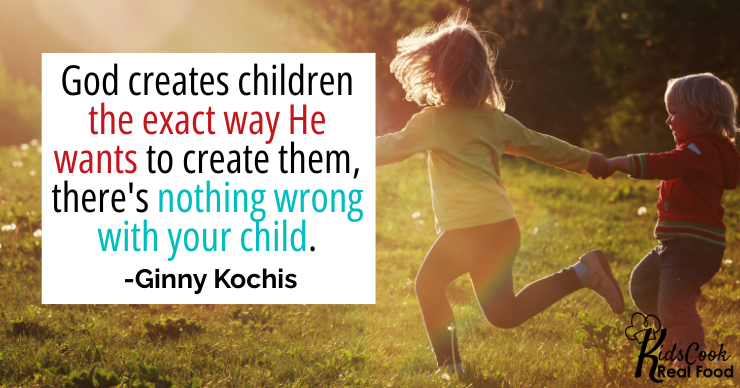
- 12:21: Ginny shares some words of encouragement for parents of neurodivergent kids. You are not alone, even if you feel very lonely. God created your children exactly the way he wanted to create them, and he gave them to the exact right person to parent them.
Routines and Rhythms for Neurodivergent Families
- 13:44: Routines and structure are especially important for neurodivergent families. You don’t have to have a strict schedule every day, but at least a rhythm for your day. This gives some direction and structure with the ability for flexibility.
- 15:42: Ginny shares their daily rhythm from when they were homeschooling. They would take frequent movement breaks between subjects to calm restless, fidgety kids and refocus.
- 18:30: Of course, I’m a huge proponent of teaching kids life skills here at Kids Cook Real Food™. Your quirky kids can think of creative, out-of-the-box solutions and systems when you’re teaching them to cook or do household chores. Some of the pitfalls to look out for are executive functioning deficits and poor working memory. Kids need specific tasks laid out with lots of checklists and visual reminders. For example, putting up a picture of the loaded dishwasher or how the toys look fully put away, or posting the steps to clean the bathroom on the back of the door.
Kids don’t need plastic knives. They need real skills.
Teach safe technique, focus, and confidence in the all-time fav lesson from our kids cooking class! (ages 2-12)
- 20:43: Ginny shares how she brings her kids into the kitchen.
- 22:43: Kids on the spectrum are more likely to be picky eaters. Ginny uses Ellyn Satter’s division of responsibility. The parent is responsible for providing food, and the child decides how much and what they will eat. Many autistic kids react strongly to the sensory stimulus of eating; all the smells, tastes, and textures can be overwhelming, and what they put in their mouth is something they have control over in a chaotic world that feels very out of their control. Get my best tips for picky eaters here!
Developing a Growth Mindset
- 26:03: One thing Ginny talks about is a growth mindset. Having a growth mindset is viewing challenges and struggles as stepping stones. Teaching kids to have a growth mindset involves helping them reframe things. Instead of saying “That is too hard” or “I can’t do that,” a growth mindset says “I’m struggling, but I’m still learning” or “I can’t do that yet.”
Suffering isn’t meaningless, there’s a reason for it. We go through it and it refines us and makes us stronger. -Ginny Kochis
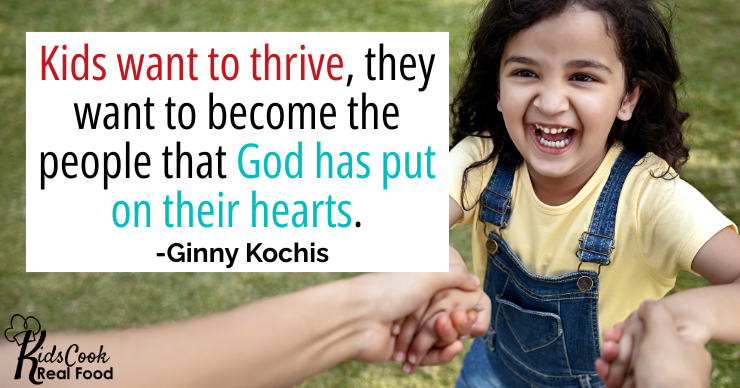
- 27:49: The world tells our children they’re made for comfort and mediocrity, but we believe our kids are made for greatness. Give your kids examples of blessings coming through suffering. It’s really helpful to use real-life examples of people who overcame hardship or setbacks. Let your kids see you learning and working through failure or difficulty. Ginny has a list of saints who had some type of neurodivergence.
- 32:00: Kids who are neurodivergent are more likely to lose their faith as they grow into adulthood. Having real-life examples of strong Christians who think like them can be so valuable.
“I just want my kids to eat what I make!”
This free 5-day challenge was made for you.

Spend just 30 minutes a day learning practical strategies that reduce mealtime battles and help kids build confidence with food.
- 35:08: Ginny has a young adult, coming-of-age novel called Blink and We’ll Miss It. She shares a bit about the plot.
- 38:56: Ginny leaves us with a message of hope. Take parenting one step at a time. Growth takes time, and it isn’t linear. You’ll have ups and downs and make mistakes. Trust that God will catch you when you stumble, and do the next right thing.
It feels like you have to run a marathon in a minute, and you don’t. The growth that will happen in your family takes time. -Ginny Kochis
Resources We Mention for Neurodivergent Parenting
- Register for #LifeSkillsNow to grab a spot in our free life skills workshop camp!
- Ginny uses Ellyn Satter’s division of responsibility
- Get my best tips for picky eaters here
- Ginny has a list of saints who had some type of neurodivergence
- Get Ginny’s books
- Find Ginny online: Quirky Catholic Kids, GinnyKochis.com
- Follow her on Instagram
 Catholic mom and author Ginny Kochis provides practical support and prayerful encouragement to Catholic families raising neurodivergent kids. After nearly two decades of parenting her own neurodivergent children, Ginny believes God gives curious, creative, intense children the exact mother they need to thrive.
If your child is on the spectrum and you want to get them into the kitchen, start with How do I teach a child with autism to cook?

Leave a Comment