If you’ve ever felt that homeschooling can slip into a checklist of math pages and grammar drills, you’ll love this conversation. Pam Barnhill, a veteran homeschooling mom of over 15 years, reminds us what education can truly be: a chance to connect deeply with our kids and nurture a lifelong love of learning.
Pam’s story began when she noticed how traditional schools were shifting toward “teaching to the test.” Instead of chasing grades, she wanted to chase curiosity. What she discovered along the way is something every homeschooling parent (and even traditional-school parent) can learn from: morning time.
Morning time isn’t about a rigid schedule or a Pinterest-perfect setup. It’s about gathering your kids together to learn, reflect, and relate to one another before the day scatters everyone in different directions. In this episode, Pam shares how this simple, relationship-centered practice transformed her homeschool, and how you can start your own version, no matter your kids’ ages.
We also talk about the “Four Rs” that make morning time magical, why it’s okay (and wise!) to outsource certain subjects, and how cooking together can become part of your educational rhythm.
Here’s what you’ll discover in this episode:
- Why Pam decided to homeschool after seeing the limits of traditional education
- What “morning time” really looks like and how it fosters connection
- How to adapt morning time for older kids without losing their interest
- The Four Rs that make morning time meaningful: reading aloud, recitation, ritual, and relationship
- Why building relationships matters more than covering every subject
- How outsourcing a few areas can actually strengthen your homeschool
- Simple ways to start small and build a morning time routine that lasts
- Creative ideas – like using cooking as part of morning time – to bring learning to life
If you’ve ever wondered how to make your homeschool day feel less like a race and more like a rhythm, this episode will give you fresh inspiration and plenty of practical ideas. Pam’s approach is gentle, realistic, and full of grace. Exactly what homeschooling parents need to hear!
Find all the episodes of the Healthy Parenting Handbook here, or wherever you get your podcasts:





Don’t forget to leave us a review on Apple Podcasts too! Thank you!
Can’t see the video? Watch here on YouTube!
No time for the video? Here are the notes!
Time Stamps for Homeschool Routines That Build Connection and Relationships
3:07 – Pam explains how her background as an English teacher showed her what was missing in public education during the “teach to the test” era. She wanted her kids to experience literature, art, and creative thinking, not just standardized testing—so homeschooling became the answer. Check out my interview with Monica Swanson if you’re considering whether homeschooling is the best choice for you.
6:02 – She describes how her love of planning naturally led to helping other families organize their homeschool days and create systems that make learning joyful instead of overwhelming.
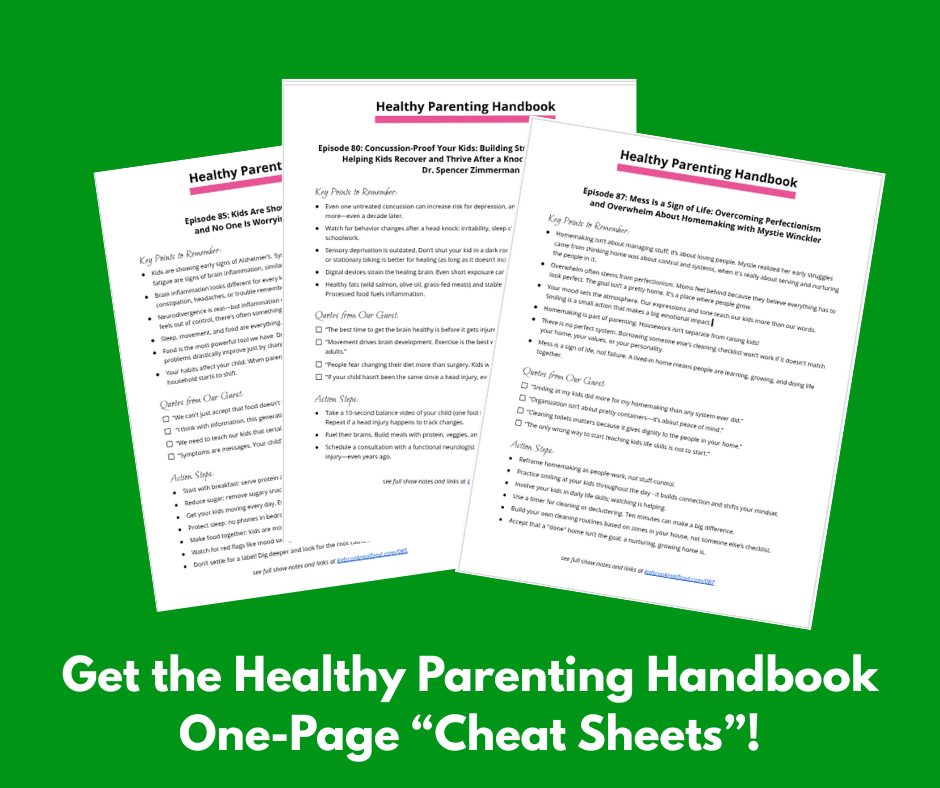
Turn expert advice into a handbook you can actually use.
I’ve interviewed hundreds of incredible experts on the Healthy Parenting Handbook podcast! Out of time to listen? You can skim on your phone!
These one-page summaries give you the highlights of every episode fast, so you can find what you need when you need it (and nothing to download).
The Morning Basket: Coming Together as a Family
7:28 – Pam introduces the concept of the morning basket: a way to gather all the “beautiful” subjects—music, poetry, art, and more—so they actually get done. Morning time brings kids of different ages together, simplifies the day, and strengthens relationships. Here’s is Pam’s post on what a morning basket is.
8:44 – When she put all the creative, connection-building subjects into the basket, they finally became a priority instead of an afterthought. As her kids grew, the basket expanded to include shared academics like science, history, and even Latin.
9:54 – Pam talks about the flexibility of morning baskets. You can use an actual basket, a tote, or even a shelf. What matters is having everything gathered in one place. This keeps transitions short, so you don’t lose kids’ attention between subjects.
11:06 – Younger kids stay engaged by keeping their hands busy with Play-Doh, Perler beads, or painting while listening. Older kids might shift to watching videos, lounging on couches, or using digital tools as part of the routine.
Morning Time for Families Who Don’t Homeschool
12:21 – For non-homeschool families, Pam explains that “morning time” can still work—either before school, after school, or even in the car. Parents can use a short playlist for family connection through songs, memory verses, or audiobooks during carpool time.
13:57 – She encourages parents to use commute time wisely, listening together instead of letting everyone scroll separately. Even three minutes of shared audio can make a difference.
14:47 – Pam shares how her morning basket evolved as her kids became teens. Instead of picture books, they discussed logic, economics, and apologetics: subjects that challenged their critical thinking. (Love this! Let’s nurture young skeptics!)
16:06 – Morning time should count toward high school credit when possible. Pam recommends logging art, music, or language arts hours to make it part of an official transcript rather than “extra work.”
17:55 – She laughs about using Mad Libs to keep older kids engaged; sometimes fun is the key to buy-in. The learning (and grammar!) came along for the ride.
18:49 – Pam shares her philosophy that relationships come before academics. She reminds parents that you can outsource subjects like math or science to protect your connection with your child.
Kids don’t need plastic knives. They need real skills.
Teach safe technique, focus, and confidence in the all-time fav lesson from our kids cooking class! (ages 2-12)
Incorporating Cooking into Morning Homeschool Time
20:45 – We talk about incorporating real-life skills like cooking into learning. Pam explains that in her family, breakfast was part of morning time, and cooking naturally flowed into science experiments or chemistry lessons in the kitchen. It’s easy to use Kids Cook Real Food™ in your homeschool curriculum! (And if you have teens, Teens Cook Real Food comes out in January! Get on the waitlist now.)
22:31 – We discuss how cooking or prepping food could easily fit into morning time, giving kids a practical task while reading aloud or listening to an audiobook.
The Four Rs of Morning Time
22:47 – Pam introduces her “Four Rs” of Morning Time: Reading Aloud, Recitation, Ritual, and Relationship.
- Reading aloud fills their minds with ideas.
- Recitation writes truth and beauty on their hearts.
- Ritual builds comfort and connection through consistent patterns.
- Relationship grows naturally through shared experiences and stories.
By sharing stories together, by memorizing a lot of the same words, we were really building those relationships with the world through the things we were learning, but also with each other as well. -Pam Barnhill
How to Start Morning Time in Your Homeschool Routine
24:27 – She encourages parents to start small—one poem, one song, one prayer, one short read-aloud—and build gradually. “Start small and build slow,” she says.
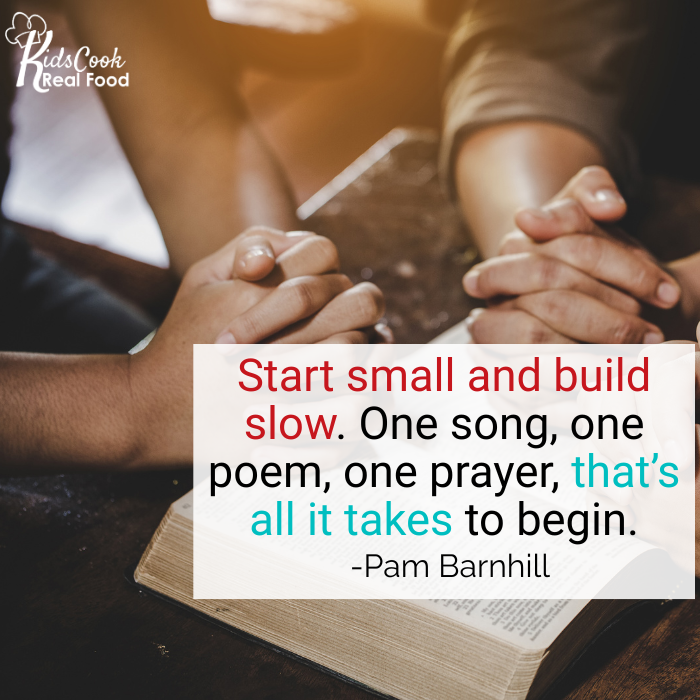
25:20 – Pam warns against overwhelming kids with too much new structure at once. Adding one small element every few days allows morning time to grow naturally into a beloved family rhythm.
26:19 – Finally, Pam shares her free Advent Morning Time Plans, a three-week resource with music, poetry, art, and nature study to guide families through the Christmas season. Parents can find it at raisinghealthyfamilies.com/advent.
“I just want my kids to eat what I make!”
This free 5-day challenge was made for you.
Spend just 30 minutes a day learning practical strategies that reduce mealtime battles and help kids build confidence with food.
Resources We Mention for Homeschool Routines
-
- Get Pam’s free Advent Morning Time Plans here
- Check out her books: Gather: Exploring the Wonder, Wisdom, and Worship of Learning at Home; Better Together: Strengthen Your Family, Simplify Your Homeschool, and Savor the Subjects that Matter Most (Amazon/Bookshop.org); Plan Your Year: Homeschool Planning for Purpose and Peace (Amazon/Bookshop.org); The Confident Homeschooler: How to Thrive in the Day-to-Day
- You can find Pam’s workshops in Seasons Two, Three, and Four of #LifeSkillsNow, including one she teaches along with her daughter in Season Three!
- Is homeschooling right for me?
- What is a morning basket
- Nurturing Young Skeptics: Essential Guide to Teaching Critical Thinking to Kids and Teens with Kathy Gibbens
- Kids Cook Real Food™ is the best homeschool cooking class online!
- Get on the wailist for Teens Cook Real Food
- Visit Pam on her website Homeschool Better Together, and follow her on social media: Instagram, Facebook, YouTube
 Pam Barnhill believes that you don’t have to sacrifice relationships to homeschool strong.
An award-winning educator, former journalist, and now homeschooling mom, she has a knack for breaking down big tasks into small, manageable steps and getting to the heart of the stories her listeners want to hear.
She is the host of the popular podcast Homeschool Better Together and the author of three homeschooling books, including: Better Together: Strengthen Your Family, Simplify Your Homeschool, and Savor the Subjects that Matter Most and Plan Your Year: Homeschool Planning for Purpose and Peace.
Pam lives in the Deep South with her husband of thirty-one years, three (mostly) awesome kids, and the dog dynamic duo.
Leave a Comment