
In America, we tend to raise kids with a constant sense of striving. We measure success early, track milestones closely, and quietly worry about whether our children are doing enough, fast enough, and well enough.
The Danish approach offers a striking contrast. Instead of pushing children to prove themselves, Danish parenting emphasizes something far more grounded: helping kids rest well within themselves.
In this episode of the Healthy Parenting Handbook, I talk with Jessica Joelle Alexander about what that actually looks like in real life. We explore:
- why Danish children are often described as calm and serene
- how play is treated as essential rather than optional
- and why connection and trust matter more than control, especially in the digital age.
This conversation is settling, perspective-shifting, and deeply reassuring for parents who feel the pressure to constantly measure and manage their kids’ development! I couldn’t stop talking with Jessica, so stay tuned for Part 2 of this interview.
Find all the episodes of the Healthy Parenting Handbook here, or wherever you get your podcasts:





Don’t forget to leave us a review on Apple Podcasts too! Thank you!
Can’t see the video? Watch here on YouTube!
No time for the video? Here are the notes!
Time Stamps for the Danish Way of Parenting
1:25 – I introduce Jessica Joelle Alexander and share why her work on Danish parenting feels so refreshing, especially in a culture that often prioritizes striving over well-being. Learning how Danish parents view children differently can immediately shift how we think about parenting in America!
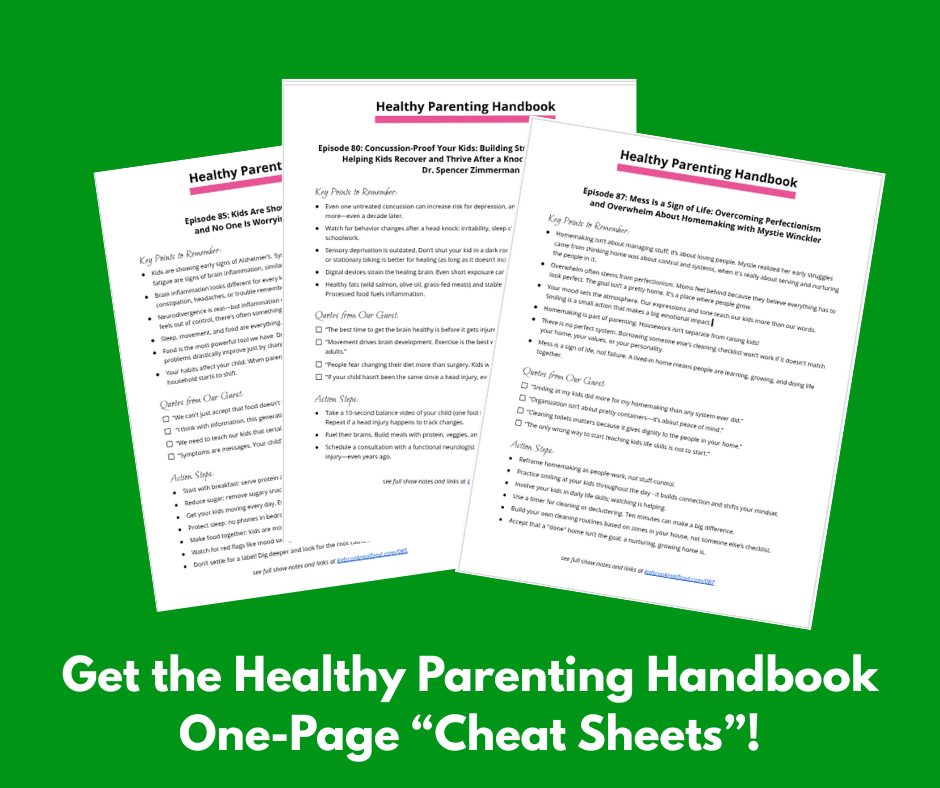
Turn expert advice into a handbook you can actually use.
I’ve interviewed hundreds of incredible experts on the Healthy Parenting Handbook podcast! Out of time to listen? You can skim on your phone!
These one-page summaries give you the highlights of every episode fast, so you can find what you need when you need it (and nothing to download).
The Moment Everything Clicked
4:02 – Jessica describes noticing how calm, well-regulated, and serene Danish children seemed and how that observation sparked her deeper research. She explains that in Denmark, play has been considered a formal educational theory since 1871 and is viewed as the primary way children learn.
6:46 – Jessica shares how living in multiple countries helped her clearly see how culture shapes parenting beliefs and expectations.
It was a choice for us to stop over-educating and stop making everything about academics. – Jessica Joelle Alexander
7:59 – Jessica explains that Danish children are allowed to truly have a childhood and that this emphasis on play may explain why Denmark consistently ranks among the happiest countries in the world.

Rethinking Education and Benchmarks
8:33 – Danish schools respect developmental differences and avoid pressuring children to meet early academic benchmarks. Jessica explains how forcing early academics can create anxiety and contributes to what researchers call “hurried child syndrome.”
There’s so much respect given to this idea that it’s not one-size-fits-all. – Jessica Joelle Alexander
10:08 – Jessica explains that Danish education values creativity, movement, and whole-body learning instead of narrowly defining what intelligence looks like.
10:53 – Meanwhile, I connect American academic pressure to rising rates of anxiety and depression among children and teens.
Raising Digital Citizens, Not Fearful Users
12:11 – Here we chat about how the Danes raise kids when it pertains to screens and the digital world. Jessica explains that Danish parents focus on teaching kids how to be good digital citizens rather than controlling technology through fear.

14:07 – Jessica explains that Denmark ranks high in digital well-being because children’s emotional health remains central, even online.
Kids don’t need plastic knives. They need real skills.
Teach safe technique, focus, and confidence in the all-time fav lesson from our kids cooking class! (ages 2-12)
15:19 – How do Danish parents set boundaries without becoming authoritarian? Jessica explains that Denmark does not recommend screens for young children but avoids strict bans, trusting parents to make thoughtful choices.
17:03 – Jessica explains that screen experiences are encouraged to be social, creative, and shared rather than solitary and passive. I totally agree and it’s what we strive for, especially with my youngest child.
Teaching Kindness and Critical Thinking
19:39 – Jessica explains that Danish education includes teaching children how to be kind, thoughtful people, not just strong academic performers. She shares examples of basic digital etiquette that many parents assume kids know but often need to be explicitly taught.
24:16 – Jessica explains that ages six to twelve are a crucial window when kids are still receptive to guidance and relationship-based teaching.
25:20 – I connect Danish parenting to raising critical thinkers who can adapt to a future we cannot predict.

Why Trust Matters Most
25:45 – Jessica challenges parents to consider whether their child would feel safe coming to them if something went wrong online.
26:10 – What is hygge? You’ve probably heard that Danish word, but what exactly is it? We start to dive into it here.
27:14 – This conversation continues in part two, where we dive deeper into hygge, Danish schooling, food, community, and why I struggle with the word happiness! Stay tuned. 🙂
“I just want my kids to eat what I make!”
This free 5-day challenge was made for you.
Spend just 30 minutes a day learning practical strategies that reduce mealtime battles and help kids build confidence with food.
Resources We Mention for Danish Parenting
- Jessica’s books: The Danish Way of Parenting (Amazon/Bookshop.org) and The Danish Way Every Day (Amazon/Bookshop.org)
- 3 Ways Parents Can Help Prevent Depression in Their Kids
- Nurturing Young Skeptics: Essential Guide to Teaching Critical Thinking to Kids and Teens with Kathy Gibbens
- My TEDx talk on building critical thinking skills in kids
- Check out the Raising Digital Citizens conversation cards here
- Find Jessica at her website Jessica Joelle Alexander or follow her on social: Facebook, Instagram, X, YouTube
 Jessica Joelle Alexander is a Bestselling Author, Danish Parenting Expert, Columnist, Speaker and Cultural Researcher. Her work has been featured in the NY Times, Time, BBC World News, Vanity Fair, NPR, Huffington Post, The Wall Street Journal and many more. Her books have been published in over 32 countries. She has a regular column in the Copenhagen Post and she currently researches and writes for UC Berkley’s Toward Belonging Center.
Jessica’s book The Danish Way of Parenting is one of the most sold parenting books of all time. She has been a spokesperson for LEGO on the power of play and gives talks on parenting, leadership and wellbeing around the world. She is extremely passionate about the human condition, building character values and creating a more compassionate society.

Leave a Comment